American White Pelican (Plate 311)
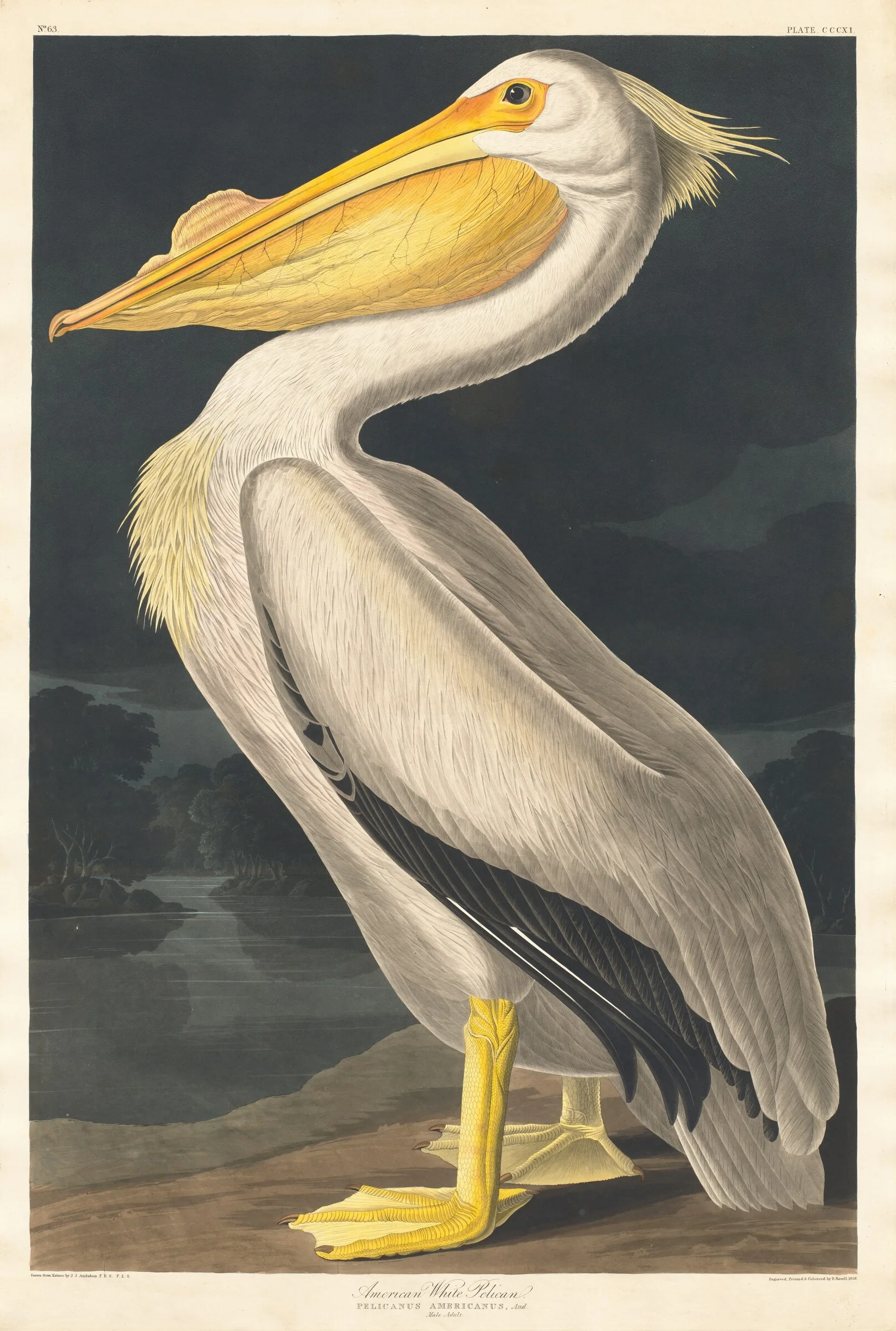
Audubon's “American White Pelican”, The Birds of America, plate CCCXI
Click or press Enter to enlarge
Open the full-resolution image (7350 px, National Gallery of Art)
| Plate | 311 (CCCXI) |
|---|---|
| Audubon's name | American White Pelican |
| Modern name | American White Pelican |
| Scientific name | Pelecanus erythrorhynchos |
| Status | Least Concern |
| Engraved by | Robert Havell, after Audubon's watercolor |
| Date | 1836 |
| Medium | Hand-colored engraving and aquatint on Whatman wove paper |
| Size | image: 89.54 × 60.01 cm (35 1/4 × 23 5/8 in.) plate: 97 x 64.8 cm (38 3/16 x 25 1/2 in.) sheet: 100.4 x 67.6 cm (39 1/2 x 26 5/8 in.) |
| Collections | Seabirds |
| This impression | National Gallery of Art, Washington, 1945.8.311; Gift of Mrs. Walter B. James |
About this plate
Plate 311 shows a single adult male American White Pelican at life size, filling the double-elephant sheet. It is all white except for black flight feathers, with an orange-yellow bill and pouch. On the upper mandible is the thin, bony plate that grows in the breeding season and is shed afterwards. Richardson had pointed to this as a feature not described in European pelicans.
Audubon announced that the American bird was not the European White Pelican, Pelecanus onocrotalus, and named it Pelecanus americanus after his "beloved country". He was right that it is a distinct species. Gmelin's earlier name, Pelecanus erythrorhynchos, takes priority, so that is the scientific name in use today.
American White Pelicans breed in colonies on islands in lakes of the northern plains, the Great Basin and the Canadian prairies. They winter along the Gulf coast, in Florida, California and Mexico. Unlike Brown Pelicans they do not plunge-dive. Groups swim in a line or a horseshoe and herd fish into shallow water, then scoop them up together, as Audubon described on the Ohio. Numbers have grown since the mid-twentieth century. The IUCN lists the species as Least Concern.
Audubon first saw them more than thirty years before he wrote, on the sand bars of the Ohio and at the falls near Louisville and Shippingport. Later, at Henderson, they were so common on a bar off Canoe Creek Island that he often killed several at a shot. In April 1837 he found them in large numbers at the mouths of the Mississippi.
In Audubon's words
Clumsily do they rise on their columnar legs, and heavily waddle to the water. But now, how changed do they seem! Lightly do they float, as they marshal themselves, and extend their line, and now their broad paddle-like feet propel them onwards. In yonder nook, the small fry are dancing in the quiet water, perhaps in their own manner bidding farewell to the orb of day, perhaps seeking something for their supper. Thousands there are, all gay, and the very manner of their mirth, causing the waters to sparkle, invites their foes to advance toward the shoal. And now the Pelicans, aware of the faculties of their scaly prey, at once spread out their broad wings, press closely forward with powerful strokes of their feet, drive the little fishes toward the shallow shore, and then, with their enormous pouches spread like so many bag-nets, scoop them out and devour them in thousands.
John James Audubon, Ornithological Biography, vol. 4 (1838), “American White Pelican”. Read the full chapter.



