Long-tailed Duck (Plate 312)
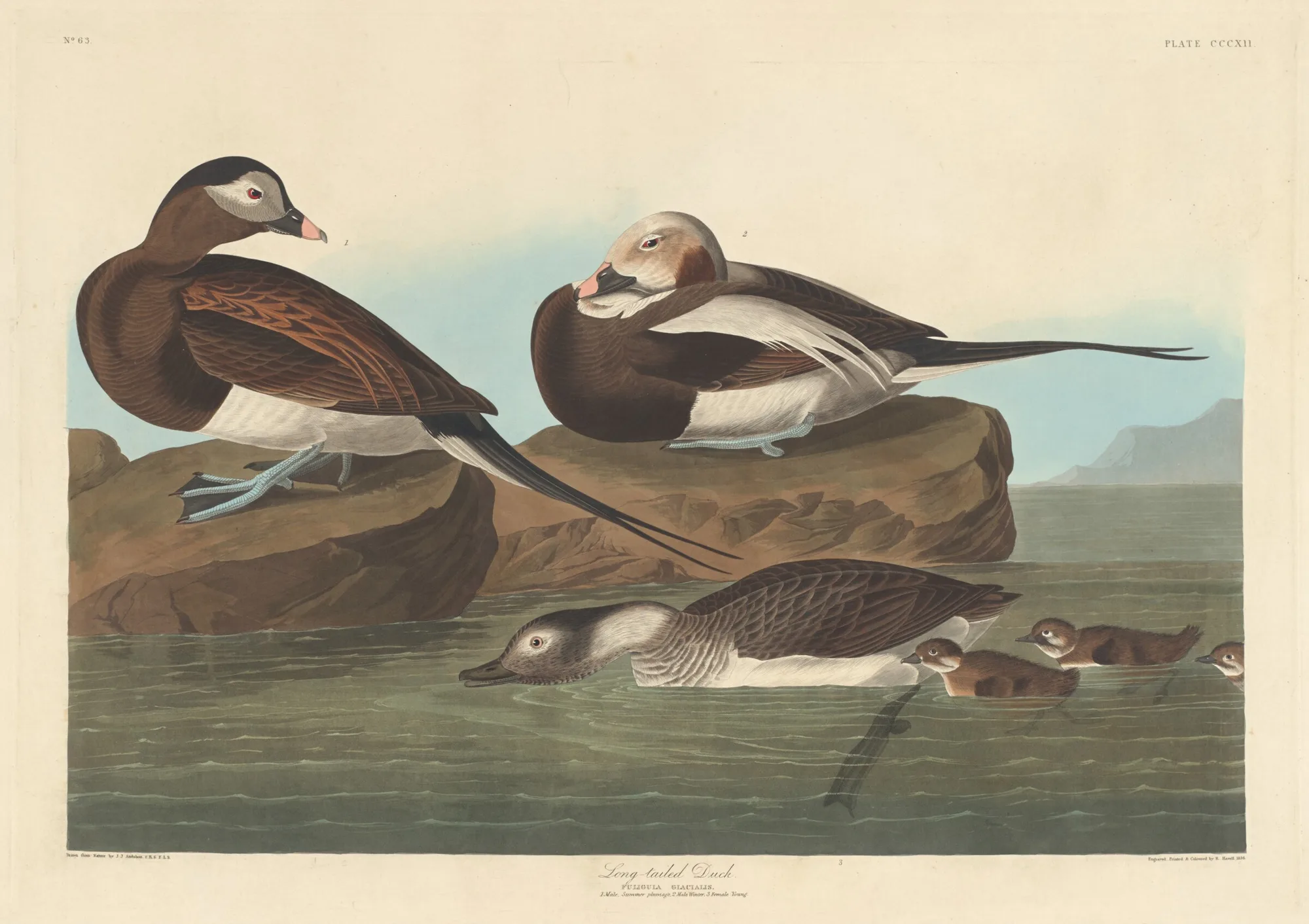
Audubon's “Long-tailed Duck”, The Birds of America, plate CCCXII
Click or press Enter to enlarge
Open the full-resolution image (4367 px, National Gallery of Art)
| Plate | 312 (CCCXII) |
|---|---|
| Audubon's name | Long-tailed Duck |
| Modern name | Long-tailed Duck |
| Scientific name | Clangula hyemalis |
| Status | Vulnerable |
| Engraved by | Robert Havell, after Audubon's watercolor |
| Date | 1836 |
| Medium | Hand-colored engraving and aquatint on Whatman wove paper |
| Collections | Ducks, Geese and Swans |
| This impression | National Gallery of Art, Washington, 1945.8.312; Gift of Mrs. Walter B. James |
About this plate
Plate 312 shows the Long-tailed Duck in its changing plumages. The OB figures line lists a male and female in summer and a male in winter, and the chapter adds unfledged young. The winter male is mostly white with a dark cheek patch and breast band. The summer male is largely dark brown with a pale face patch. Both have the long, slender central tail feathers that give the bird its name, and a pink band on the bill.
Audubon's Fuligula glacialis is now Clangula hyemalis. For most of the twentieth century American birders called it the Oldsquaw, from its constant chattering calls. The AOU changed the official name to Long-tailed Duck in 2000, matching British usage.
Long-tailed Ducks breed on tundra pools and Arctic lakes around the pole and winter at sea, on the Great Lakes, along both coasts of North America and in the Baltic. They are among the deepest-diving ducks, reaching depths of more than sixty metres. Large numbers drown in fishing nets, and the big Baltic wintering population fell steeply in the 1990s and 2000s. The IUCN lists the species as Vulnerable.
On 28 July 1833, beside a large freshwater lake near Bras d'Or in Labrador, Audubon found eleven broods with their mothers and seven nests under alders. With his young companions away and no dog, he waded in to his middle in cold water to chase the ducklings himself, and he caught several.
In Audubon's words
My young companions had, unfortunately for me, walked that morning to Blanc Sablon, about thirty miles distant, down the Straits of Belle Isle; and having no dog to assist me in procuring some of the young ducks, I was obliged to enact the part of one myself, although the thermometer that day was 45° 50', and the atmosphere felt chilly. I gave chase to the younglings, which made for different parts of the shore, as I followed them up to my middle in the water, while they dived before me like so many Water-witches, the mothers keeping aloof, and sounding their notes of alarm and admonition. I was fortunate enough to procure several of the young birds, and afterwards shot one of the old, which having young much smaller than the rest, was more anxious for their safety, and kept with them within shot.
John James Audubon, Ornithological Biography, vol. 4 (1838), “Long-tailed Duck”. Read the full chapter.