Blue-winged Teal (Plate 313)
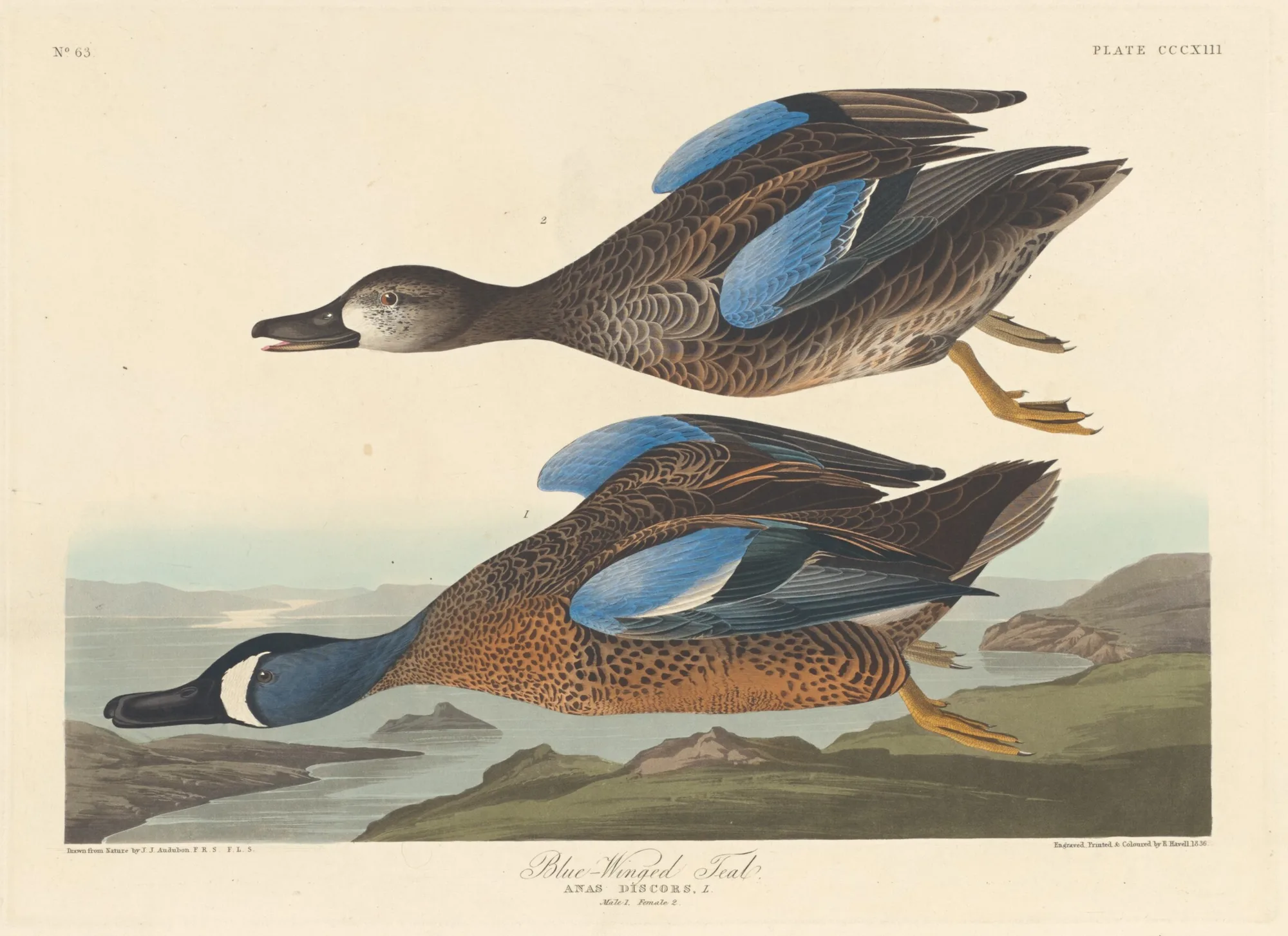
Audubon's “Blue-winged Teal”, The Birds of America, plate CCCXIII
Click or press Enter to enlarge
Open the full-resolution image (2947 px, National Gallery of Art)
| Plate | 313 (CCCXIII) |
|---|---|
| Audubon's name | Blue-winged Teal |
| Modern name | Blue-winged Teal |
| Scientific name | Spatula discors |
| Status | Least Concern |
| Engraved by | Robert Havell, after Audubon's watercolor |
| Date | 1836 |
| Medium | Hand-colored engraving and aquatint on Whatman wove paper |
| Collections | Ducks, Geese and Swans |
| This impression | National Gallery of Art, Washington, 1945.8.313; Gift of Mrs. Walter B. James |
About this plate
Plate 313 shows a male and female Blue-winged Teal. The male in spring has a slate-blue head with a white crescent in front of the eye and a speckled brown body. Both sexes show a powder-blue patch on the forewing, the mark that gives the bird its name. Audubon noted that the teal is among the first ducks to arrive in Louisiana each autumn, often in early September.
Audubon's Anas discors is now placed in the genus Spatula, with the shovelers and the Cinnamon Teal, following DNA studies adopted by the AOS in 2017. Audubon explained that the Creoles of New Orleans called the bright spring drake Sarcelle Printanière and the dull autumn birds Sarcelle Automnière. Because of this, many people believed there were two kinds of Blue-winged Teal.
Blue-winged Teal breed in prairie potholes, marshes and ponds across much of Canada and the northern and central United States. They are among the earliest ducks to migrate south in autumn and among the latest to return in spring. Many winter in Mexico, Central America, the Caribbean and northern South America. It is one of the most abundant ducks in North America, and the IUCN lists it as Least Concern.
Audubon used the bird to explain his idea of a double sense of migration. He was puzzled that it bred both on the Saskatchewan River and in Texas, apparently skipping the regions in between. He called the marshes at the mouths of the Mississippi the bird's great rendezvous in winter.
In Audubon's words
The mouths of the Mississippi, surrounded by extensive flat marshes, which are muddy, and in some degree periodically inundated by the overflowings of that great stream, or by the tides of the Mexican Gulf, and having in the winter months a mildness of temperature favourable to almost all our species of Waders and Swimmers, may be looked upon as the great rendezvous of the Blue-winged Teals, which are seen arriving there coastways, in autumn and the greater part of winter, to meet the multitudes that have travelled across the interior from the north and west. At New Orleans, and during spring, when this bird is in full plumage, it is called by the Creoles of Louisiana "Sarcelle Printanniere;" and in autumn, when scarcely an individual can be seen retaining the beauty of its spring plumage, it is known as the "Sarcelle Automniere;" in consequence of which double appellation, many persons imagine that there are two Blue-winged Teals.
John James Audubon, Ornithological Biography, vol. 4 (1838), “Blue-winged Teal”. Read the full chapter.