Laughing Gull (Plate 314)
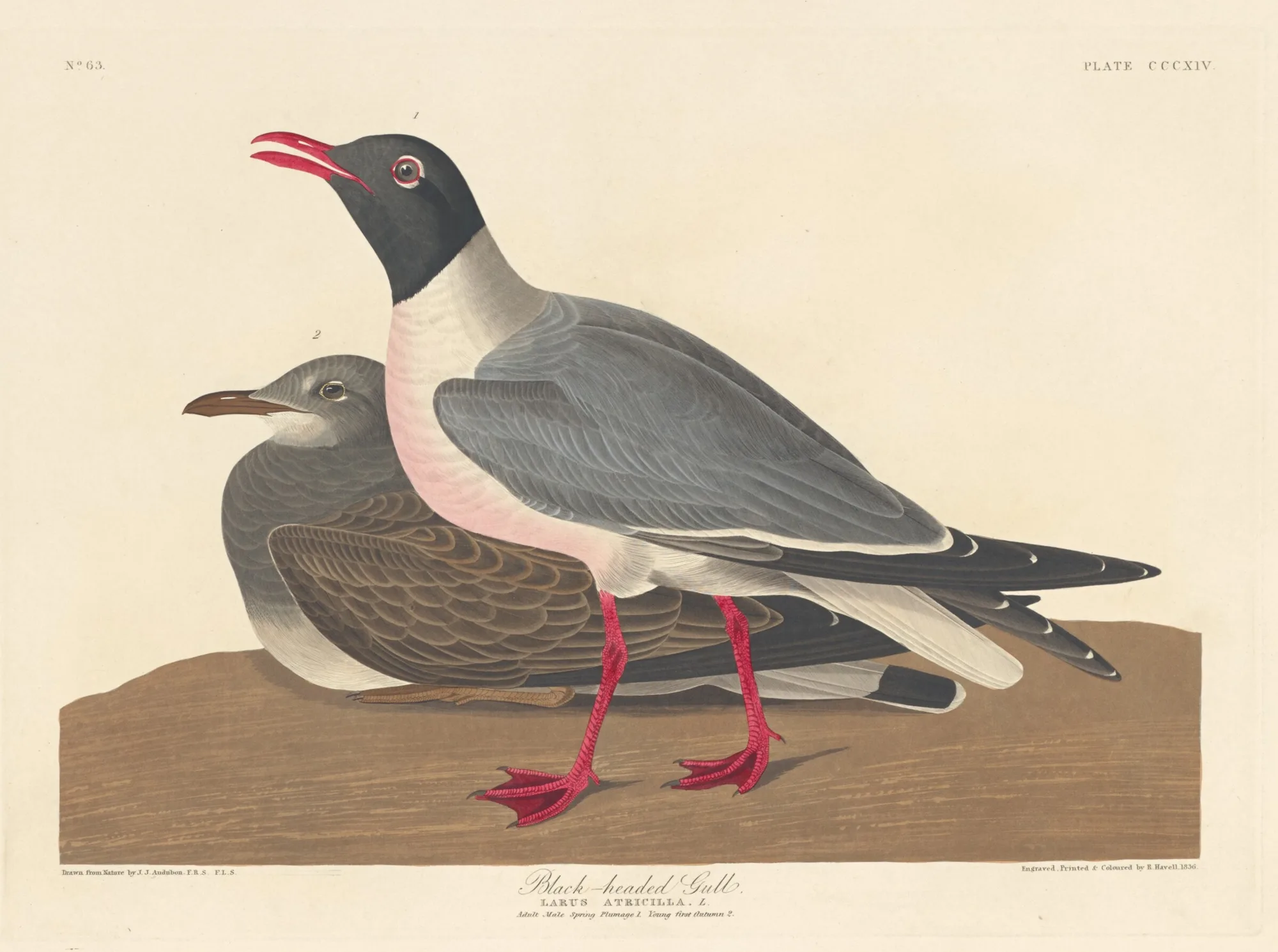
Audubon's “Black-headed Gull”, The Birds of America, plate CCCXIV
Click or press Enter to enlarge
Open the full-resolution image (2943 px, National Gallery of Art)
| Plate | 314 (CCCXIV) |
|---|---|
| Audubon's name | Black-headed Gull |
| Modern name | Laughing Gull |
| Scientific name | Leucophaeus atricilla |
| Status | Least Concern |
| Engraved by | Robert Havell, after Audubon's watercolor |
| Date | 1836 |
| Medium | Hand-colored engraving and aquatint on Whatman wove paper |
| Collections | Seabirds |
| This impression | National Gallery of Art, Washington, 1945.8.314; Gift of Mrs. Walter B. James |
About this plate
Plate 314 shows a Laughing Gull in spring plumage, with a black hood, white eye crescents, dark grey back and a dark red bill, together with a brownish young bird. The Havell plate calls it the Black-headed Gull, and the Ornithological Biography chapter is headed Black-headed, or Laughing Gull.
Audubon's Larus atricilla is now Leucophaeus atricilla, a genus that also holds Franklin's Gull. It should not be confused with the Black-headed Gull of Europe, Chroicocephalus ridibundus, which has a brown hood and is a different species. The English name Laughing Gull comes from its long, laughing call, ha-ha-ha-haah.
Laughing Gulls breed in colonies on salt marshes and sandy islands along the Atlantic coast from Nova Scotia to Florida, along the Gulf coast and in the Caribbean. They winter from the Carolinas south to northern South America. In the late nineteenth century egging and the millinery trade cut the northern colonies sharply, and the birds recovered after protection. They follow ferries and beg food on beaches today. The IUCN lists the species as Least Concern.
Audubon opens the chapter with general remarks on gulls. He observes that they ignore a working fisherman, and even beg from his boat, but keep well out of range of a man carrying a gun, laughing at him from a safe distance.
In Audubon's words
To the peaceable and industrious fisherman they scarcely pay any regard, whether he drags his heavy net along the shore, or patiently waits until his well-baited hook is gulped below the dancing yet well-anchored bark, over the side of which he leans in constant and anxious expectation. At such a time indeed, if the fisher has had much success, and his boat displays a good store, Gulls will almost assail him like so many beggars, and perhaps receive from him a trifling yet dainty morsel. But, on the opposite side of the bay, see how carefully and suspiciously the same birds are watching every step of the man who, with a long gun held in a trailing position, tries to approach the flock of sleeping Widgeons. Why, not one of the Gulls will go within three times the range of his murderous engine; and, as if to assure him of their knowledge of his designs, they merely laugh at him from their secure station.
John James Audubon, Ornithological Biography, vol. 4 (1838), “Black-headed, or Laughing Gull”. Read the full chapter.



