Red Knot (Plate 315)
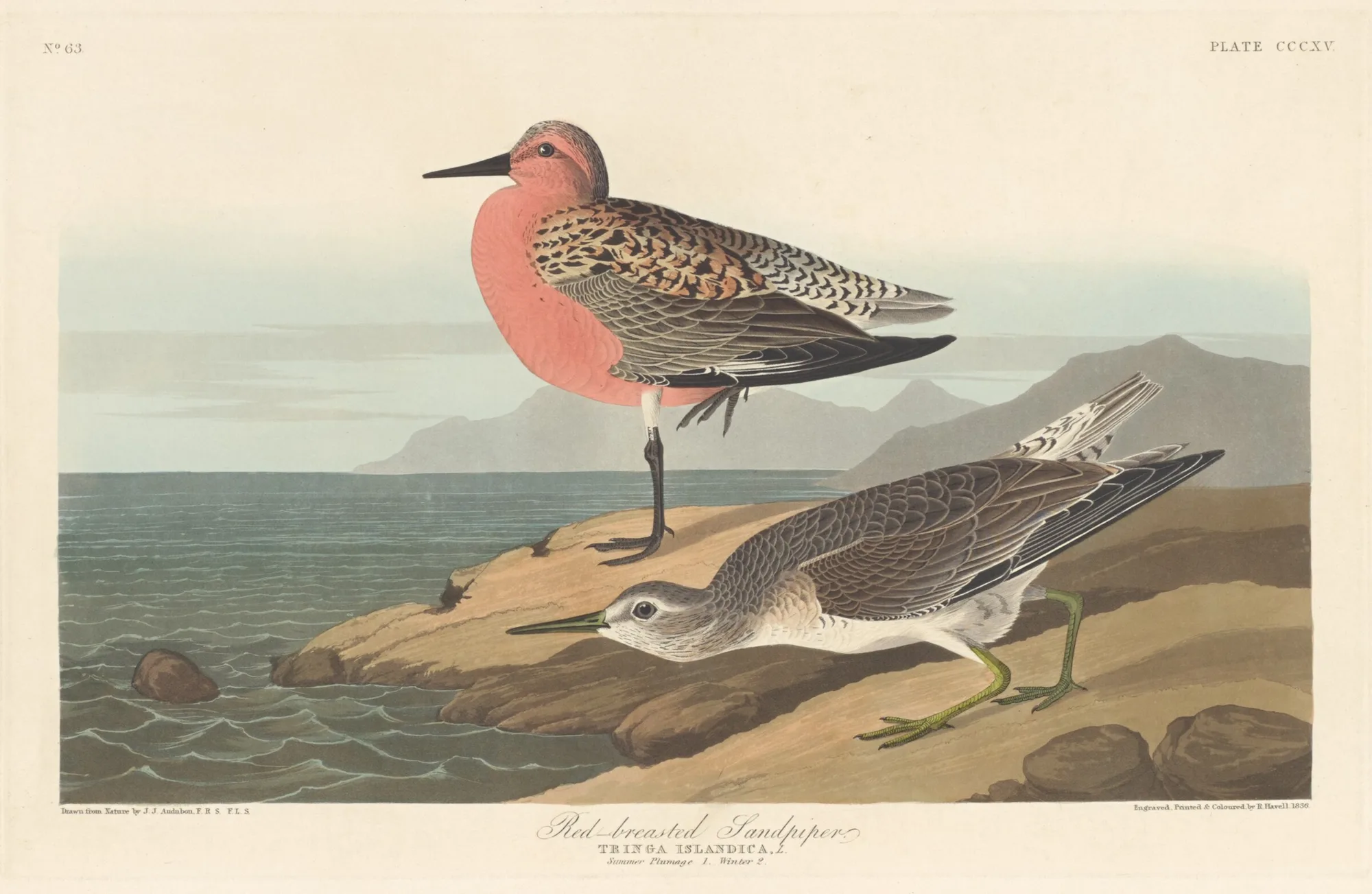
Audubon's “Red-breasted Sandpiper”, The Birds of America, plate CCCXV
Click or press Enter to enlarge
Open the full-resolution image (2770 px, National Gallery of Art)
| Plate | 315 (CCCXV) |
|---|---|
| Audubon's name | Red-breasted Sandpiper |
| Modern name | Red Knot |
| Scientific name | Calidris canutus |
| Status | Near Threatened |
| Engraved by | Robert Havell, after Audubon's watercolor |
| Date | 1836 |
| Medium | Hand-colored engraving and aquatint on Whatman wove paper |
| Size | plate: 31.8 x 49.5 cm (12 1/2 x 19 1/2 in.) sheet: 67.3 x 101 cm (26 1/2 x 39 3/4 in.) |
| Collections | Shorebirds, Rails and Cranes |
| This impression | National Gallery of Art, Washington, 1945.8.315; Gift of Mrs. Walter B. James |
About this plate
Plate 315 shows the Red Knot in two plumages. The summer adult has a rich salmon-red face and underparts, which gave the plate its name, Red-breasted Sandpiper. The winter adult is plain grey above and white below, the Ash-coloured Sandpiper of older books. The OB chapter is headed Knot or Ash-coloured Sandpiper.
Audubon's Tringa islandica is now Calidris canutus. The English name Knot has long been linked to King Canute, though the connection is uncertain. Older American gunners called it the Robin Snipe for its red breast.
Red Knots breed on high Arctic tundra and make some of the longest migrations of any bird. The American race, C. c. rufa, flies from the Canadian Arctic to Tierra del Fuego and back each year. In May it stops at Delaware Bay to fatten on horseshoe crab eggs. Overharvest of the crabs for bait contributed to a crash in numbers, and rufa was listed as Threatened under the US Endangered Species Act in 2015. The IUCN lists the species as Near Threatened.
Audubon admitted he knew nothing of its breeding habits, since he found none in Labrador. Its nest was not described in detail until the twentieth century. He traced it along the coast from Texas to the Bay of Fundy in spring and autumn and found it wintering in East Florida. In April 1837 at Galveston Bay he watched small groups heading east along the Gulf shore.
In Audubon's words
The Knot, good Reader, is a handsome and interesting species, whether in its spring or in its winter plumage, and, provided it be young and fat, is always welcome to the palate of the connoisseur in dainties. As to its habits, however, during the breeding season, I am sorry to inform you that I know nothing at all, for in Labrador, whither I went to examine them, I did not find a single individual. I have been informed that several students of nature have visited its breeding places; but why they have given us no information on the subject, seeing that not only you and I, but many persons besides, would be glad to hear about it, is what we cannot account for.
John James Audubon, Ornithological Biography, vol. 4 (1838), “Knot or Ash-coloured Sandpiper”. Read the full chapter.



