Surf Scoter (Plate 317)
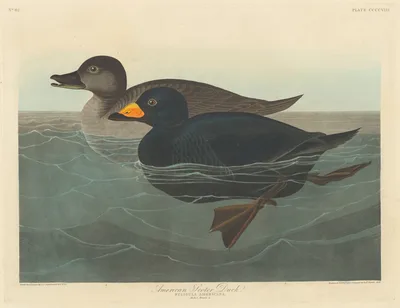
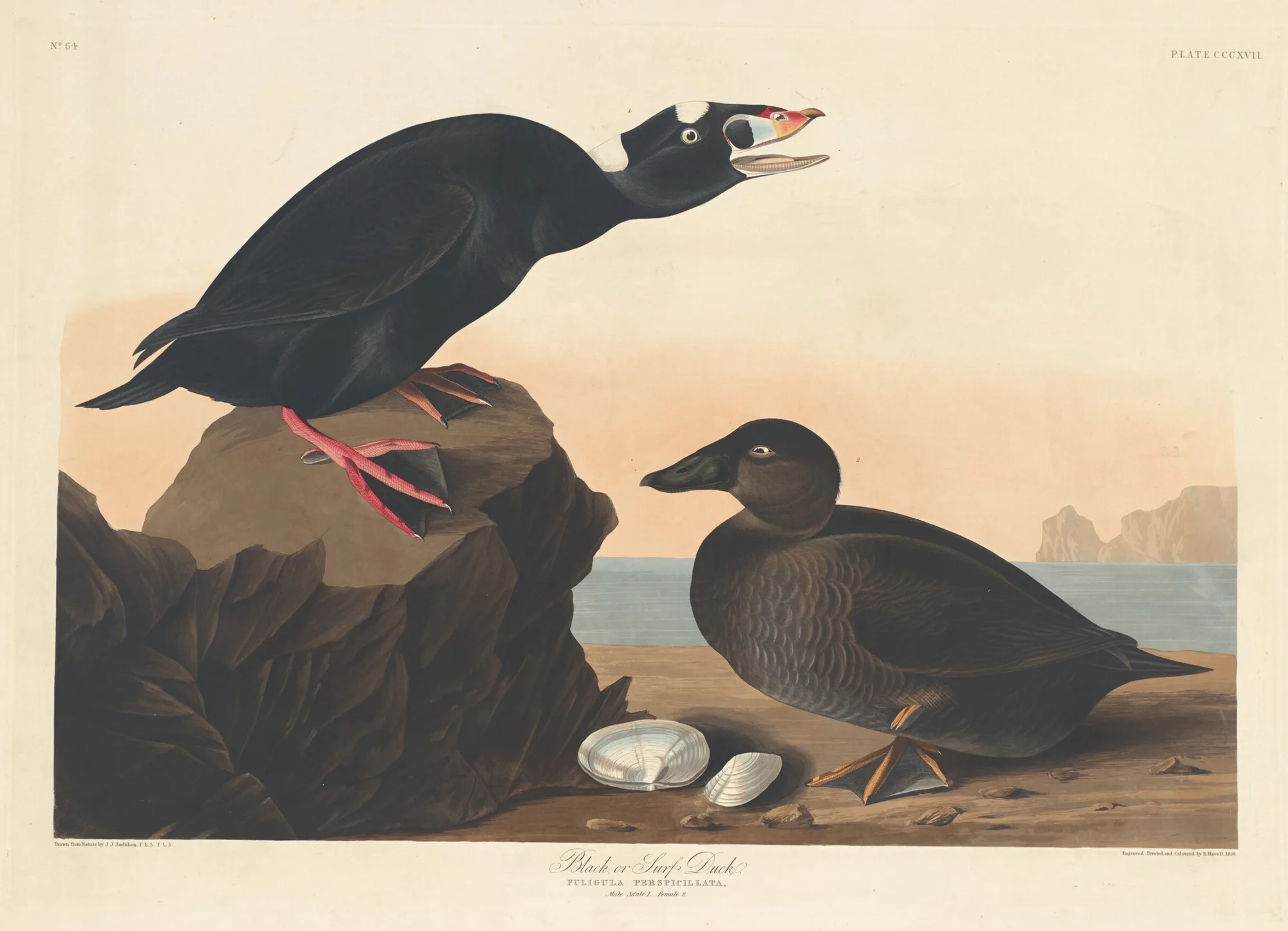
Audubon's “Black or Surf Duck”, The Birds of America, plate CCCXVII
Click or press Enter to enlarge
Open the full-resolution image (4360 px, National Gallery of Art)
| Plate | 317 (CCCXVII) |
|---|---|
| Audubon's name | Black or Surf Duck |
| Modern name | Surf Scoter |
| Scientific name | Melanitta perspicillata |
| Status | Least Concern |
| Engraved by | Robert Havell, after Audubon's watercolor |
| Date | 1836 |
| Medium | Hand-colored engraving and aquatint on Whatman wove paper |
| Collections | Ducks, Geese and Swans |
| This impression | National Gallery of Art, Washington, 1945.8.317; Gift of Mrs. Walter B. James |
About this plate
Plate 317 shows a male and female Surf Scoter. The male is velvet black with white patches on the forehead and nape and a swollen, multicoloured bill of orange, white and black. The female is dark brown with two pale patches on each side of the face. Hunters called the male the skunk-head coot.
Audubon's Fuligula perspicillata is now Melanitta perspicillata. It is one of three North American scoters, with the Black and White-winged Scoters. The Havell title, Black or Surf Duck, can cause confusion, because Black Duck now means the American Black Duck of plate 302.
Surf Scoters breed on lakes in the boreal forest and taiga of Alaska and Canada, east to Labrador. They winter along both coasts of North America, where they dive in the surf for mussels and clams. Their nest was poorly known until the twentieth century. Numbers appear to have declined over the long term, and the species is hunted, but the IUCN lists it as Least Concern.
The chapter opens with Audubon's wish to spend a winter in Labrador with his host there, Mr Jones. He had seen thousands of Surf Ducks in New York harbour, the Chesapeake and the Gulf. He was still astonished at the numbers passing Labrador in 1833 as the schooner Ripley approached the coast. At Little Macatina he searched more than a week for a nest without success.
In Audubon's words
While proceeding towards that country in 1833, on board the Ripley, I found the waters of the Gulf of St Lawrence alive with ducks of different species. The nearer we approached the coast, the more numerous did they become; and of the many kinds that presented themselves to our anxious gaze, the Surf Duck was certainly not the least numerous. It is true that in the noble bays of our own coast, in the Sound, between New York and the Hook, on the broader waters of the Chesapeake, and beyond them to the mouths of the Mississippi, I had seen thousands of Surf Ducks; but the numbers that passed the shores of Labrador, bound for the far north, exceeded all my previous conceptions.
John James Audubon, Ornithological Biography, vol. 4 (1838), “Surf Duck”. Read the full chapter.