Anhinga (Plate 316)
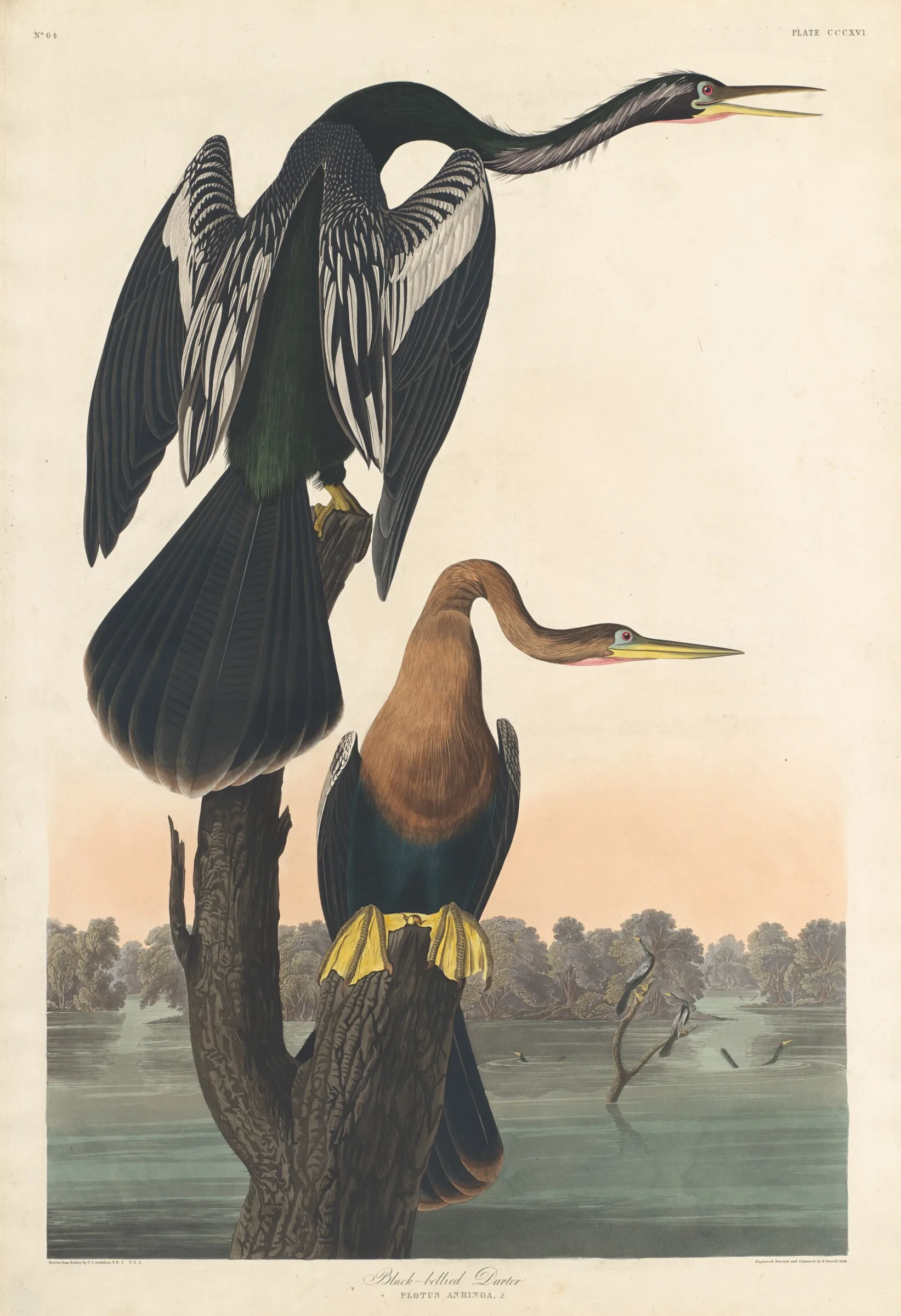
Audubon's “Black-bellied Darter”, The Birds of America, plate CCCXVI
Click or press Enter to enlarge
Open the full-resolution image (5358 px, National Gallery of Art)
| Plate | 316 (CCCXVI) |
|---|---|
| Audubon's name | Black-bellied Darter |
| Modern name | Anhinga |
| Scientific name | Anhinga anhinga |
| Status | Least Concern |
| Engraved by | Robert Havell, after Audubon's watercolor |
| Date | 1836 |
| Medium | Hand-colored engraving and aquatint on Whatman wove paper |
| Size | plate: 96.6 x 65 cm (38 1/16 x 25 9/16 in.) sheet: 100.9 x 68.2 cm (39 3/4 x 26 7/8 in.) |
| Collections | Seabirds, Florida and Wading Birds |
| This impression | National Gallery of Art, Washington, 1945.8.316; Gift of Mrs. Walter B. James |
About this plate
Plate 316 shows a male and female Anhinga. The male is glossy greenish black with silver-white streaks and spots on the back and wings. The female has a buff head, neck and breast. Both have a long, thin S-shaped neck, a dagger-like bill and a long, fan-shaped tail. The Havell plate calls it the Black-bellied Darter, and the Ornithological Biography chapter is headed Anhinga or Snake-bird.
Audubon's Plotus anhinga is now Anhinga anhinga. Anhingas are related to cormorants. They swim with only the head and neck above water, which gives the name Snake-bird, and they spear fish with a half-open bill rather than grasping them. Their feathers soak up water, which helps them dive but forces them to perch with wings spread to dry. The name Water Turkey comes from the broad, pale-tipped tail.
Anhingas live in swamps, slow rivers and lakes from the southeastern United States through Mexico, Central America and the Caribbean to Argentina. They nest in colonies, often with herons, in trees over water. They soar well and are often seen circling high on thermals, like the male Audubon describes rising until it was a speck. The IUCN lists the species as Least Concern.
The chapter opens with Audubon's memories of sultry summer days in the swamps of Louisiana. He watched a female sitting on her nest on a high cypress branch over a lake while the male soared overhead. He later climbed to the nest to watch the downy young being fed by regurgitation.
In Audubon's words
Many sultry summer days I have passed amidst the most dismal swamps of the secluded woods of Louisiana, watching with anxiety and in silence the curious habits of the Anhinga; the female bird now sitting closely on her eggs, in a nest constructed by herself and securely placed on the widely extended branch of the tallest cypress, that, as if by magic planted, stood in the midst of an ample lake, while with keen eyes she watched every motion of the wily Buzzard and cunning Crow, lest either of these cowardly marauders might deprive her of her treasures; the partner of her cares and joys meanwhile, with outspread wings and fan-like tail, soaring on high, and glancing first anxiously towards her he loves, then in anger towards one and all of their numerous enemies.
John James Audubon, Ornithological Biography, vol. 4 (1838), “Anhinga or Snake-bird”. Read the full chapter.