American Avocet (Plate 318)
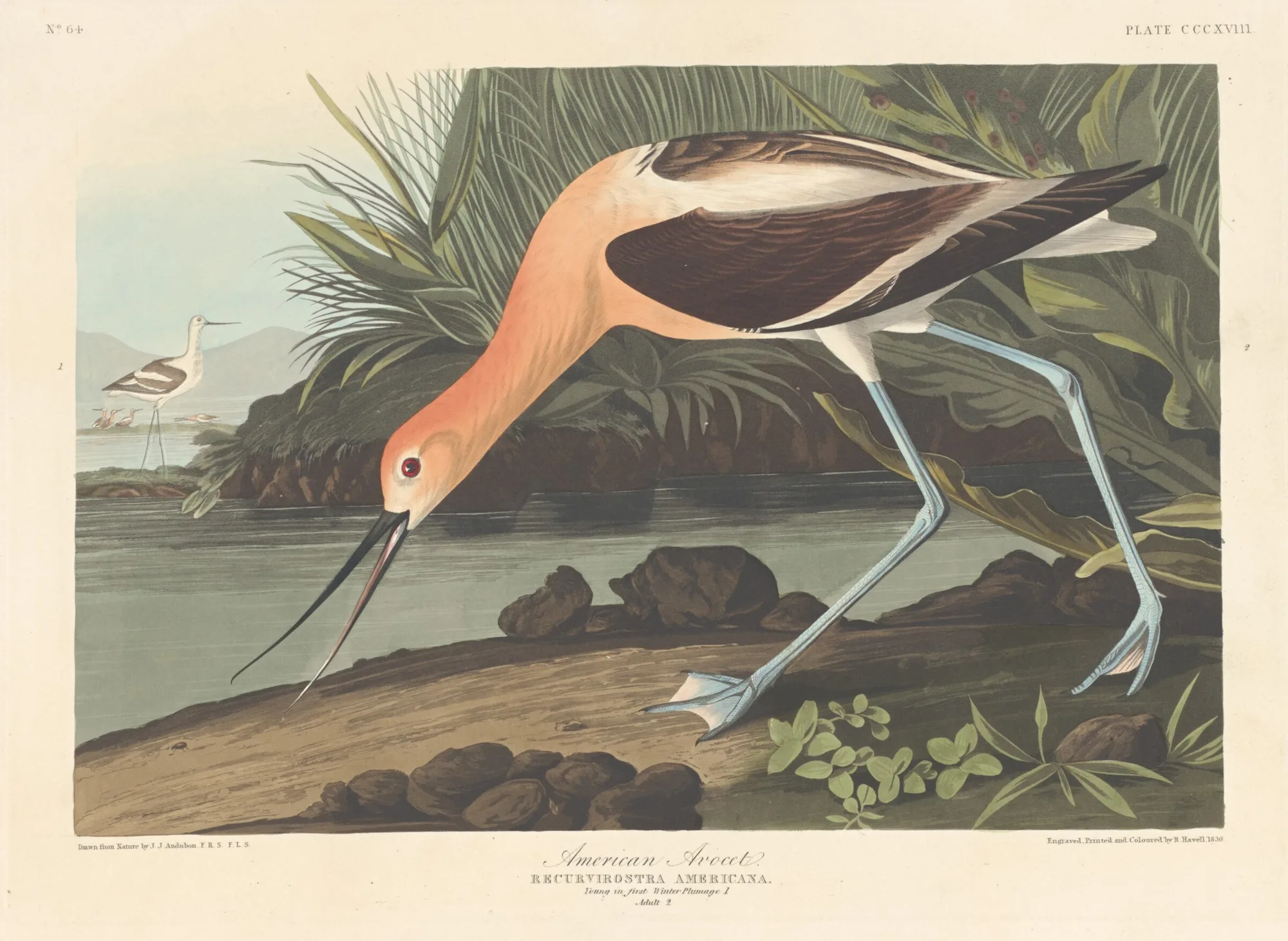
Audubon's “American Avocet”, The Birds of America, plate CCCXVIII
Click or press Enter to enlarge
Open the full-resolution image (2906 px, National Gallery of Art)
| Plate | 318 (CCCXVIII) |
|---|---|
| Audubon's name | American Avocet |
| Modern name | American Avocet |
| Scientific name | Recurvirostra americana |
| Status | Least Concern |
| Engraved by | Robert Havell, after Audubon's watercolor |
| Date | 1836 |
| Medium | Hand-colored engraving and aquatint on Whatman wove paper |
| Collections | Shorebirds, Rails and Cranes |
| This impression | National Gallery of Art, Washington, 1945.8.318; Gift of Mrs. Walter B. James |
About this plate
Plate 318 shows an adult male American Avocet and a young bird in winter plumage. The adult has a cinnamon head and neck, black and white wings and back, long blue-grey legs and the thin bill that curves sharply upward. In winter the head and neck turn pale grey. Audubon spelled the name Avoset in the Ornithological Biography.
Audubon's Recurvirostra americana is still the scientific name. The avocet feeds by sweeping its bill from side to side through shallow water, catching small crustaceans and insects. Females have a shorter, more sharply curved bill than males. Old gunners called the bird the Blue-stocking for its legs.
American Avocets breed on shallow alkaline lakes, salt ponds and marshes of the western United States and the Canadian prairies. They winter along the coasts of California, the Gulf of Mexico and Mexico, with smaller numbers in the Southeast. They were once shot in numbers on the Atlantic coast, where they are now uncommon. The IUCN lists the species as Least Concern.
In June 1814, riding from Henderson to Vincennes, Indiana, Audubon saw avocets over a shallow pond about two miles from Vincennes. He waded through knee-deep mud to the islets, where he found three nests with eggs and a female with young. The next morning he hid in the rushes at sunrise to watch them. Avocets no longer nest anywhere near Indiana.
In Audubon's words
Leaving my horse at liberty, I walked toward the pond, when, on being at once assailed by four of the birds, I felt confident that they had nests, and that their mates were either sitting or tending their young. The pond, which was about two hundred yards in length, and half as wide, was surrounded by tall bulrushes extending to some distance from the margin. Near its centre were several islets, eight or ten yards in length, and disposed in a line. Having made my way through the rushes, I found the water only a few inches deep; but the mud reached above my knees, as I carefully advanced towards the nearest island. The four birds kept up a constant noise, remained on wing, and at times dived through the air until close to me, evincing their displeasure at my intrusion.
John James Audubon, Ornithological Biography, vol. 4 (1838), “American Avoset”. Read the full chapter.