Least Tern (Plate 319)
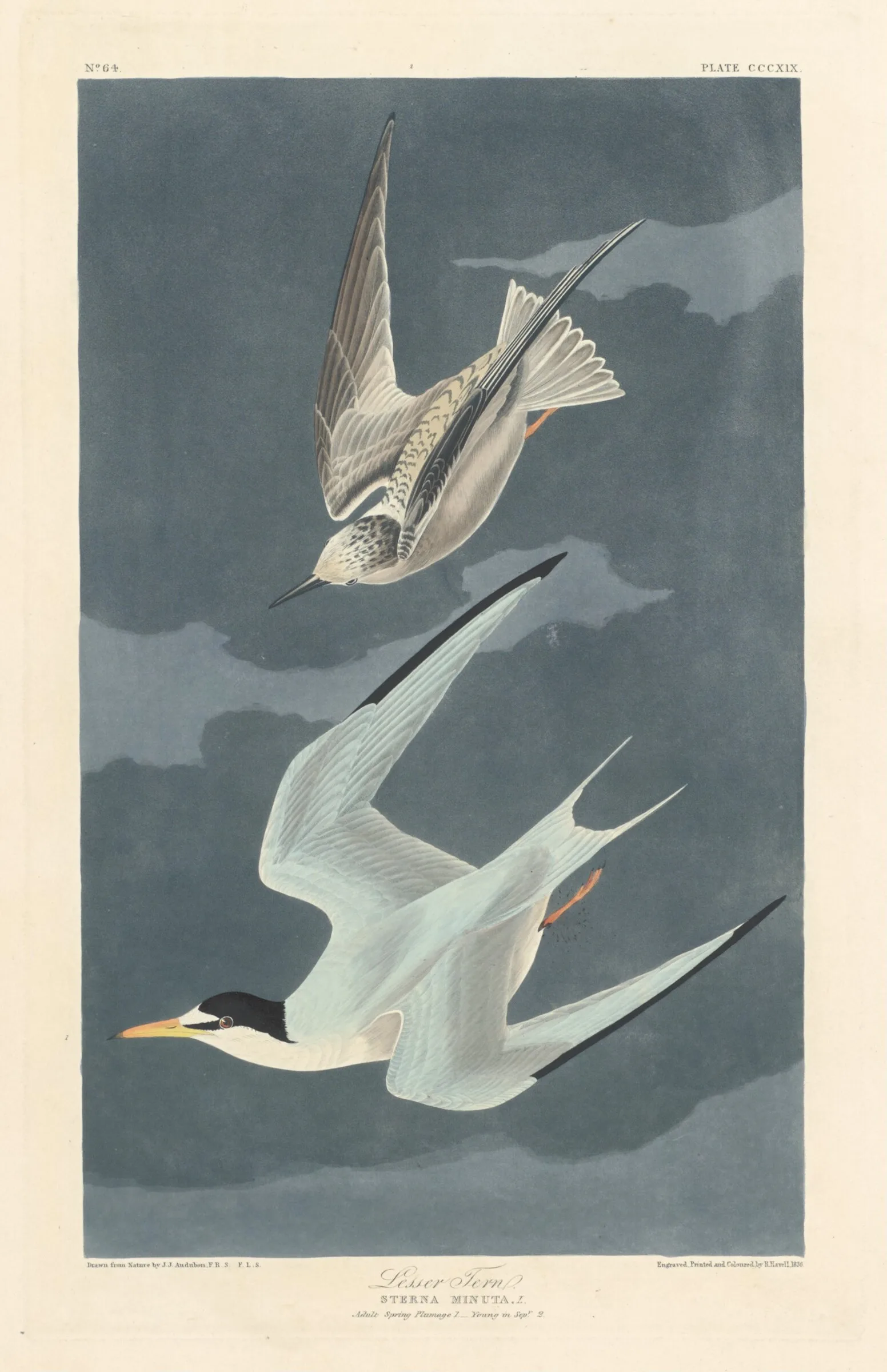
Audubon's “Lesser Tern”, The Birds of America, plate CCCXIX
Click or press Enter to enlarge
Open the full-resolution image (2869 px, National Gallery of Art)
| Plate | 319 (CCCXIX) |
|---|---|
| Audubon's name | Lesser Tern |
| Modern name | Least Tern |
| Scientific name | Sternula antillarum |
| Status | Least Concern |
| Engraved by | Robert Havell, after Audubon's watercolor |
| Date | 1836 |
| Medium | Hand-colored engraving and aquatint on Whatman wove paper |
| Collections | Seabirds |
| This impression | National Gallery of Art, Washington, 1945.8.319; Gift of Mrs. Walter B. James |
About this plate
Plate 319 shows an adult and a young Least Tern. The adult has a black cap with a white forehead, a pale grey back and a yellow bill tipped black. The young bird has a scaly brownish back and a dark bill. This is the smallest tern in North America.
Audubon used Sterna minuta, the name of the European Little Tern, and the Havell plate calls it the Lesser Tern. The OB chapter calls it the Least Tern. The American birds are now treated as a separate species, Sternula antillarum, though the two are very similar.
Least Terns nest in small colonies on bare sand and shell beaches along the Atlantic, Gulf and California coasts, and on sandbars of the Mississippi, Missouri and other big rivers. They winter in Central and South America. Plume hunters nearly wiped out the coastal colonies in the late nineteenth century. Today beach use and dammed rivers threaten them. The interior population was listed as endangered in the United States in 1985 and removed in 2021 after recovery. The California race remains listed. The IUCN lists the species as Least Concern.
Audubon reported finding it breeding in Labrador in June 1833, which is far north of its known range, so that record is doubtful. In late April 1837 he saw hundreds of pairs on the islands of Galveston Bay. Once, in June, on a dry sandbar at Bayou Sara, Louisiana, some two hundred miles from the sea, he found the eggs of three pairs.
In Audubon's words
Sylph-like bird of the waters, how delightful has it been to me to gaze on thy gliding movements, on the fannings of thy gentle wings, on the delicate silvery glance of thy soft and sattiny bosom, as thou camest from distant and unknown shores, when the winter had passed away, and the mild breezes of early summer blew around thee, and thou soughtest a place of safety in which to sojourn for a time. That frail frame of thine must have suffered many a hardship. Fronting that last damp and chilling blast, I have seen thee gathering up all thy little strength to force thy way; and when the fury of the tempest assailed thee, wert thou not glad to seek for refuge under yon bold headland! Ah, deny it not, for I have seen the delight expressed by thee, when after awhile, returning calm and sunshine revived thee, and thou spreadest thy wings anew, to ramble gaily over the still turbulent waters.
John James Audubon, Ornithological Biography, vol. 4 (1838), “Least Tern”. Read the full chapter.



