Least Sandpiper (Plate 320)
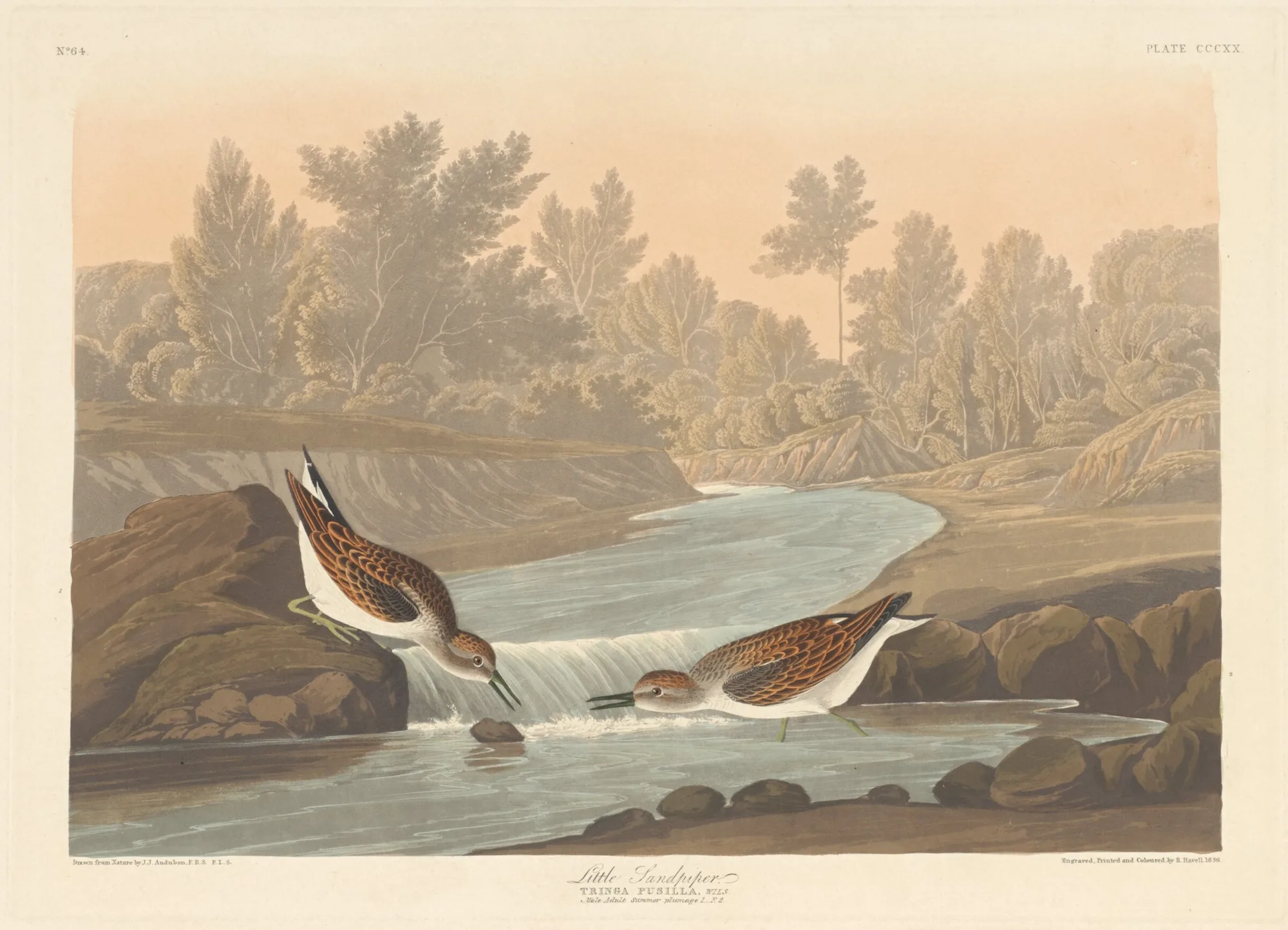
Audubon's “Little Sandpiper”, The Birds of America, plate CCCXX
Click or press Enter to enlarge
Open the full-resolution image (2945 px, National Gallery of Art)
| Plate | 320 (CCCXX) |
|---|---|
| Audubon's name | Little Sandpiper |
| Modern name | Least Sandpiper |
| Scientific name | Calidris minutilla |
| Status | Least Concern |
| Engraved by | Robert Havell, after Audubon's watercolor |
| Date | 1836 |
| Medium | Hand-colored engraving and aquatint on Whatman wove paper |
| Collections | Shorebirds, Rails and Cranes |
| This impression | National Gallery of Art, Washington, 1945.8.320; Gift of Mrs. Walter B. James |
About this plate
Plate 320 shows a male and female Least Sandpiper, brown and buff above, with a streaked breast, a fine slightly drooping bill and yellowish legs. Least Sandpipers are the smallest shorebirds in the world, weighing about twenty to thirty grams.
Audubon kept Wilson's name, Tringa pusilla, and argued that only one tiny sandpiper of this type lived in the United States. He rejected several European names that other authors had applied to American birds. The bird is now Calidris minutilla. Birders group it with the Semipalmated and Western Sandpipers as peeps. It is told from them by its yellow-green legs and browner plumage.
Least Sandpipers breed on mossy bogs and tundra across Alaska and northern Canada, south to Newfoundland and Nova Scotia. They winter from the southern United States to northern South America, feeding on muddy margins, often at the grassy edges rather than on open flats. The IUCN lists the species as Least Concern.
Audubon found it breeding on moss-covered rocks near the sea in Labrador. He described how a parent flushed from the nest flies low with whirring wings and limps along the ground to draw an intruder away. His advice was to drop your hat at the spot as a marker. Using that method he found a nest with eggs on 20 July 1833.
In Audubon's words
On all such occasions, Reader, you ought to mark well the spot from which the bird has started, and, to assure yourself that your eye may not be deceived, throw your cap or hat at your feet to serve as a beacon, should necessity afterwards call for it, to guide you around the place until you have discovered the nest which you are desirous of seeing. Through these means, on the 20th of July 1833, I after some search found the nest and eggs of this species. The birds flew, to use the words of my Journal, like Partridges, and not like Tringas. I marked them well, for both the female and the male flew from near the nest, and having left my fisher's hat where I then stood, I walked carefully over the moss hither and thither, until at last I came upon the spot.
John James Audubon, Ornithological Biography, vol. 4 (1838), “Little Sandpiper”. Read the full chapter.



