Redhead (Plate 322)
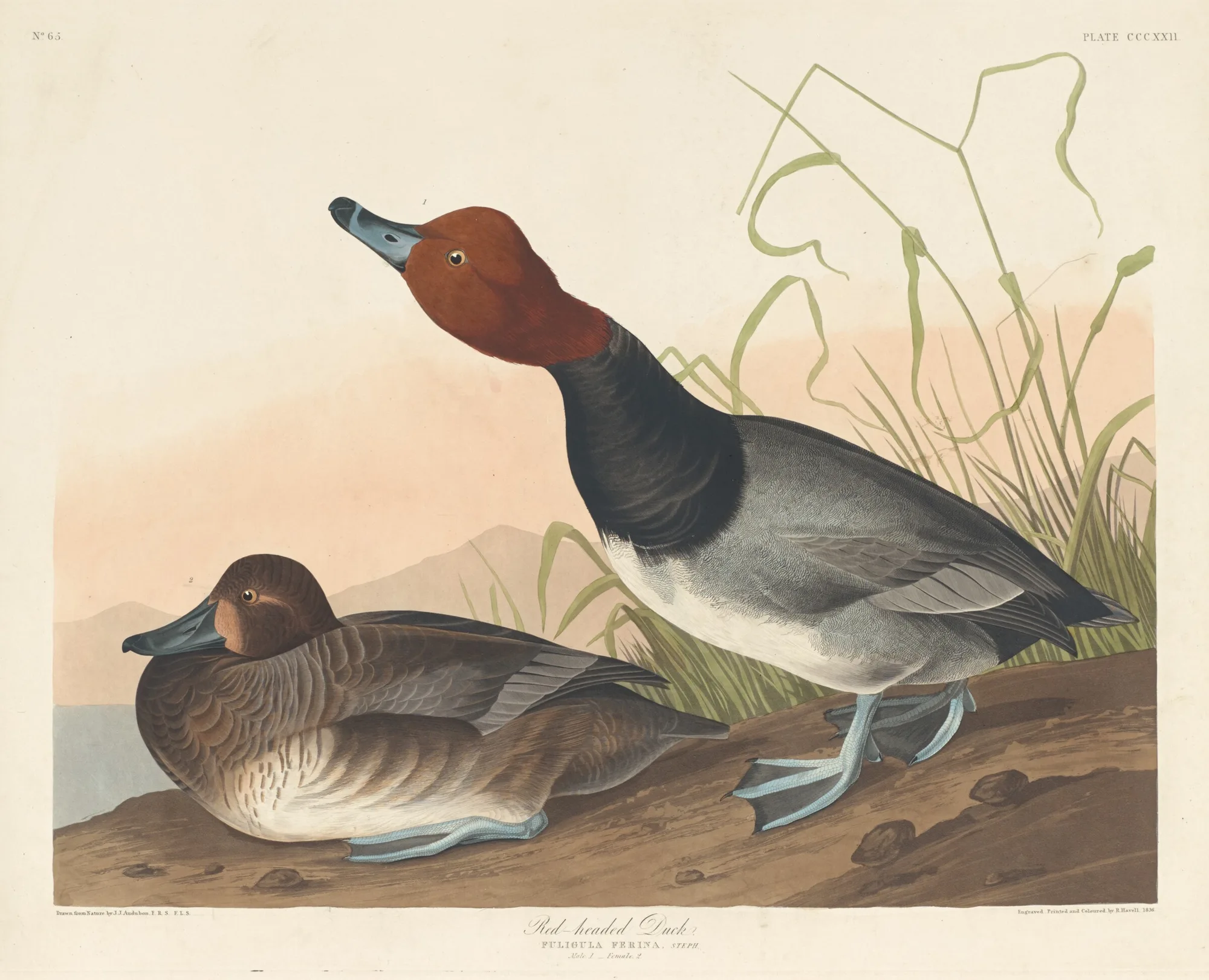
Audubon's “Red-Headed Duck”, The Birds of America, plate CCCXXII
Click or press Enter to enlarge
Open the full-resolution image (3640 px, National Gallery of Art)
| Plate | 322 (CCCXXII) |
|---|---|
| Audubon's name | Red-Headed Duck |
| Modern name | Redhead |
| Scientific name | Aythya americana |
| Status | Least Concern |
| Engraved by | Robert Havell, after Audubon's watercolor |
| Date | 1836 |
| Medium | Hand-colored engraving and aquatint on Whatman wove paper |
| Collections | Ducks, Geese and Swans |
| This impression | National Gallery of Art, Washington, 1945.8.322; Gift of Mrs. Walter B. James |
About this plate
Plate 322 shows a male and female Redhead. The male has a round, rich red head, black breast, grey back and a blue-grey bill with a black tip. The female is plain warm brown. The male looks much like a Canvasback, but its head is rounded rather than wedge-shaped, and its back is darker grey.
Audubon called it Fuligula ferina, the name of the Common Pochard of Europe. Like several writers of his time he treated the two as one species. They are now known to be distinct, and the American bird is Aythya americana. Redheads are notable for laying eggs in the nests of other ducks, including Canvasbacks and other Redheads.
Redheads breed in prairie pothole marshes of the northern Great Plains and the intermountain West. Most winter along the Laguna Madre of Texas and Mexico, where they feed on shoal grass, as well as on the Gulf coast and in Chesapeake Bay. The IUCN lists the species as Least Concern.
At New Orleans it was called Dos Gris. Audubon found it plentiful on Lakes Borgne, St John and Pontchartrain. He recalled that in 1816 a Frenchman netted thousands of ducks there and sent them to market alive in cages, until he could no longer find enough cages. He also found many in the marshes near St Augustine, Florida, in November 1831.
In Audubon's words
At New Orleans, this bird is commonly known by the name of "Dos Gris." It arrives there in great flocks, about the first of November, and departs late in April, or in the beginning of May. On the lakes Borgne, St John, and Ponchartrain, it is very abundant, keeping in large flocks, separate from the other species. In that part of the country its food consists of small fishes, in pursuit of which it is seen constantly diving. It is caught in different sorts of nets, and easily kept in confinement, feeding greedily on Indian corn, whether entire or crushed by the millstone. In 1816, many thousands of these ducks as well as others of different species, were caught in nets by a Frenchman, who usually sent them alive to market in cages from the narrows of the Lakes, especially from those called "La pointe aux herbes," and the "Isle aux pins."
John James Audubon, Ornithological Biography, vol. 4 (1838), “Red-headed Duck”. Read the full chapter.