Black Skimmer (Plate 323)
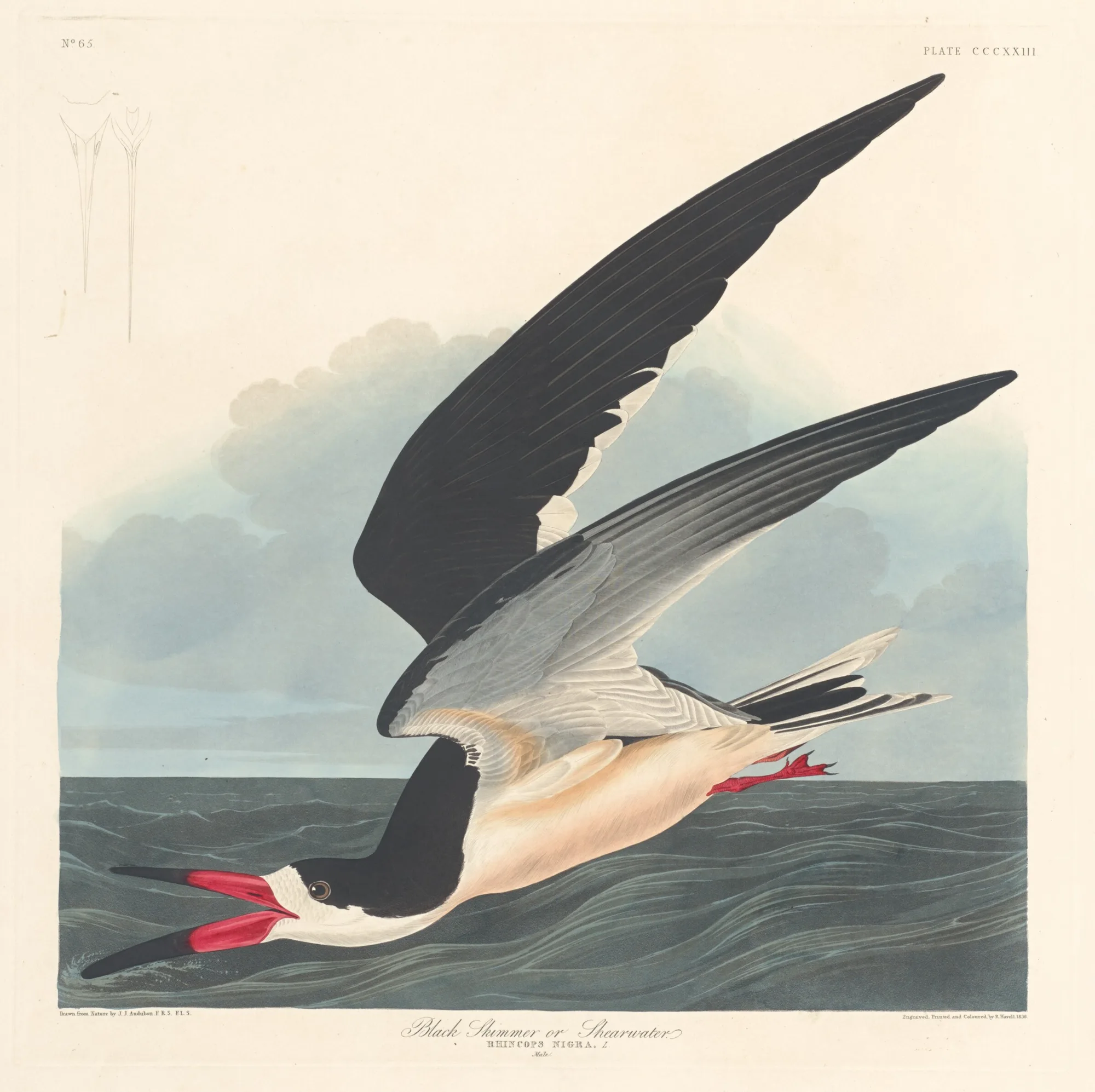
Audubon's “Black Skimmer”, The Birds of America, plate CCCXXIII
Click or press Enter to enlarge
Open the full-resolution image (3117 px, National Gallery of Art)
| Plate | 323 (CCCXXIII) |
|---|---|
| Audubon's name | Black Skimmer |
| Modern name | Black Skimmer |
| Scientific name | Rynchops niger |
| Status | Least Concern |
| Engraved by | Robert Havell, after Audubon's watercolor |
| Date | 1836 |
| Medium | Hand-colored engraving and aquatint on Whatman wove paperr |
| Size | plate: 53.3 x 54 cm (21 x 21 1/4 in.) sheet: 100.5 x 68 cm (39 9/16 x 26 3/4 in.) |
| Collections | Seabirds |
| This impression | National Gallery of Art, Washington, 1945.8.323; Gift of Mrs. Walter B. James |
About this plate
Plate 323 shows a male Black Skimmer, black above and white below, with short red legs and a large red and black bill. The lower mandible is longer than the upper. That is the bird's most famous feature. It flies low with the lower mandible slicing the surface and snaps the bill shut when it touches a small fish.
Audubon's Rhynchops nigra is now Rynchops niger. Skimmers are related to terns and gulls and are the only birds whose lower mandible is longer than the upper. Their pupils can close to vertical slits, like a cat's, which may help them in bright sun over sand and water. They often feed at dusk and at night, when the water is calm.
Black Skimmers breed in colonies on sandy beaches, islands and shell banks along the Atlantic and Gulf coasts from Massachusetts to Texas, in southern California, and on rivers and coasts in South America. Northern birds winter from the Carolinas south. Beach development and disturbance threaten many colonies. The IUCN lists the species as Least Concern.
Audubon found skimmers resident from South Carolina to the Sabine River and abundant in Texas in early spring. He wrote of winter flocks resting packed together on sand bars, like a black pall spread on the sand. He believed he had seen at least ten thousand in a single flock. The NGA title has Black Skimmer, and the plate list adds his other name, or Shearwater.
In Audubon's words
There, during the warm sunshine of the winter days, you will see thousands of Skimmers, covered as it were with their gloomy mantles, peaceably lying beside each other, and so crowded together as to present to your eye the appearance of an immense black pall accidentally spread on the sand. Such times are their hours of rest, and I believe of sleep, as, although partially diurnal, and perfectly able to discern danger by day, they rarely feed then, unless the weather be cloudy. On the same sands, yet apart from them, equal numbers of our common Black-headed Gulls may be seen enjoying the same comfort in security. Indeed the Skimmers are rarely at such times found on sand or gravel banks which are not separated from the neighbouring shores by some broad and deep piece of water. I think I can safely venture to say that in such places, and at the periods mentioned, I have seen not fewer than ten thousand of these birds in a single flock.
John James Audubon, Ornithological Biography, vol. 4 (1838), “Black Skimmer or Razor-billed Shearwater”. Read the full chapter.



