Roseate Spoonbill (Plate 321)
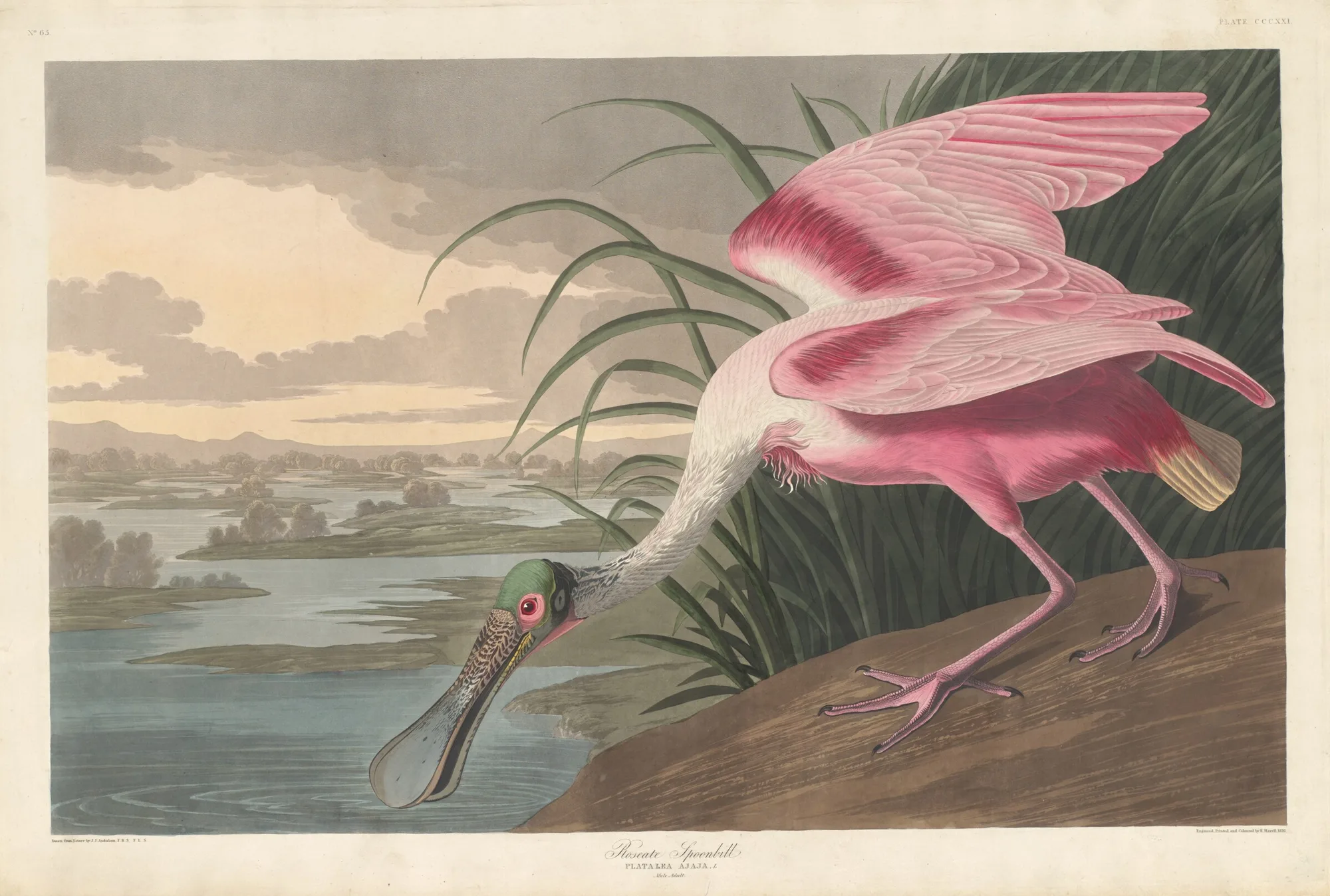
Audubon's “Roseate Spoonbill”, The Birds of America, plate CCCXXI
Click or press Enter to enlarge
Open the full-resolution image (5430 px, National Gallery of Art)
| Plate | 321 (CCCXXI) |
|---|---|
| Audubon's name | Roseate Spoonbill |
| Modern name | Roseate Spoonbill |
| Scientific name | Platalea ajaja |
| Status | Least Concern |
| Engraved by | Robert Havell, after Audubon's watercolor |
| Date | 1836 |
| Medium | Hand-colored engraving and aquatint on Whatman wove paper |
| Size | plate: 64.5 x 97.2 cm (25 3/8 x 38 1/4 in.) sheet: 67.3 x 100.3 cm (26 1/2 x 39 1/2 in.) |
| Collections | Herons and Egrets, Florida and Wading Birds |
| This impression | National Gallery of Art, Washington, 1945.8.321; Gift of Mrs. Walter B. James |
About this plate
Plate 321 shows one adult male Roseate Spoonbill. It is pink with carmine shoulders, a bare greenish head and the long, flat bill that widens into a spoon at the tip. The bird feeds by sweeping that bill from side to side through shallow water and snapping it shut on shrimp, small fish and insects.
The scientific name Audubon used, Platalea ajaja, has returned to use after a period when the species was placed in its own genus, Ajaia. It is the only spoonbill of the Americas. The pink colour comes from carotenoid pigments in the crustaceans it eats.
Roseate Spoonbills breed in Florida, coastal Texas and Louisiana, Cuba and the Caribbean, and south to Argentina. In the nineteenth century plume hunters, who sold the wings for fans, almost wiped them out in Florida. Only a few pairs nested in Florida by the 1930s. Protection led to a recovery, and in recent decades Florida Bay birds have shifted their nesting north as water management in the Everglades has changed their feeding grounds. The IUCN lists the species as Least Concern.
Audubon met the bird in the Florida Keys near Cape Sable and later on Galveston Bay in Texas, where he found it more plentiful. He noted that it was rarely seen inland and that John Bachman had seen only three in South Carolina in twenty years.
In Audubon's words
The Roseate Spoonbill is found for the most part along the marshy and muddy borders of estuaries, the mouths of rivers, ponds, or sea islands or keys partially overgrown with bushes, and perhaps still more commonly along the shores of those singular salt-water bayous so abundant within a mile or so of the shores, where they can reside and breed in perfect security in the midst of an abundance of food. It is more or less gregarious at all seasons, and it is rare to meet with fewer than half a dozen together, unless they have been dispersed by a tempest, in which case one of them is now and then found in a situation where you would least expect it. At the approach of the breeding season, these small flocks collect to form great bodies, as is the manner of the Ibises, and resort to their former places of residence, to which they regularly return, like Herons.
John James Audubon, Ornithological Biography, vol. 4 (1838), “Roseate Spoonbill”. Read the full chapter.
Roseate Spoonbill (Plate 321): the story behind one of the most famous plates in the collection →