Bonaparte's Gull (Plate 324)
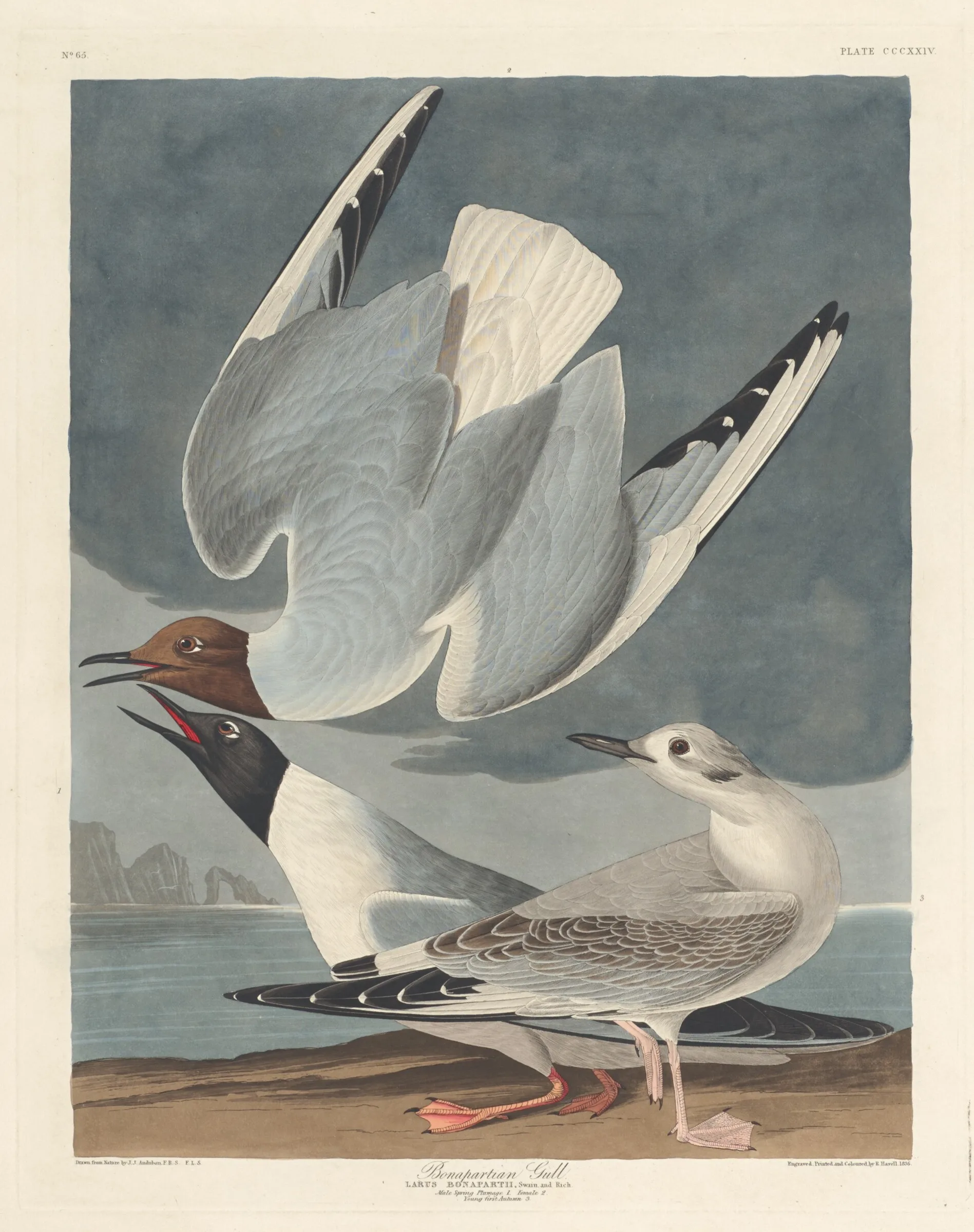
Audubon's “Bonapartian Gull”, The Birds of America, plate CCCXXIV
Click or press Enter to enlarge
Open the full-resolution image (3105 px, National Gallery of Art)
| Plate | 324 (CCCXXIV) |
|---|---|
| Audubon's name | Bonapartian Gull |
| Modern name | Bonaparte's Gull |
| Scientific name | Chroicocephalus philadelphia |
| Status | Least Concern |
| Engraved by | Robert Havell, after Audubon's watercolor |
| Date | 1836 |
| Medium | Hand-colored engraving and aquatint on Whatman wove paper |
| Collections | Seabirds |
| This impression | National Gallery of Art, Washington, 1945.8.324; Gift of Mrs. Walter B. James |
About this plate
Plate 324 shows three Bonaparte's Gulls: a male, a female and a young bird. The adults have a slate-black hood, a thin black bill, a pale grey back and white wedges in the outer wing. The young bird has a white head with a dark ear spot and a dark bar across the wing. Audubon thought the female's hood was brown, but the sexes are alike, and a brownish hood usually marks a younger or moulting bird.
The species was described by George Ord in 1815 as Sterna philadelphia, and Swainson later named it Larus bonapartii in honour of Charles Lucien Bonaparte, the name Audubon used. Today it is Chroicocephalus philadelphia, in the same genus as the Black-headed Gull of Europe. It is the only gull that nests mainly in trees.
Bonaparte's Gulls breed in conifers near lakes in the boreal forest of Alaska and Canada. They winter on the Great Lakes, along both coasts and on large rivers. They often feed tern-like, picking small fish and insects from the surface, and gather in large flocks at river mouths and on the Niagara River. The IUCN lists the species as Least Concern.
Audubon first met it at Cincinnati in August 1819, when he crossed the Ohio with Robert Best of the Cincinnati Museum. In May 1833 at Eastport, Maine, his son John killed seventeen young birds with one shot.
In Audubon's words
I was crossing the Ohio, along with Mr Robert Best, then curator of the Cincinnati Museum, for the purpose of visiting the Cliff Swallows which had taken up their abode on the walls of the garrison on the Kentucky side, when we observed two Gulls sweeping gracefully over the tranquil waters. Now they would alight side by side, as if intent on holding a close conversation; then they would rise on wing and range about, looking downwards with sidelong glances, searching for small fishes, or perhaps eyeing the bits of garbage that floated on the surface. We watched them for nearly half an hour, and having learned something of their manners, shot one, which happened to be a female. On her dropping, her mate almost immediately alighted beside her, and was shot. There, side by side, as in life, so in death, floated the lovely birds.
John James Audubon, Ornithological Biography, vol. 4 (1838), “Bonapartian Gull”. Read the full chapter.