Bufflehead (Plate 325)
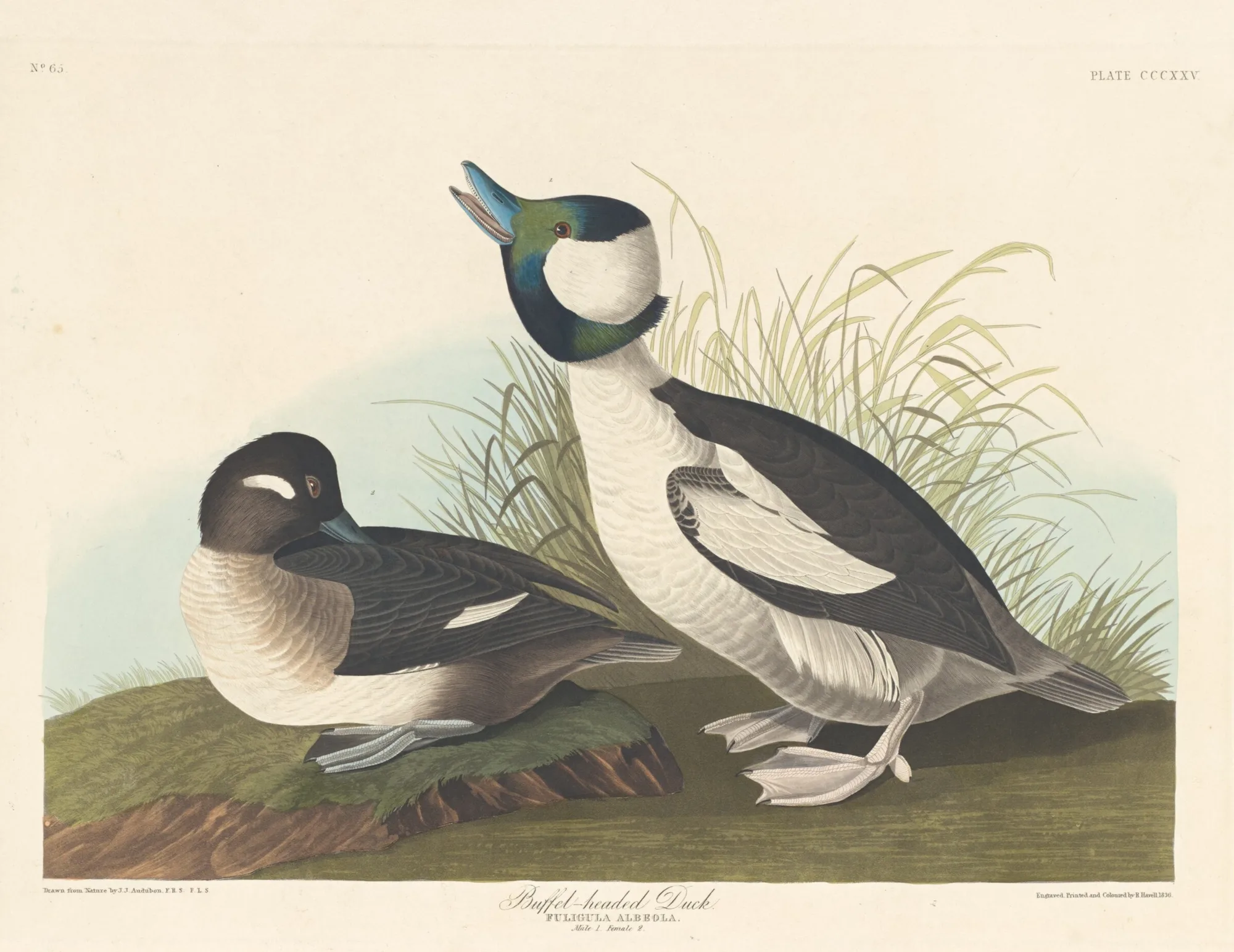
Audubon's “Buffel-headed Duck”, The Birds of America, plate CCCXXV
Click or press Enter to enlarge
Open the full-resolution image (2897 px, National Gallery of Art)
| Plate | 325 (CCCXXV) |
|---|---|
| Audubon's name | Buffel-headed Duck |
| Modern name | Bufflehead |
| Scientific name | Bucephala albeola |
| Status | Least Concern |
| Engraved by | Robert Havell, after Audubon's watercolor |
| Date | 1836 |
| Medium | Hand-colored engraving and aquatint on Whatman wove paper |
| Collections | Ducks, Geese and Swans |
| This impression | National Gallery of Art, Washington, 1945.8.325; Gift of Mrs. Walter B. James |
About this plate
Plate 325 shows a male and female Bufflehead. The male is mostly white with a black back and a large puffy head, glossy green and purple, with a broad white patch behind the eye. The female is grey-brown with a small white cheek spot. Audubon called it a beautiful miniature of the Golden-eye.
Audubon's Fuligula albeola is now Bucephala albeola. The genus also holds the goldeneyes. The English name comes from buffalo-head, after the male's oversized head. Audubon listed the local names Spirit Duck, Butter-box, Marrionette, Dipper and Die-dipper, and he thought Marrionette a pretty one. Hunters today often call it the Butterball.
Buffleheads are the smallest diving ducks in North America. They nest in tree holes, very often old Northern Flicker holes, in boreal and aspen forest from Alaska across Canada. They winter on bays, lakes and rivers across much of the United States and Mexico. The IUCN lists the species as Least Concern.
Audubon met the bird almost everywhere in autumn and winter. He saw it diving among floating ice on the Ohio, and he shot some near Eastport, Maine, on 11 May 1833. He correctly said it did not breed within the United States as it then stood. He also described boys at the river snapping a faulty flintlock at a group of Buffleheads, which dived at each click and popped up again close by.
In Audubon's words
Possessed of a feeling of security arising from the rapidity with which they can dive, they often allow you to go quite near them, though they will then watch every motion, and at the snap of your gun, or on its being discharged, disappear with the swiftness of thought, and perhaps as quickly rise again, within a few yards as if to ascertain the cause of their alarm. I have sometimes been much amused to see the apparent glee with which these little Dippers would thus dive at the repeated snappings of a miserable flint lock, patiently tried by some vagrant boys, who becoming fatigued with the ill luck of their piece, would lay it aside, and throw stones at the birds, which would appear quite pleased.
John James Audubon, Ornithological Biography, vol. 4 (1838), “Buffel-headed Duck”. Read the full chapter.