Northern Gannet (Plate 326)
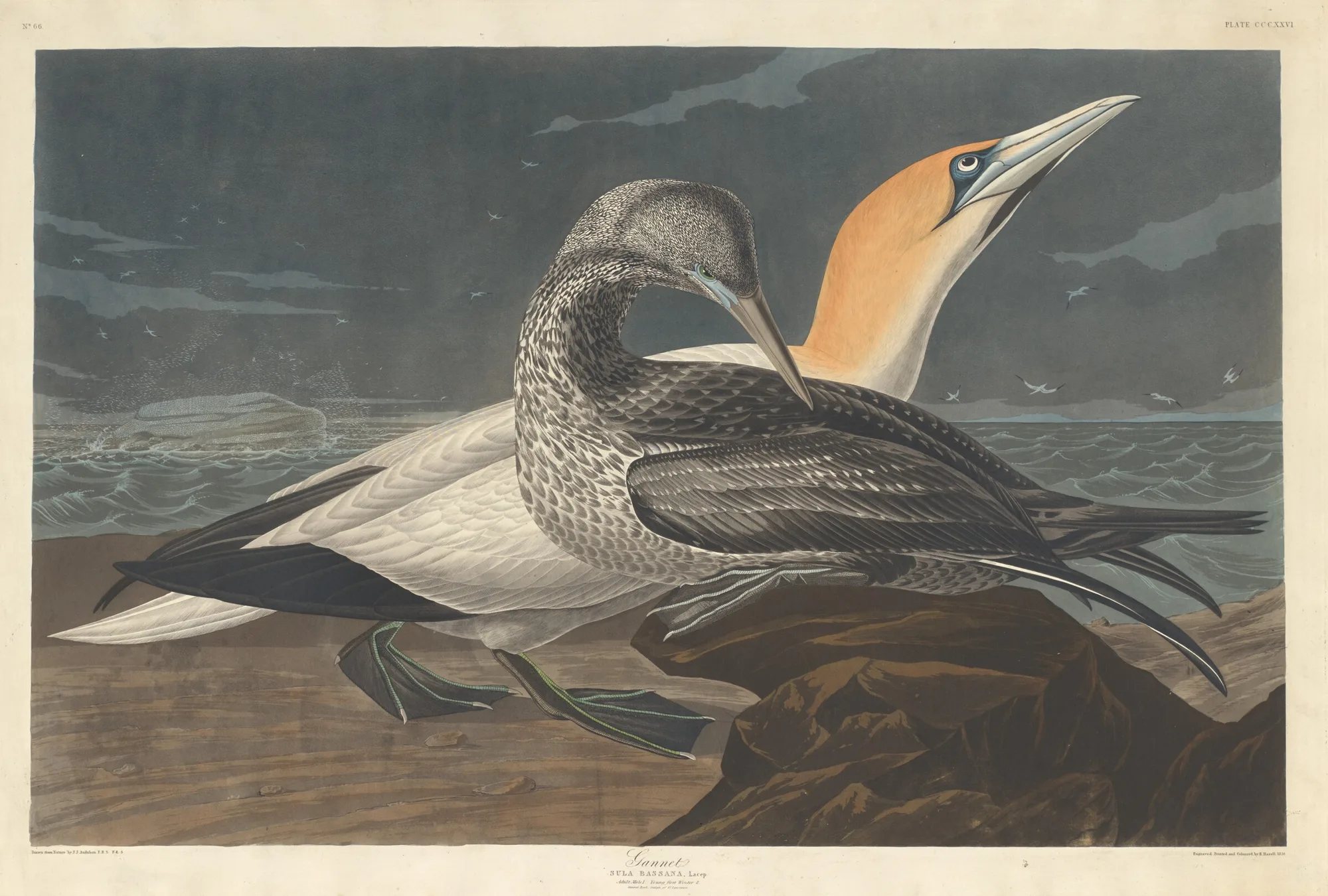
Audubon's “Gannet”, The Birds of America, plate CCCXXVI
Click or press Enter to enlarge
Open the full-resolution image (5402 px, National Gallery of Art)
| Plate | 326 (CCCXXVI) |
|---|---|
| Audubon's name | Gannet |
| Modern name | Northern Gannet |
| Scientific name | Morus bassanus |
| Status | Least Concern |
| Engraved by | Robert Havell, after Audubon's watercolor |
| Date | 1836 |
| Medium | Hand-colored engraving and aquatint on Whatman wove paper |
| Collections | Seabirds |
| This impression | National Gallery of Art, Washington, 1945.8.326; Gift of Mrs. Walter B. James |
About this plate
Plate 326 shows an adult male Northern Gannet and a young bird. The adult is white with black wingtips, a buff-yellow wash on the head, a pale blue-grey dagger bill and pale eyes. The young bird is dark grey-brown speckled with white. Gannets take about four or five years to reach full adult plumage.
Audubon's Sula bassana is now Morus bassanus. The scientific and old English names come from the Bass Rock in the Firth of Forth, one of the largest colonies. Older British writers called it the Solan Goose. It is the largest seabird of the North Atlantic, and it dives on fish from heights of thirty metres or more, folding its wings just before it hits the water.
Northern Gannets breed in dense colonies on cliffs and rocky islands on both sides of the North Atlantic: in Quebec and Newfoundland, Iceland, Norway, the British Isles and France. They winter at sea, American birds south to the Gulf of Mexico. Numbers have grown over the twentieth century, but avian influenza killed many in 2022. The IUCN lists the species as Least Concern.
On 14 June 1833, the schooner Ripley approached Great Gannet Rock in the Gulf of St Lawrence, now part of the Bird Rocks off the Magdalen Islands. Audubon at first took the white top of the rock for snow. A storm came up, and his son John and Thomas Lincoln went ashore in the whaleboat. Audubon stayed aboard and watched the birds from the deck.
In Audubon's words
After a while I could distinctly see its top from the deck, and thought that it was still covered with snow several feet deep. As we approached it, I imagined that the atmosphere around was filled with flakes, but on my turning to the pilot, who smiled at my simplicity, I was assured that nothing was in sight but the Gannets and their island home. I rubbed my eyes, took up my glass, and saw that the strange dimness of the air before us was caused by the innumerable birds, whose white bodies and black-tipped pinions produced a blended tint of light-grey. When we had advanced to within half a mile, this magnificent veil of floating Gannets was easily seen, now shooting upwards, as if intent on reaching the sky, then descending as if to join the feathered masses below, and again diverging toward either side and sweeping over the surface of the ocean.
John James Audubon, Ornithological Biography, vol. 4 (1838), “Common Gannet”. Read the full chapter.



