Northern Shoveler (Plate 327)
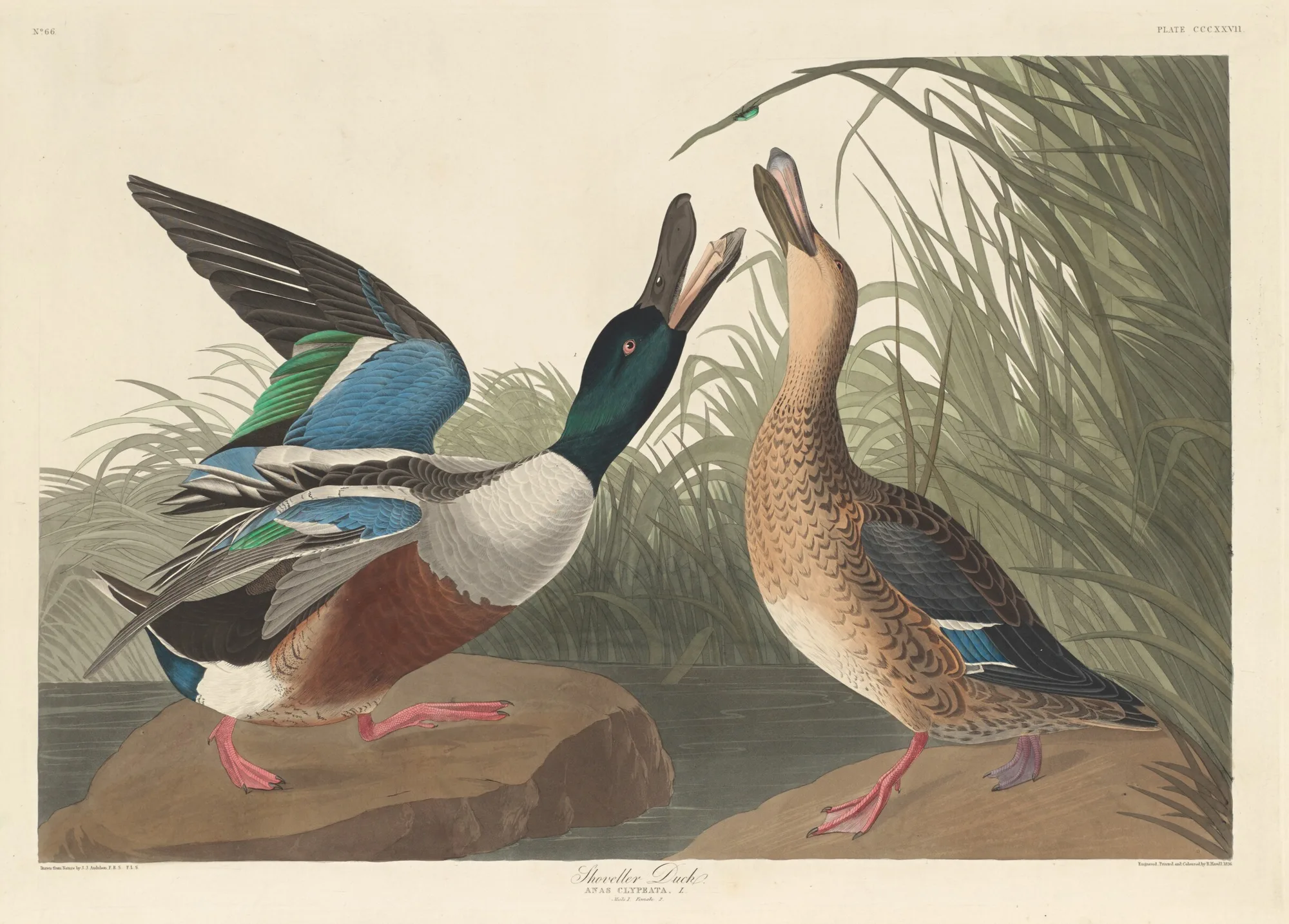
Audubon's “Shoveller Duck”, The Birds of America, plate CCCXXVII
Click or press Enter to enlarge
Open the full-resolution image (4275 px, National Gallery of Art)
| Plate | 327 (CCCXXVII) |
|---|---|
| Audubon's name | Shoveller Duck |
| Modern name | Northern Shoveler |
| Scientific name | Spatula clypeata |
| Status | Least Concern |
| Engraved by | Robert Havell, after Audubon's watercolor |
| Date | 1836 |
| Medium | Hand-colored engraving and aquatint on Whatman wove paper |
| Collections | Ducks, Geese and Swans |
| This impression | National Gallery of Art, Washington, 1945.8.327; Gift of Mrs. Walter B. James |
About this plate
Plate 327 shows a male and female Northern Shoveler. The male in breeding plumage has a glossy green head, a white breast, chestnut sides and a yellow eye. The female is mottled brown. Both carry the long, broad, spoon-shaped bill that names the species. Audubon wrote that no American duck changes its plumage more than the male shoveler.
Audubon's Anas clypeata is now Spatula clypeata. Since 2017 the AOS places it with the Blue-winged Teal and Cinnamon Teal in the genus Spatula, a grouping Audubon anticipated when he called it very nearly allied to the teals. The bill has fine comb-like lamellae along its edges. The bird sweeps it through the water to strain out seeds, tiny crustaceans and insects, often feeding in tight groups that spin in circles.
Northern Shovelers breed on prairie marshes and shallow wetlands across western and central North America, and across northern Europe and Asia. American birds winter from the southern United States to Central America. The IUCN lists the species as Least Concern.
Audubon knew the bird best in Louisiana, where the Creoles called it Micoine. He found it arriving with the Blue-winged Teal in autumn and spending the winter there. He noted that it fed at night and rested by day on the sand bars of the Mississippi. Despite its strainer bill, he found leeches, small fish, earthworms and snails in its stomach.
In Audubon's words
At other times I have found them swimming or wading along the muddy margins of ponds and streams, immersing the head and part of the neck while alternately moving the bill to either side, in the manner of the Roseate Spoonbill, sifting as it were the contents of the soft mud or water, and ejecting the substances unfit for food. Repeated inspection of the stomach has shewn me that the Shoveller is not more nice as to the quality of its food than the Mallard or any other of the Duck tribe, for I have found in it leeches, small fishes, large ground-worms, and snails. They never however, I believe, feed by semi-immersion, like the Mallards and Teals; nor do they dive unless hard pressed, or when in a sportive mood, when they will dash for a moment beneath the surface.
John James Audubon, Ornithological Biography, vol. 4 (1838), “Shoveller Duck”. Read the full chapter.