Black-necked Stilt (Plate 328)
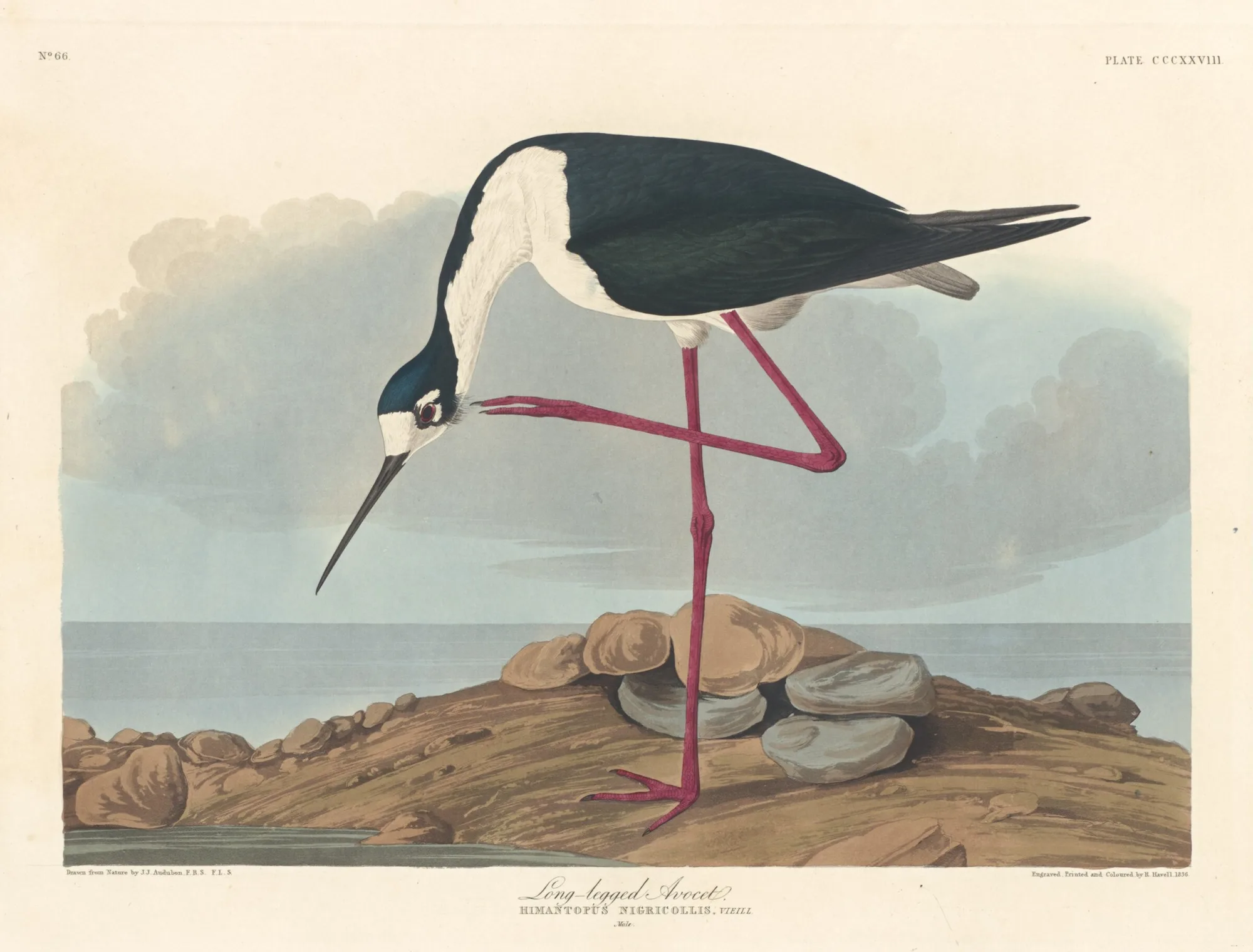
Audubon's “Long-legged Avocet”, The Birds of America, plate CCCXXVIII
Click or press Enter to enlarge
Open the full-resolution image (2861 px, National Gallery of Art)
| Plate | 328 (CCCXXVIII) |
|---|---|
| Audubon's name | Long-legged Avocet |
| Modern name | Black-necked Stilt |
| Scientific name | Himantopus mexicanus |
| Status | Least Concern |
| Engraved by | Robert Havell, after Audubon's watercolor |
| Date | 1836 |
| Medium | Hand-colored engraving and aquatint on Whatman wove paper |
| Size | plate: 37.8 x 52.1 cm (14 7/8 x 20 1/2 in.) sheet: 67.6 x 68 cm (26 5/8 x 26 3/4 in.) |
| Collections | Shorebirds, Rails and Cranes |
| This impression | National Gallery of Art, Washington, 1945.8.328; Gift of Mrs. Walter B. James |
About this plate
Plate 328 shows an adult male Black-necked Stilt. It is black above and white below, with a white spot over the eye, a needle-thin black bill and very long pink-red legs. In proportion to its body, the stilt's legs are among the longest of any bird. The Havell plate calls it the Long-legged Avocet, while the OB chapter uses Black-necked Stilt.
Audubon's Himantopus nigricollis is now Himantopus mexicanus. Some authorities treat it as a race of the Black-winged Stilt of the Old World, H. himantopus, but the AOS keeps it as a species. Stilts are close relatives of avocets, which explains the plate title. Its loud, yapping kek-kek calls earned it the old name Lawyer Bird.
Black-necked Stilts breed in shallow wetlands, salt ponds and flooded fields in the western United States, along the Gulf and southern Atlantic coasts, and south through Central America and the Caribbean to South America. The Hawaiian race is listed as endangered. Stilts were heavily shot on the Atlantic coast in the nineteenth century and have since spread back north. The IUCN lists the species as Least Concern.
Audubon saw the first arrivals at Galveston Bay in April 1837, in small flocks that split into pairs on brackish ponds. He, Edward Harris and his son disputed earlier writers' claim that the stilt walks with a staggering gait. He also noted the whistling cry of birds in flight and the cleek, cleek of birds with nests.
In Audubon's words
In April 1837, I observed their first appearance at Galveston Bay in Texas, where many remained until our departure. They were in small flocks, seldom composed of more than seven or eight individuals, which almost immediately separated into parties of two or three, and commenced their search for food. They kept about the small shallow brackish ponds on the islands of the bay, and now and then were observed following the sinuosities of bayous in company with other birds. They were much more shy than they are while breeding, and it was with some difficulty that we procured specimens. When one was killed, the rest would fly to a considerable distance, sometimes from one island to another, in a rapid manner, with regular beats of the wings, their necks and legs extended.
John James Audubon, Ornithological Biography, vol. 4 (1838), “Black-necked Stilt”. Read the full chapter.



