Common Merganser (Plate 331)
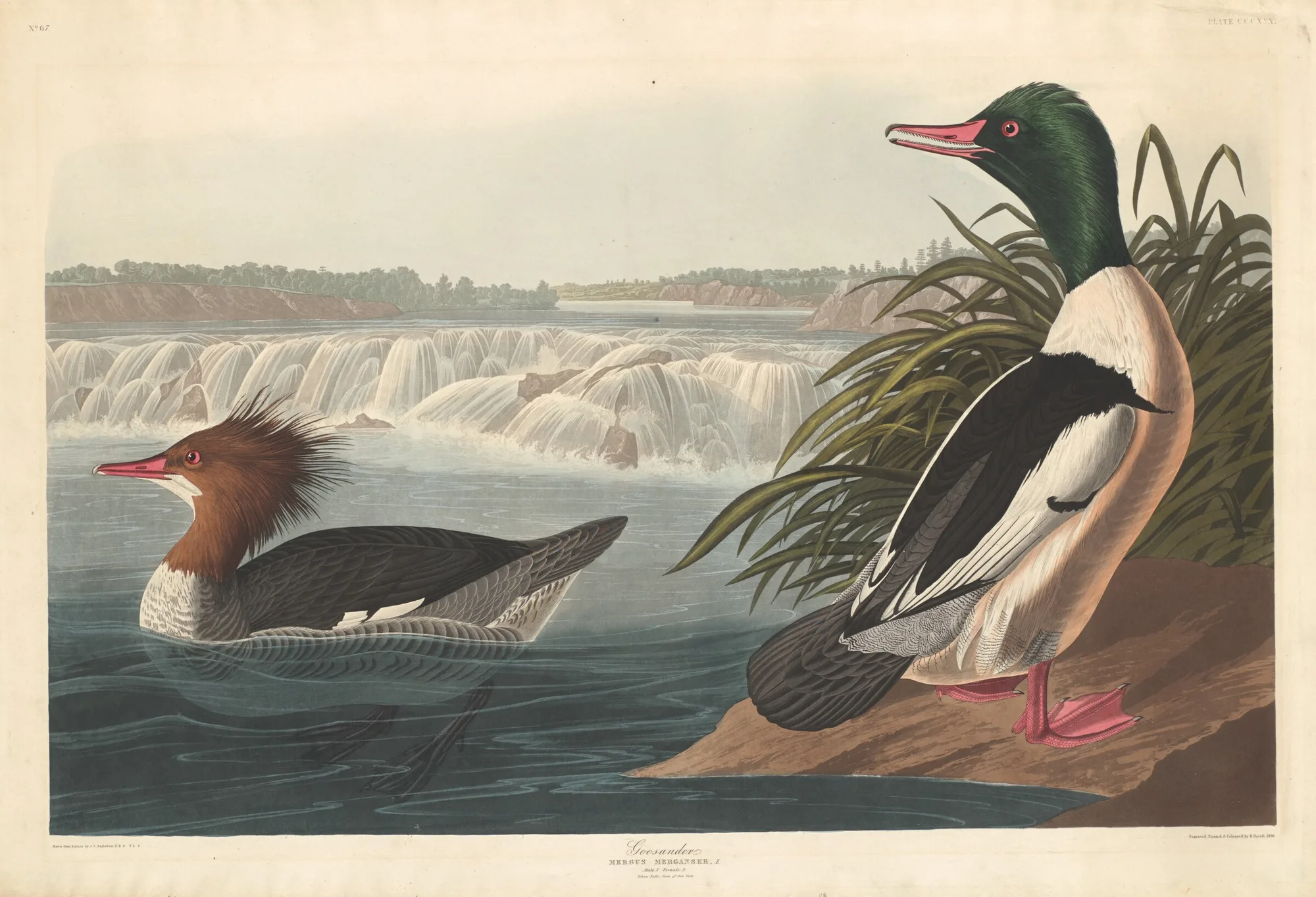
Audubon's “Goosander”, The Birds of America, plate CCCXXXI
Click or press Enter to enlarge
Open the full-resolution image (5422 px, National Gallery of Art)
| Plate | 331 (CCCXXXI) |
|---|---|
| Audubon's name | Goosander |
| Modern name | Common Merganser |
| Scientific name | Mergus merganser |
| Status | Least Concern |
| Engraved by | Robert Havell, after Audubon's watercolor |
| Date | 1836 |
| Medium | Hand-colored engraving and aquatint on Whatman wove paper |
| Collections | Ducks, Geese and Swans |
| This impression | National Gallery of Art, Washington, 1945.8.331; Gift of Mrs. Walter B. James |
About this plate
Plate 331 shows a male and a female of the large fish-eating duck Audubon called the Goosander. The male is white below with a dark green head. The female has a grey body and a shaggy rufous head. Both have the long, narrow, saw-edged red bill of the mergansers.
The bird is the Common Merganser, Mergus merganser. Goosander is still its standard name in Britain and Europe. The American population is sometimes treated as a separate subspecies, M. m. americanus. Audubon noted that Louisiana hunters called it the Bec-scie-de-mer and that it was poor eating, being fishy, oily and tough.
Common Mergansers breed on rivers and lakes across the northern forests of North America and Eurasia. They nest in tree cavities and winter wherever water stays open. They feed mainly on fish caught on long dives. The species is listed as Least Concern.
In the Ornithological Biography Audubon said that he had collected the bird in Texas in April 1837 and seen a large flock in Galveston Bay that May. He also kept captives and recorded that they ate more than two dozen four-inch fish four times a day.
In Audubon's words
It usually swims and dives against the current, and close by the shores, extricating itself from floating ice by passing under it. Its voracity is great, so that it consumes an extraordinary quantity of fish. I have found fishes in its stomach seven inches in length, and of smaller kinds so many as to weigh more than half a pound. Digestion takes place with great rapidity, insomuch that some which I have fed in captivity devoured more than two dozen of fishes about four inches in length, four times daily, and yet always seemed to be desirous of more.
John James Audubon, Ornithological Biography, vol. 4 (1838), “Goosander”. Read the full chapter.