Semipalmated Plover (Plate 330)
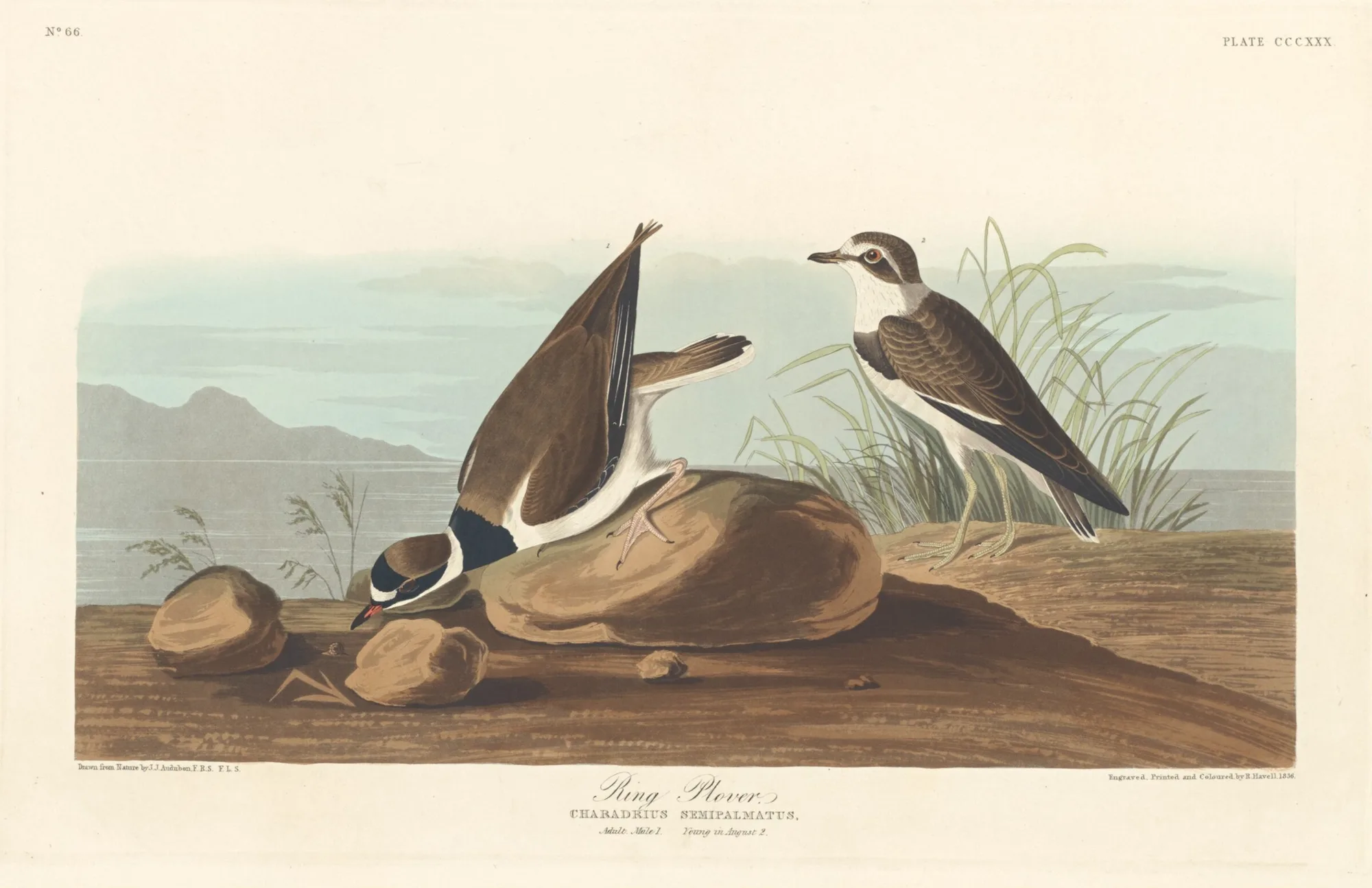
Audubon's “Ring Plover”, The Birds of America, plate CCCXXX
Click or press Enter to enlarge
Open the full-resolution image (2742 px, National Gallery of Art)
| Plate | 330 (CCCXXX) |
|---|---|
| Audubon's name | Ring Plover |
| Modern name | Semipalmated Plover |
| Scientific name | Charadrius semipalmatus |
| Status | Least Concern |
| Engraved by | Robert Havell, after Audubon's watercolor |
| Date | 1836 |
| Medium | Hand-colored engraving and aquatint on Whatman wove paper |
| Collections | Shorebirds, Rails and Cranes |
| This impression | National Gallery of Art, Washington, 1945.8.330; Gift of Mrs. Walter B. James |
About this plate
Plate 330 shows a male Semipalmated Plover and a young bird. The male has a brown back, a single black breast band, a white forehead and collar, an orange bill tipped black and orange legs. The young bird is duller, with a brown band and dark bill. The OB chapter names the species the American Ring Plover.
Audubon used Bonaparte's name, Charadrius semipalmatus, which is still current. The name refers to the small webs between the bases of the toes. It is the American counterpart of the Common Ringed Plover of Eurasia, which is very similar but lacks the webs and has a different call.
Semipalmated Plovers breed on gravel, sand and moss across Arctic and sub-Arctic North America, from Alaska to Labrador and Nova Scotia. They winter on beaches and mudflats from the southern United States to southern South America. They feed in a run-stop-peck manner, and their call is a rising chu-wee. The IUCN lists the species as Least Concern.
Audubon saw them almost everywhere he landed on the way to Labrador in 1833, and he found them breeding at Natashquan. He noted that they leave the beaches and nest on mossy uplands. His party was charmed by their tactics. A bird that had been seen would freeze, squat on the moss or bare rock, then run off with drooping wings. Parents with young would beat the ground with their wings as if crippled.
In Audubon's words
On my way to Labrador, I saw some of them in almost every place at which we landed; and when I reached Nastasguan Bay, they were breeding in all the spots that were adapted for that purpose. Their manners formed an agreeable subject of observation to all the members of my party. As soon as one of us was noticed by a Ring Plover, it would at once stand still and become silent. If we did the same, it continued, and seldom failed to wear out our patience. If we advanced, it would lower itself and squat on the moss or bare rock until approached, when it would suddenly rise on its feet, droop its wings, depress its head, and run with great speed to a considerable distance, uttering all the while a low rolling and querulous cry, very pleasing to the ear.
John James Audubon, Ornithological Biography, vol. 4 (1838), “American Ring Plover”. Read the full chapter.