Labrador Duck (Plate 332)
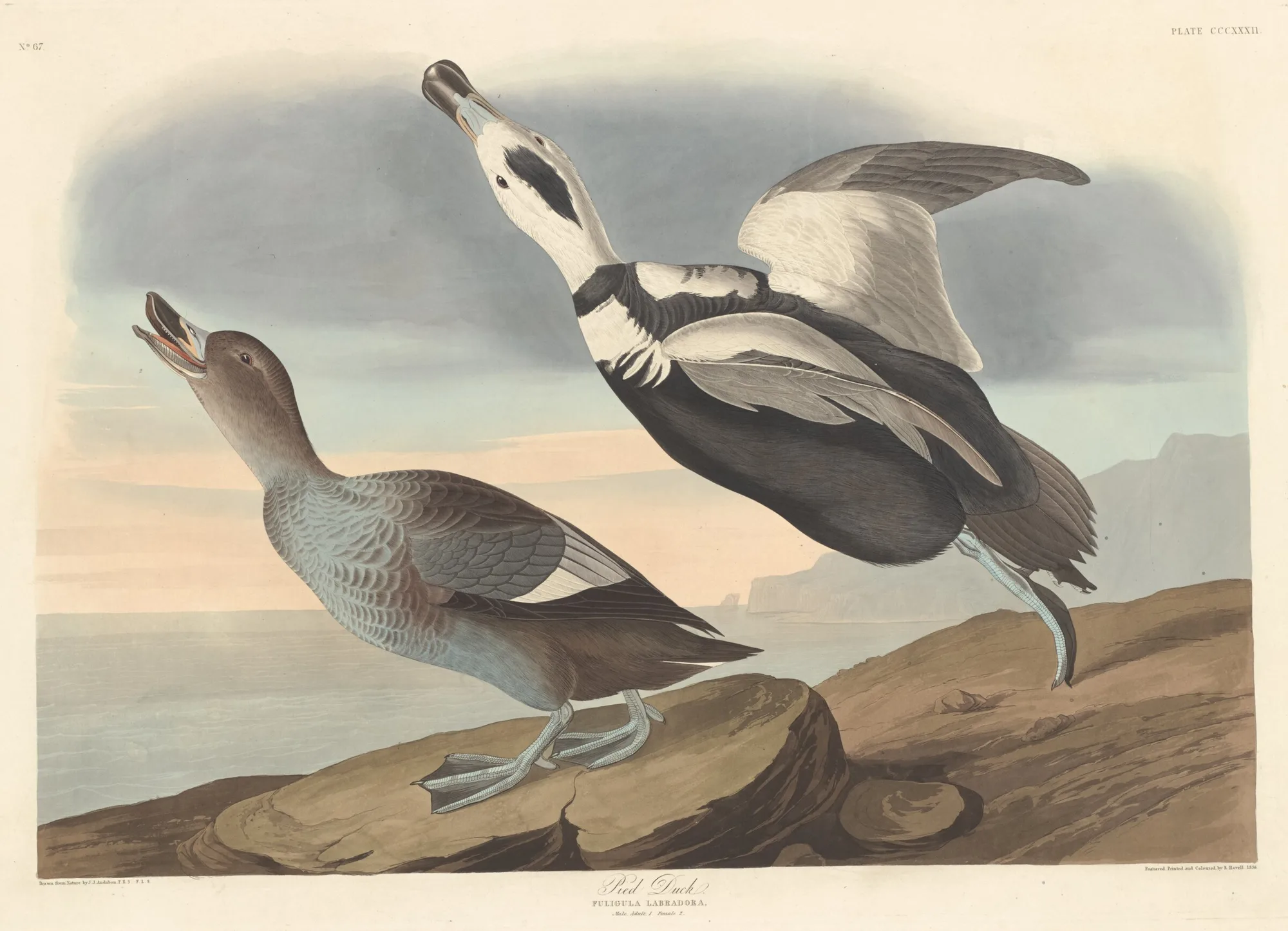
Audubon's “Pied Duck”, The Birds of America, plate CCCXXXII
Click or press Enter to enlarge
Open the full-resolution image (4174 px, National Gallery of Art)
| Plate | 332 (CCCXXXII) |
|---|---|
| Audubon's name | Pied Duck |
| Modern name | Labrador Duck |
| Scientific name | Camptorhynchus labradorius |
| Status | Extinct |
| Engraved by | Robert Havell, after Audubon's watercolor |
| Date | 1836 |
| Medium | Hand-colored engraving and aquatint on Whatman wove paper |
| Collections | Ducks, Geese and Swans, Extinct Birds |
| This impression | National Gallery of Art, Washington, 1945.8.332; Gift of Mrs. Walter B. James |
About this plate
Plate 332 shows a male and a female Labrador Duck, which Audubon called the Pied Duck. The male is boldly black and white, with a white head and neck and a black collar. The female is a plain brownish grey. Audubon admitted in the text that the female he figured was not an old bird.
This is one of the few paintings of the Labrador Duck made from freshly killed birds. Audubon drew the pair from specimens shot on the Vineyard Islands off Massachusetts and sent to him by Daniel Webster, the Boston statesman. He believed the female had not been figured before.
The Labrador Duck wintered along the Atlantic coast from Nova Scotia to Chesapeake Bay and fed on shellfish in shallow sandy bays. Its breeding grounds were never documented. Audubon's son John Woodhouse found deserted nests at Blanc Sablon in July 1833 that an English clerk said belonged to this species, but that record is not proven. The last confirmed specimen was shot off Long Island in 1875, and the species is extinct. Fewer than sixty specimens survive in museums.
Audubon never saw a living Labrador Duck in Labrador. He knew it from markets in Baltimore and from a Camden bird-stuffer who caught them on baited trot-lines in the Delaware River.
In Audubon's words
The range of this species along our shores does not extend farther southward than Chesapeake Bay, where I have seen some near the influx of the St James River. I have also met with several in the Baltimore market. Along the coast of New Jersey and Long Island it occurs in greater or less number every year. It also at times enters the Delaware River in Pennsylvania, and ascends that stream at least as far as Philadelphia. A bird-stuffer whom I knew at Camden had many fine specimens, all of which he had procured by baiting fish-hooks with the common mussel, on a “trot-line” sunk a few feet beneath the surface, but on which he never found one alive, on account of the manner in which these Ducks dive and flounder when securely hooked.
John James Audubon, Ornithological Biography, vol. 4 (1838), “Pied Duck”. Read the full chapter.