Mallard x Gadwall hybrid (Plate 338)
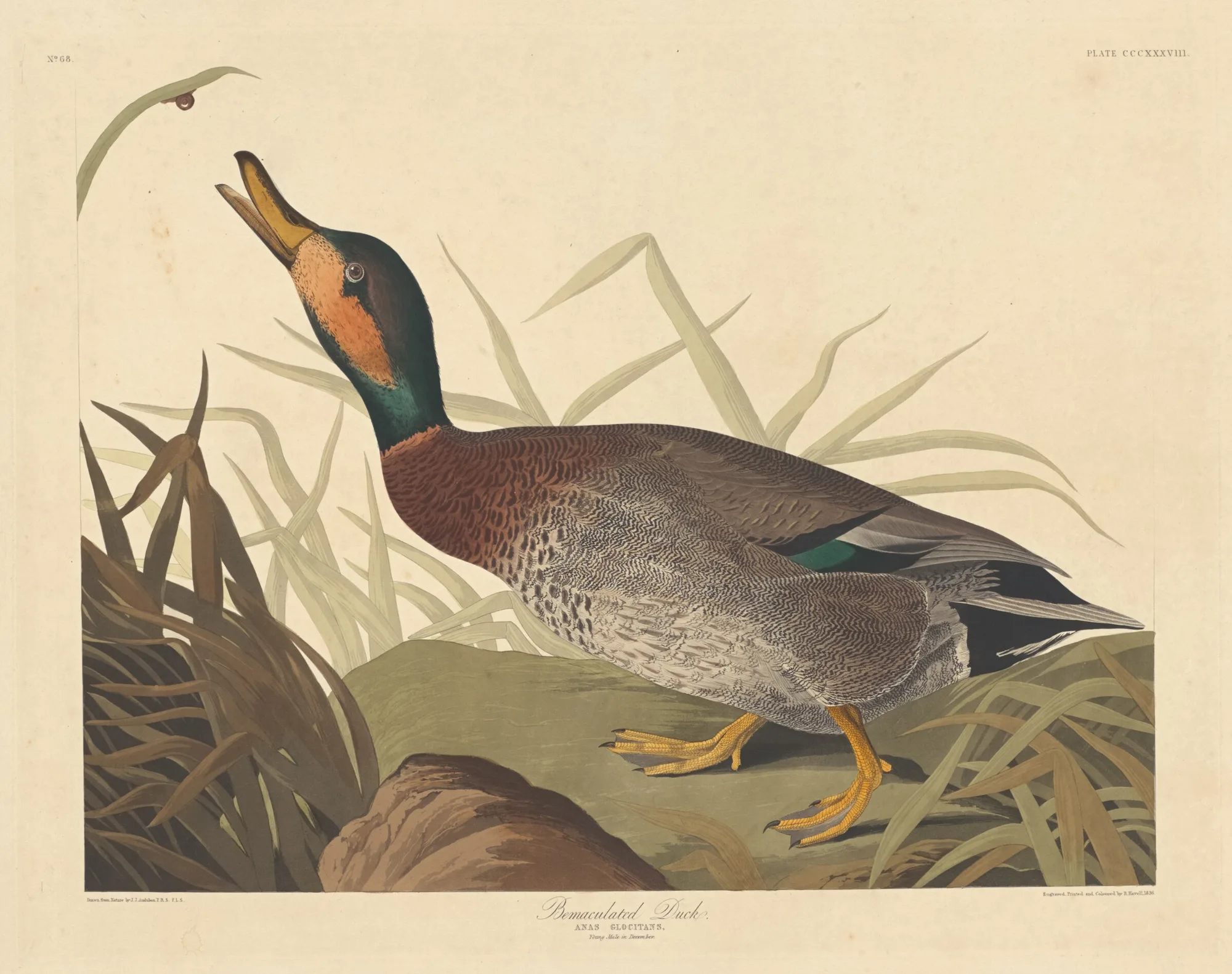
Audubon's “Bemaculated Duck”, The Birds of America, plate CCCXXXVIII
Click or press Enter to enlarge
Open the full-resolution image (3459 px, National Gallery of Art)
| Plate | 338 (CCCXXXVIII) |
|---|---|
| Audubon's name | Bemaculated Duck |
| Modern name | Mallard x Gadwall hybrid (Brewer's Duck) |
| Scientific name | Anas platyrhynchos x Mareca strepera |
| Status | Least Concern |
| Engraved by | Robert Havell, after Audubon's watercolor |
| Date | 1836 |
| Medium | Hand-colored engraving and aquatint on Whatman wove paper |
| Collections | Ducks, Geese and Swans |
| This impression | National Gallery of Art, Washington, 1945.8.338; Gift of Mrs. Walter B. James |
About this plate
Plate 338 shows a single male duck. It looks much like a Mallard but has a narrower bill, no curled tail feathers, dull yellow feet, and a large reddish patch on the side of the head.
Audubon shot the bird on Lake Barataria, Louisiana, in February 1822, in company with a few Canvasbacks. The plate names it Anas glocitans, the Baikal Teal, because he first thought it matched descriptions of that Asian species. After comparing his drawing with specimens in the Zoological Society of London, he saw the identification was wrong. In the Ornithological Biography he renamed it Brewer's Duck, Anas breweri, after his Boston friend Thomas Brewer.
Audubon himself suggested it might be a hybrid between the Mallard and some other species, perhaps the Gadwall. That is the modern view. Mallard and Gadwall hybrids occur in the wild from time to time, and the plate is now cited as an early illustration of one. Because it is a hybrid, there is no separate species or conservation status. The status given here is that of both parent species, which are common.
He never found a second bird, and this is one of several Audubon plates that depict an individual rather than a true species.
In Audubon's words
The beautiful Duck from which I made the drawing copied on the plate before you, was shot on Lake Barataria, in Louisiana, in February 1822. It was in company with seven or eight Canvass-back Ducks. No other individuals of the species were in sight at the time, and all my efforts to procure another have been ineffectual. You will see that this curious bird is named in the plate “Anas glocitans,” the descriptions of that species having induced me to consider it identical with this. But on comparing my drawing with specimens in the Museum of the Zoological Society of London, I found that the former represents a much larger bird, which, besides, is differently coloured in some of its parts. The individual figured was a male; but I have some doubts whether it had acquired the full beauty of its mature plumage, and I considered it at the time as a bird of the preceding season.
John James Audubon, Ornithological Biography, vol. 4 (1838), “Brewer's Duck”. Read the full chapter.