Dovekie (Plate 339)
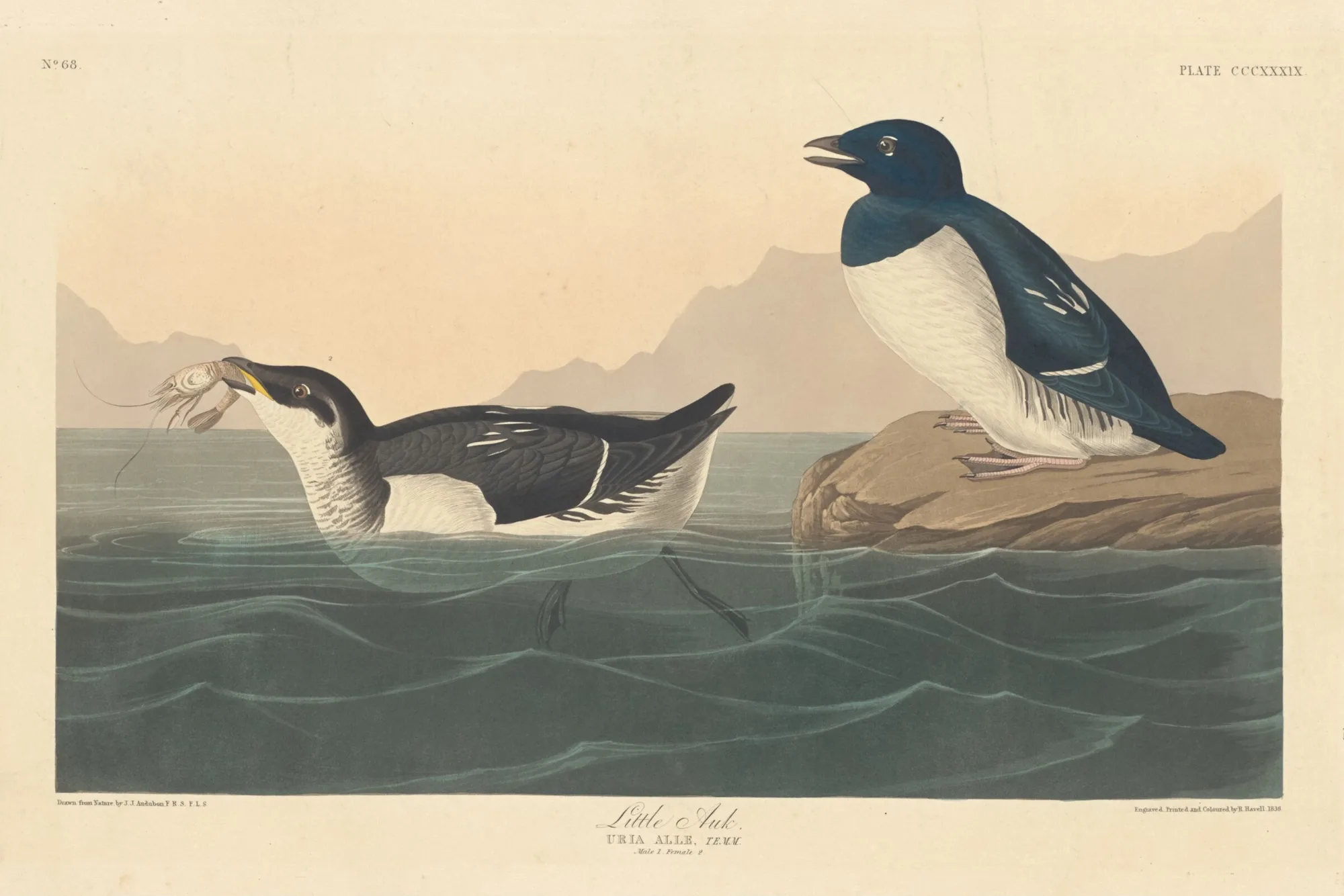
Audubon's “Little Auk”, The Birds of America, plate CCCXXXIX
Click or press Enter to enlarge
Open the full-resolution image (2792 px, National Gallery of Art)
| Plate | 339 (CCCXXXIX) |
|---|---|
| Audubon's name | Little Auk |
| Modern name | Dovekie (Little Auk) |
| Scientific name | Alle alle |
| Status | Least Concern |
| Engraved by | Robert Havell, after Audubon's watercolor |
| Date | 1836 |
| Medium | Hand-colored engraving and aquatint on Whatman wove paper |
| Collections | Seabirds |
| This impression | National Gallery of Art, Washington, 1945.8.339; Gift of Mrs. Walter B. James |
About this plate
Plate 339 shows a pair of Dovekies, which Audubon called the Little Auk on the plate and the Little Guillemot in the text. They are stubby black and white seabirds with tiny bills, about the size of a starling.
The bird is Alle alle. Its standard name in North America is Dovekie, while British and international lists call it Little Auk. It is the only member of its genus. Audubon's figures are of adults in summer plumage, with a dark throat.
Dovekies breed in enormous colonies in rock scree on Greenland, Svalbard and other high Arctic islands. They feed on tiny crustaceans, which they carry to their chicks in a throat pouch. In winter they move into the North Atlantic, and storms sometimes drive them onto the coast and even far inland. The species is listed as Least Concern and is one of the most numerous seabirds in the world.
Audubon wrote that he often saw small groups from ships on his Atlantic crossings and that some birds were so heedless that sailors killed them with oars. He found none breeding in Labrador or Newfoundland, although cod fishermen told him they did. He also noted storm-driven birds caught exhausted in Passamaquoddy Bay near Eastport and around Boston and Salem.
In Audubon's words
In the course of my voyages across the Atlantic, I have often observed the Little Guillemots in small groups, rising and flying to short distances at the approach of the ship, or diving close to the bow and reappearing a little way behind. Now with expanded wings they would flutter and run as it were on the surface of the deep; again, they would seem to be busily engaged in procuring food, which consisted apparently of shrimps, other crustacea, and particles of sea-weeds, all of which I have found in their stomach. I have often thought how easy it would be to catch these tiny wanderers of the ocean with nets thrown expertly from the bow of a boat, for they manifest very little apprehension of danger from the proximity of one, insomuch that I have seen several killed with the oars.
John James Audubon, Ornithological Biography, vol. 4 (1838), “Little Guillemot”. Read the full chapter.



