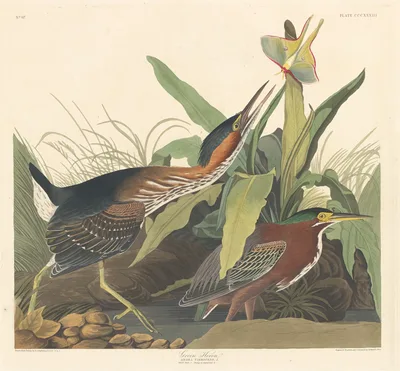
American Bittern (Plate 337)
Audubon's “American Bittern”, The Birds of America, plate CCCXXXVII
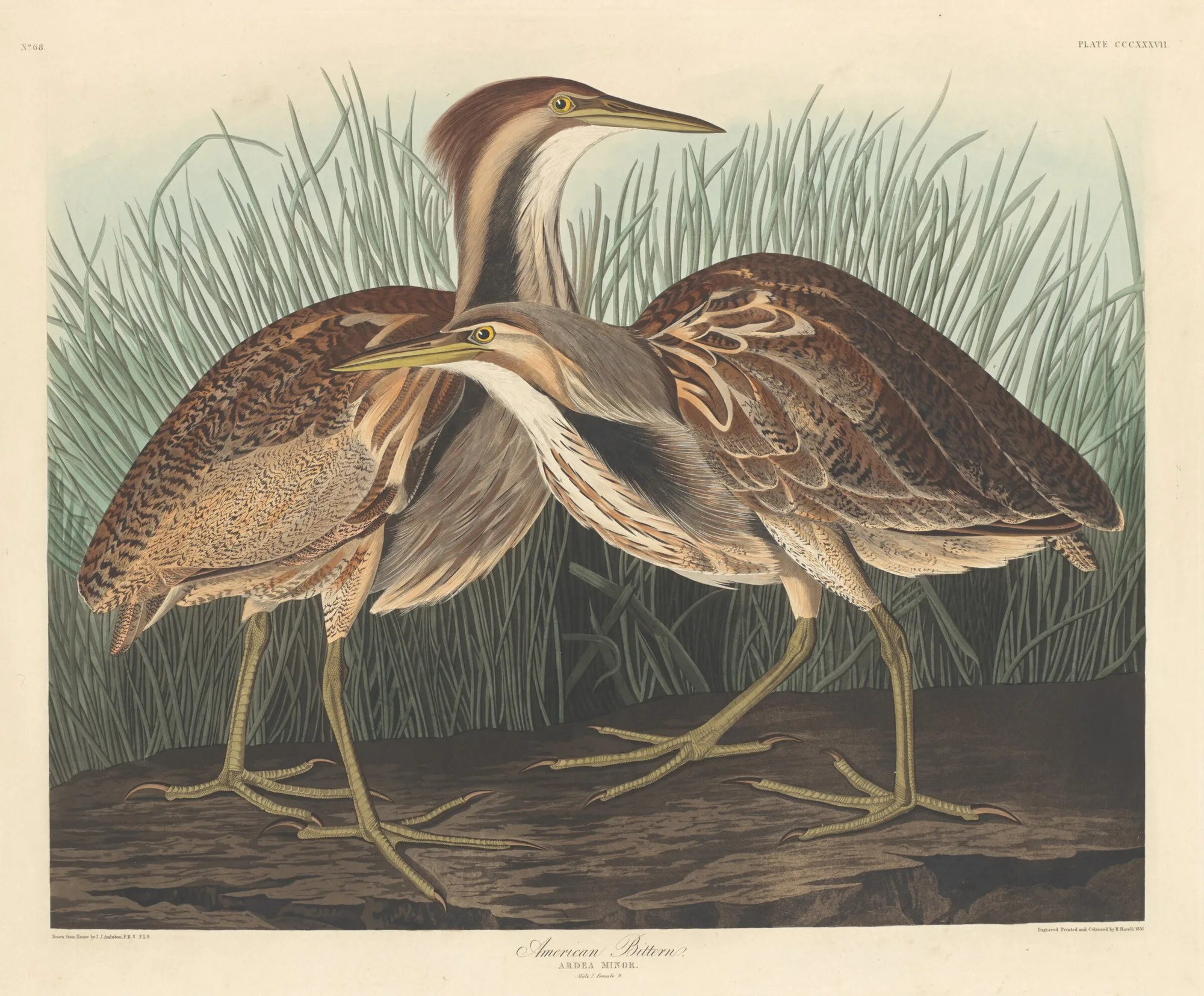
Click or press Enter to enlarge
Open the full-resolution image (3975 px, National Gallery of Art)
| Plate | 337 (CCCXXXVII) |
|---|---|
| Audubon's name | American Bittern |
| Modern name | American Bittern |
| Scientific name | Botaurus lentiginosus |
| Status | Least Concern |
| Engraved by | Robert Havell, after Audubon's watercolor |
| Date | 1836 |
| Medium | Hand-colored engraving and aquatint on Whatman wove paper |
| Collections | Herons and Egrets |
| This impression | National Gallery of Art, Washington, 1945.8.337; Gift of Mrs. Walter B. James |
About this plate
Plate 337 shows a male and a female American Bittern. Both are streaked brown and buff, with a black stripe down the side of the neck. Their pattern hides them among reeds, especially when they freeze with the bill pointed upward.
Audubon called it Ardea minor, following Wilson. The modern name is Botaurus lentiginosus. It is a heron, but bitterns are short-legged, secretive birds of dense marsh rather than open shallows.
American Bitterns breed in freshwater marshes across Canada and the northern United States and winter in the southern states and Mexico. The male's spring call is a deep, pumping 'oonk-a-lunk' that carries a long way. Draining of wetlands has reduced numbers in many areas, but IUCN lists the species as Least Concern.
Audubon was frank that he knew the bird poorly. He never found a nest and never heard the booming call, or was not sure he had. In Lower Louisiana he learned the name Garde Soleil, from the belief that it stood for hours staring at the sun. He also noted that it was sold in New Orleans markets for gumbo and that elsewhere it was called the Indian Hen.
In Audubon's words
In Lower Louisiana, it is called the “Garde Soleil,” because they say it will stand on one foot for hours, with its eyes, or one of them at least, fixed on the orb of day, and frequently spread out its wings, in the manner of Cormorants and Vultures, to enjoy the heat, or perhaps the gentle breeze. There it is seldom obtained in spring, but is a regular autumnal visitant, appearing early in October, and frequenting the marshes both of fresh and salt water, where many remain until the beginning of May. It is then common in the markets of New Orleans, where it is bought by the poorer classes to make gombo soup. In almost every other part of the United States it is commonly called the “Indian Pullet,” or “Indian Hen.”
John James Audubon, Ornithological Biography, vol. 4 (1838), “American Bittern”. Read the full chapter.