European Storm Petrel (Plate 340)
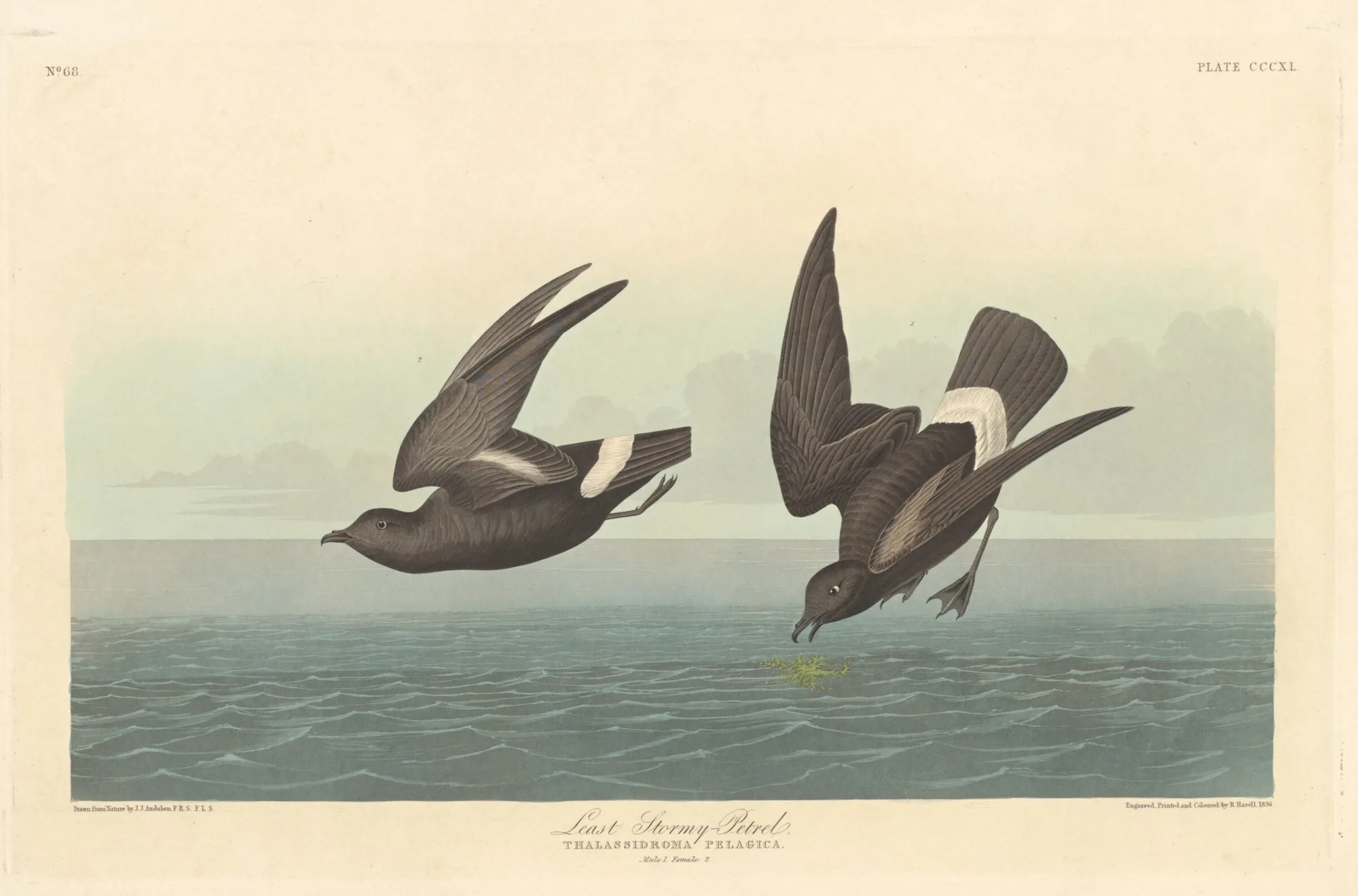
Audubon's “Least Stormy Petrel”, The Birds of America, plate CCCXL
Click or press Enter to enlarge
Open the full-resolution image (2824 px, National Gallery of Art)
| Plate | 340 (CCCXL) |
|---|---|
| Audubon's name | Least Stormy Petrel |
| Modern name | European Storm Petrel |
| Scientific name | Hydrobates pelagicus |
| Status | Least Concern |
| Engraved by | Robert Havell, after Audubon's watercolor |
| Date | 1836 |
| Medium | Hand-colored engraving and aquatint on Whatman wove paper |
| Collections | Seabirds |
| This impression | National Gallery of Art, Washington, 1945.8.340; Gift of Mrs. Walter B. James |
About this plate
Plate 340 shows two tiny dark petrels, a male and a female. They are sooty black with a white rump and a thin white bar on the underwing.
Audubon's Least Petrel, Thalassidroma pelagica, is the European Storm Petrel, Hydrobates pelagicus. It is the smallest seabird of the North Atlantic. It breeds on islands off northwest Europe and in the Mediterranean and winters off southern Africa. It is very rare in North American waters.
Audubon said he collected several birds of this species from a mixed flock of Leach's and Wilson's Storm Petrels while becalmed on the Newfoundland banks, and he dated this to August 1830. Given how rarely the species is recorded in the western Atlantic, modern readers treat that record with caution. For breeding habits he quoted at length the English naturalist William Hewitson, who caught birds in their burrows in the Shetland Islands and kept two alive in his room.
European Storm Petrels nest in crevices and burrows and visit their colonies only at night to avoid gulls and skuas. The species is listed as Least Concern, though rats and other introduced predators threaten some colonies.
In Audubon's words
In August 1830, being becalmed on the banks of Newfoundland, I obtained several individuals of this species from a flock composed chiefly of Thalassidroma Leachii, and Th. Wilsoni. Their smaller size, and the more rapid motions of their wings, rendered them quite conspicuous, and suggested the idea of their being a new species, although a closer inspection shewed them to belong to the present. In their general manners, while feeding, floating on the water, or rambling round the boat in which I went in pursuit of them, they did not differ materially from the other species. Their flight, however, was more hurried and irregular, and none of them uttered any note or cry, even when wounded and captured.
John James Audubon, Ornithological Biography, vol. 4 (1838), “Least Petrel”. Read the full chapter.