Great Auk (Plate 341)
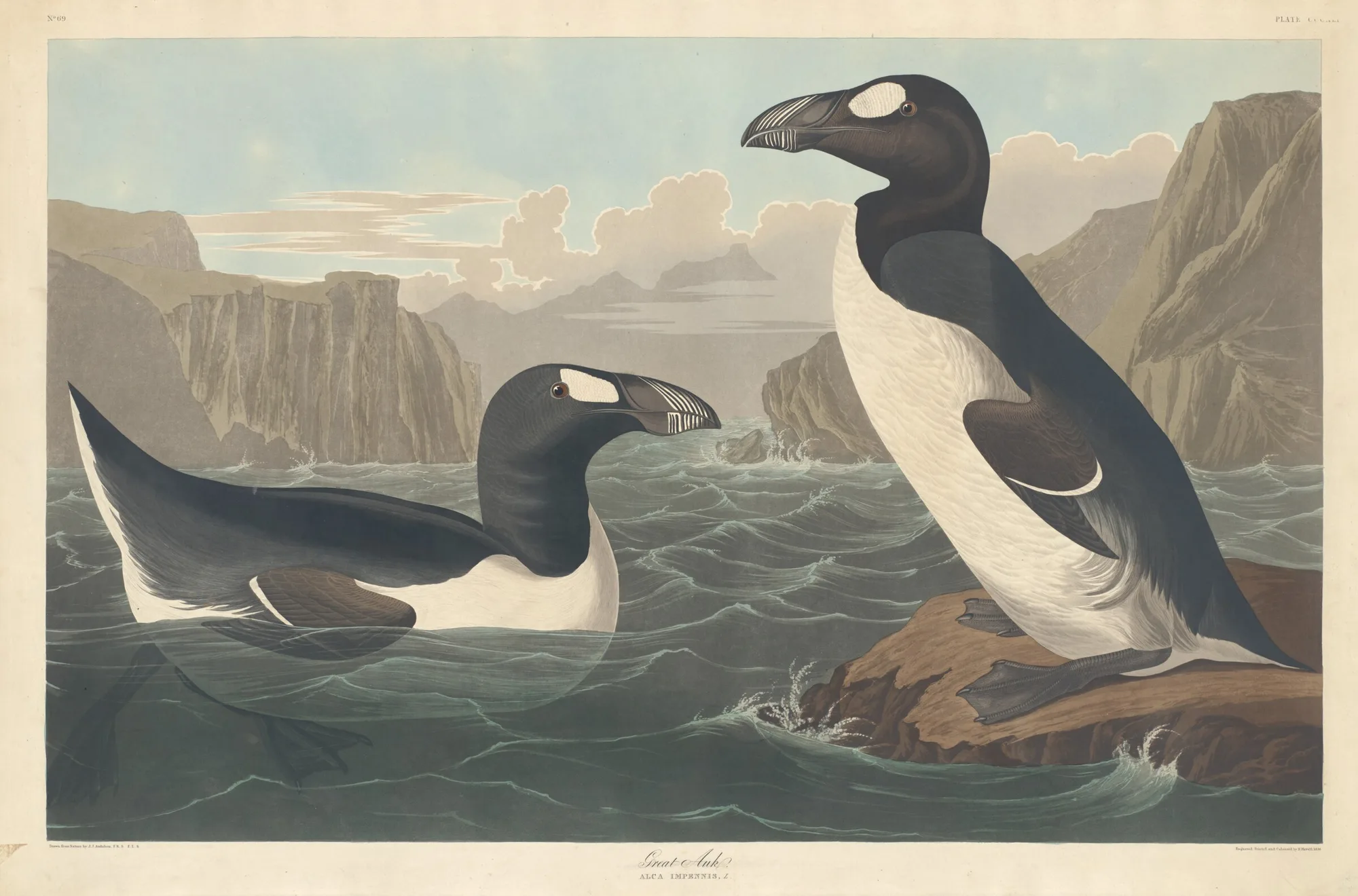
Audubon's “Great Auk”, The Birds of America, plate CCCXLI
Click or press Enter to enlarge
Open the full-resolution image (5470 px, National Gallery of Art)
| Plate | 341 (CCCXLI) |
|---|---|
| Audubon's name | Great Auk |
| Modern name | Great Auk |
| Scientific name | Pinguinus impennis |
| Status | Extinct |
| Engraved by | Robert Havell, after Audubon's watercolor |
| Date | 1836 |
| Medium | Hand-colored engraving and aquatint on Whatman wove paper |
| Collections | Seabirds, Extinct Birds |
| This impression | National Gallery of Art, Washington, 1945.8.341; Gift of Mrs. Walter B. James |
About this plate
Plate 341 shows two adult Great Auks in summer plumage. They have black backs, white fronts, a white patch in front of each eye, and a deep, grooved bill. The text refers to figures 1 and 2 of a single adult type.
The Great Auk is Pinguinus impennis. Audubon used Linnaeus's name Alca impennis. Sailors and fishermen called it the Penguin, and the name was later given to the unrelated birds of the Southern Hemisphere. It stood about 75 to 85 centimetres tall and could not fly.
Great Auks bred on a few rocky islands, including Funk Island off Newfoundland, St Kilda and islands off Iceland. Sailors killed them in huge numbers for food, bait and feathers. The last confirmed pair was killed on Eldey, off Iceland, in June 1844, only a few years after this plate was issued.
Audubon never saw a live Great Auk. His only first-hand American report came from Henry Havell, brother of his engraver Robert Havell, who hooked one on the Newfoundland banks and kept it on deck for several days before releasing it. In Labrador and Newfoundland fishermen told him the birds still bred on a low island southeast of Newfoundland. An old gunner near Boston remembered them as plentiful around Nahant.
In Audubon's words
The only authentic account of the occurrence of this bird on our coast that I possess, was obtained from Mr Henry Havell, brother of my Engraver, who, when on his passage from New York to England, hooked a Great Auk on the banks of Newfoundland, in extremely boisterous weather. On being hauled on board, it was left at liberty on the deck. It walked very awkwardly, often tumbling over, bit every one within reach of its powerful bill; and refused food of all kinds. After continuing several days on board, it was restored to its proper element. When I was in Labrador, many of the fishermen assured me that the “Penguin,” as they name this bird, breeds on a low rocky island to the south-east of Newfoundland, where they destroy great numbers of the young for bait; but as this intelligence came to me when the season was too far advanced, I had no opportunity of ascertaining its accuracy.
John James Audubon, Ornithological Biography, vol. 4 (1838), “Great Auk”. Read the full chapter.
Great Auk (Plate 341): the story behind one of the most famous plates in the collection →