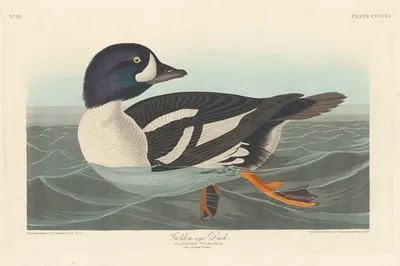
Common Goldeneye (Plate 342)
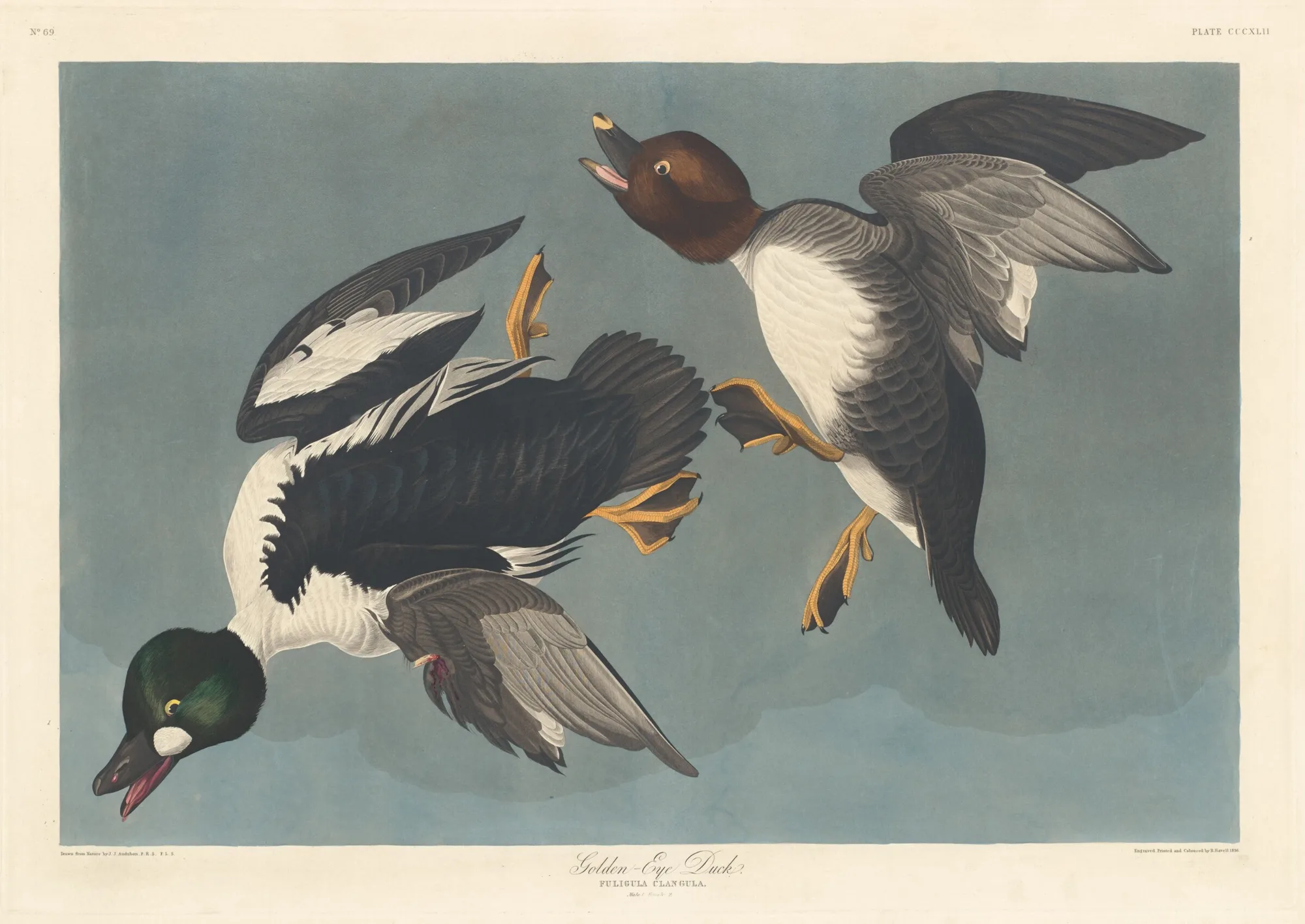
Audubon's “Golden-eye Duck”, The Birds of America, plate CCCXLII
Click or press Enter to enlarge
Open the full-resolution image (4355 px, National Gallery of Art)
| Plate | 342 (CCCXLII) |
|---|---|
| Audubon's name | Golden-eye Duck |
| Modern name | Common Goldeneye |
| Scientific name | Bucephala clangula |
| Status | Least Concern |
| Engraved by | Robert Havell, after Audubon's watercolor |
| Date | 1836 |
| Medium | Hand-colored engraving and aquatint on Whatman wove paper |
| Size | plate: 54.3 x 77.2 cm (21 3/8 x 30 3/8 in.) sheet: 67.6 x 101 cm (26 5/8 x 39 3/4 in.) |
| Collections | Ducks, Geese and Swans |
| This impression | National Gallery of Art, Washington, 1945.8.342; Gift of Mrs. Walter B. James |
About this plate
Plate 342 shows a male and a female Common Goldeneye. The male has a glossy green-black head with a round white spot before the eye, a white body and a black back. The female has a brown head and a grey body. Both have the bright yellow eye that gives the species its name.
The modern scientific name is Bucephala clangula. Audubon called it Fuligula clangula. Hunters call it the Whistler for the loud whistling of its wings in flight, which Audubon mentions in the text.
Common Goldeneyes breed in the boreal forests of North America and Eurasia. They nest in tree holes, often well away from water, and the ducklings jump from the nest a day or so after hatching. In winter they spread to open lakes, rivers and coastal bays. The species is listed as Least Concern.
Audubon's chapter opens with one of his warmest passages, addressed directly to the bird. He knew it on the rapids of the Ohio, in Massachusetts and Chesapeake bays, and in South Carolina rice reserves in winter. He described it as warier than most ducks and wrote that the female carried her young to the water in her bill. Modern observers report that the ducklings leap from the nest hole on their own.
In Audubon's words
Happy being! Equally fitted for travelling through the air and the water, and not altogether denied the pleasure of walking on the shore; endowed with a cunning, too, which preserves you from many at least of the attempts of man to destroy you; and instinctively sagacious enough to place your eggs deep in the hollow of a tree, where they are secure from the nocturnal prowler, and, amid the down of your snowy breast, are fostered until the expected young come forth. Then with your own bill you carry your brood to the lake, where under your tender care they grow apace. The winged marauders, rapid as their flight may be, cannot injure you there; for while your young ones sink into the deep waters, you arise on whistling wings, and, swifter than Jer Falcon, speed away.
John James Audubon, Ornithological Biography, vol. 4 (1838), “Golden-eye Duck”. Read the full chapter.