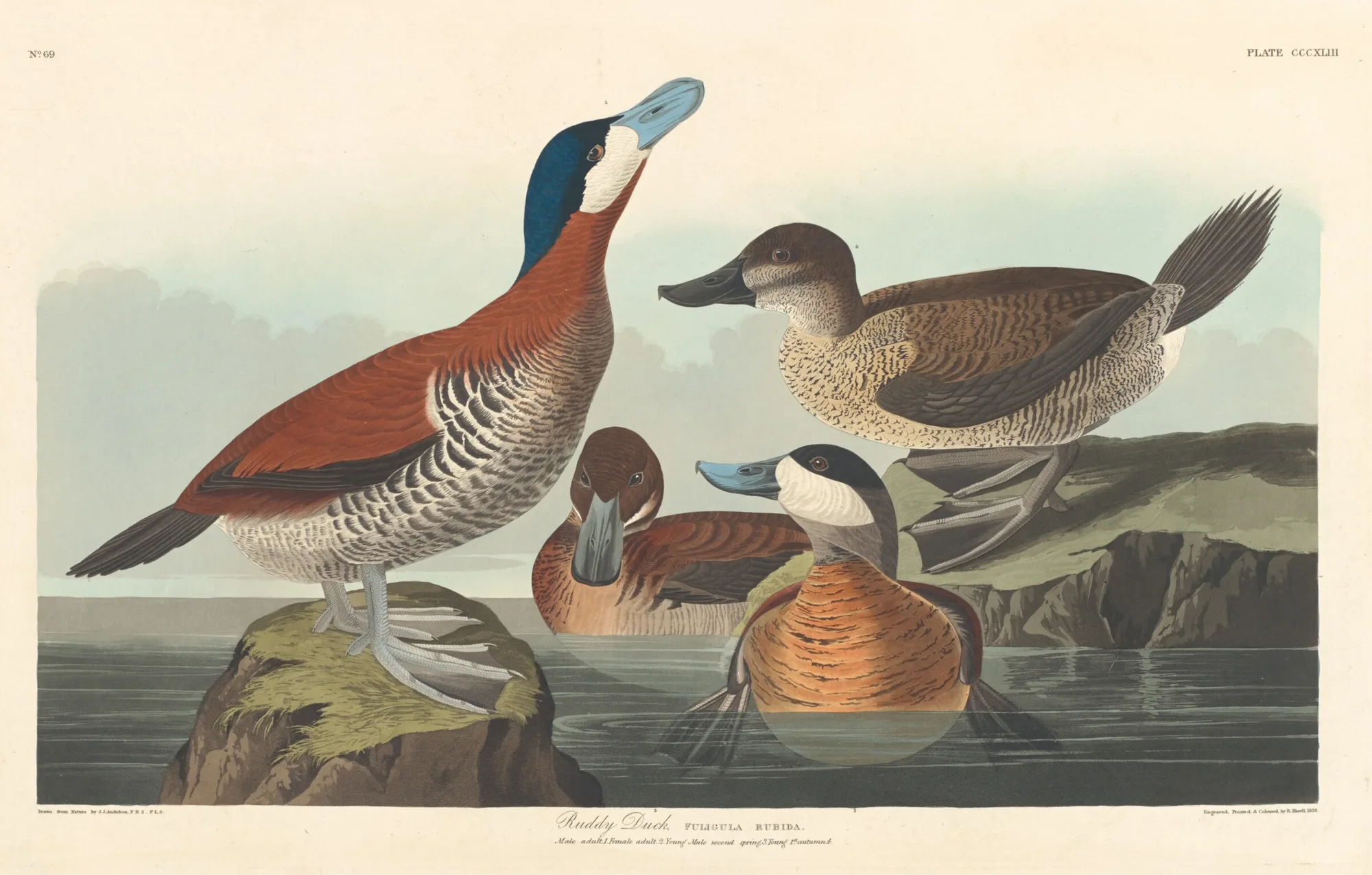
Ruddy Duck (Plate 343)
Audubon's “Ruddy Duck”, The Birds of America, plate CCCXLIII
Click or press Enter to enlarge
Open the full-resolution image (3682 px, National Gallery of Art)
| Plate | 343 (CCCXLIII) |
|---|---|
| Audubon's name | Ruddy Duck |
| Modern name | Ruddy Duck |
| Scientific name | Oxyura jamaicensis |
| Status | Least Concern |
| Engraved by | Robert Havell, after Audubon's watercolor |
| Date | 1836 |
| Medium | Hand-colored engraving and aquatint on Whatman wove paper |
| Collections | Ducks, Geese and Swans |
| This impression | National Gallery of Art, Washington, 1945.8.343; Gift of Mrs. Walter B. James |
About this plate
Plate 343 shows the Ruddy Duck, a small, compact diving duck with a large head, a broad bill and a stiff tail that is often cocked upright. Breeding males are chestnut red with a white cheek, a black cap and a bright blue bill. Females and winter males are brown with a pale cheek crossed by a dark line.
The modern name, Oxyura jamaicensis, is the same species Audubon knew. It belongs to the stiff-tailed ducks, a group that dives for food and rarely walks on land. Hunters called it the Butterball because birds in autumn were often very fat.
Ruddy Ducks breed in reedy marshes and prairie potholes from Canada to the southwestern United States, with resident populations in the Caribbean and the Andes. They winter on lakes and coastal bays farther south. Males court with a bubbling display, beating the bill against the inflated neck. The species is listed as Least Concern.
Birds brought to Britain for waterfowl collections escaped in the mid-twentieth century and spread into Europe. There they hybridised with the endangered White-headed Duck in Spain, which led Britain to run a programme to remove its feral Ruddy Ducks.