Stilt Sandpiper (Plate 344)
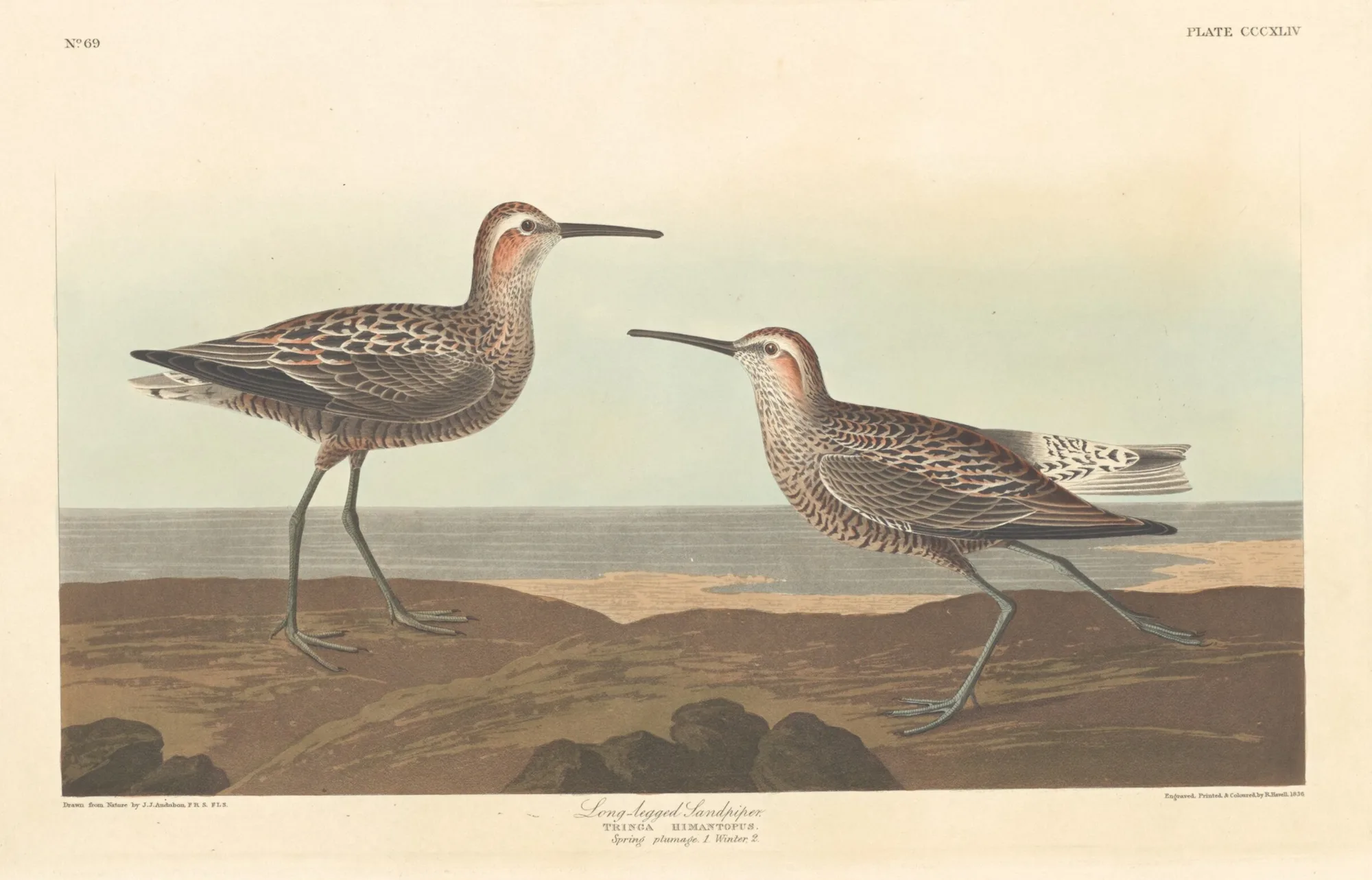
Audubon's “Long-legged Sandpiper”, The Birds of America, plate CCCXLIV
Click or press Enter to enlarge
Open the full-resolution image (2759 px, National Gallery of Art)
| Plate | 344 (CCCXLIV) |
|---|---|
| Audubon's name | Long-legged Sandpiper |
| Modern name | Stilt Sandpiper |
| Scientific name | Calidris himantopus |
| Status | Least Concern |
| Engraved by | Robert Havell, after Audubon's watercolor |
| Date | 1836 |
| Medium | Hand-colored engraving and aquatint on Whatman wove paper |
| Collections | Shorebirds, Rails and Cranes |
| This impression | National Gallery of Art, Washington, 1945.8.344; Gift of Mrs. Walter B. James |
About this plate
Plate 344 shows the Stilt Sandpiper, a slim wader with long greenish legs and a long bill that droops slightly at the tip. In breeding plumage it has a rusty ear patch and heavy barring below. In winter it is plain grey above and white below.
Audubon called it Tringa himantopus, the name given by Bonaparte, who first described it. The species is now Calidris himantopus. For a time it was placed in its own genus, Micropalama. Audubon pointed out that Richardson and Swainson had redescribed it as Tringa douglassii, an example of the confusion caused when birds of different ages and seasons were treated as separate species.
Stilt Sandpipers breed on wet tundra in Alaska and northern Canada and winter mostly in central South America. They migrate through the Great Plains. They feed in belly-deep water by probing straight down with rapid jabs. The species is listed as Least Concern.
On 4 April 1837 Audubon sat among the driftwood on the south shore of the island of Barataria, forty miles from the Southwest Pass of the Mississippi, while watching pelicans. A flock of about thirty Long-legged Sandpipers landed within ten steps of him. He watched them feed along the wash of the waves for about three quarters of an hour. He used birds shot from that flock to show how much individuals of one species can differ.
In Audubon's words
On the morning of the 4th of April 1837, while seated among the drift wood that had accumulated on the southern shore of the island of Barataria, forty miles from the south-west pass of the Mississippi, and occupied in observing some Pelicans, I saw a flock of about thirty Long-legged Sandpipers alight within ten steps of me, near the water. They immediately scattered, following the margin of the retiring and advancing waves, in search of food, which I could see them procure by probing the wet sand in the manner of Curlews, that is, to the full length of their bill, holding it for a short time in the sand, as if engaged in sucking up what they found. In this way they continued feeding on an extended line of shore of about thirty yards, and it was pleasing to see the alacrity with which they simultaneously advanced and retreated, according to the motions of the water.
John James Audubon, Ornithological Biography, vol. 4 (1838), “Long-legged Sandpiper”. Read the full chapter.