American Wigeon (Plate 345)
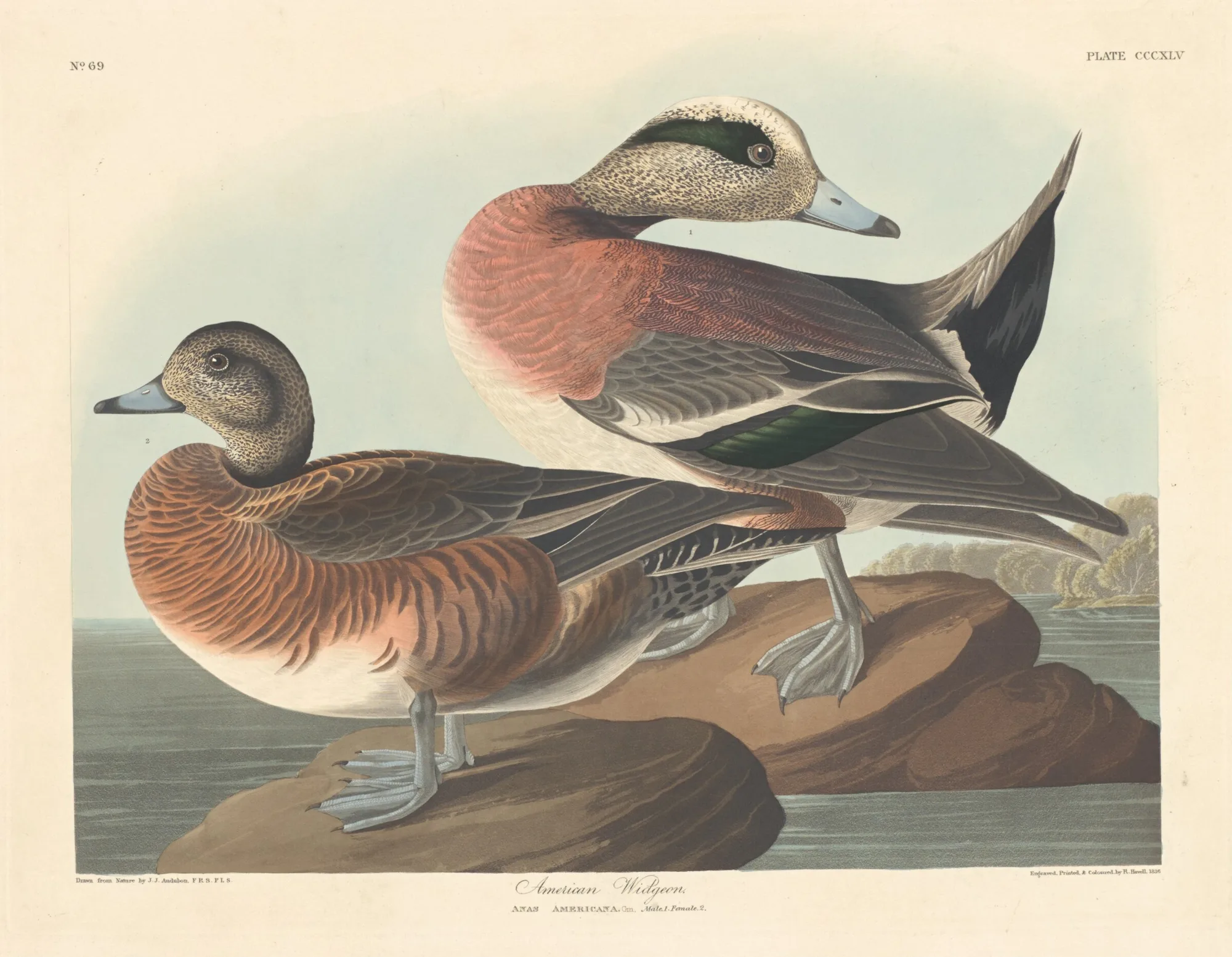
Audubon's “American Widgeon”, The Birds of America, plate CCCXLV
Click or press Enter to enlarge
Open the full-resolution image (2840 px, National Gallery of Art)
| Plate | 345 (CCCXLV) |
|---|---|
| Audubon's name | American Widgeon |
| Modern name | American Wigeon |
| Scientific name | Mareca americana |
| Status | Least Concern |
| Engraved by | Robert Havell, after Audubon's watercolor |
| Date | 1836 |
| Medium | Hand-colored engraving and aquatint on Whatman wove paper |
| Collections | Ducks, Geese and Swans |
| This impression | National Gallery of Art, Washington, 1945.8.345; Gift of Mrs. Walter B. James |
About this plate
Plate 345 shows a male and a female American Wigeon. The male has a white crown, a broad green stripe behind the eye, a pinkish brown body and a white wing patch. The female is greyish brown with a rusty tinge on the flanks.
Audubon's Anas americana is now placed in the genus Mareca, with the Gadwall and the Eurasian Wigeon, following DNA studies. The modern spelling is wigeon. The old name Baldpate refers to the male's white crown, which looks like a bald head at a distance.
American Wigeons breed in marshes and lakes of Alaska, western Canada and the northern prairies, and winter across the southern United States, Mexico and the Caribbean. They graze on land more than most ducks and often steal aquatic plants from diving ducks and coots. The species is listed as Least Concern.
Audubon noted that in New Orleans it was known as the Zinzin and valued for its juicy flesh. In April 1837 he and his party saw it daily along the Gulf coast and in Texas. Texas officials told him it bred there. American Wigeons do not normally breed in coastal Texas or Florida, so his belief that some nested that far south was probably mistaken.
In Audubon's words
While advancing along the shores of the Bay of Mexico, in April 1837, I and my party observed this species in considerable numbers: and during the whole of our stay in the Texas, we daily saw and very frequently procured Widgeons. There they were found in ponds of brackish water, as well as in the fresh-water streams. Before we left that country they were all paired, and I was informed by the Honourable M. Fisher, Secretary to the Texian Navy, that a good number of them breed in the maritime districts, along with several other Ducks, and that he annually received many of the young birds. Their manners at this time fully proved the correctness of the statements of all those who spoke to me on this subject. Indeed my opinion is that some of these birds also propagate in certain portions of the most southern districts of the Floridas, and in the Island of Cuba, as I have seen Widgeons in the peninsula in single pairs, in the beginning of May.
John James Audubon, Ornithological Biography, vol. 4 (1838), “American Widgeon”. Read the full chapter.