Arctic Loon (Plate 346)
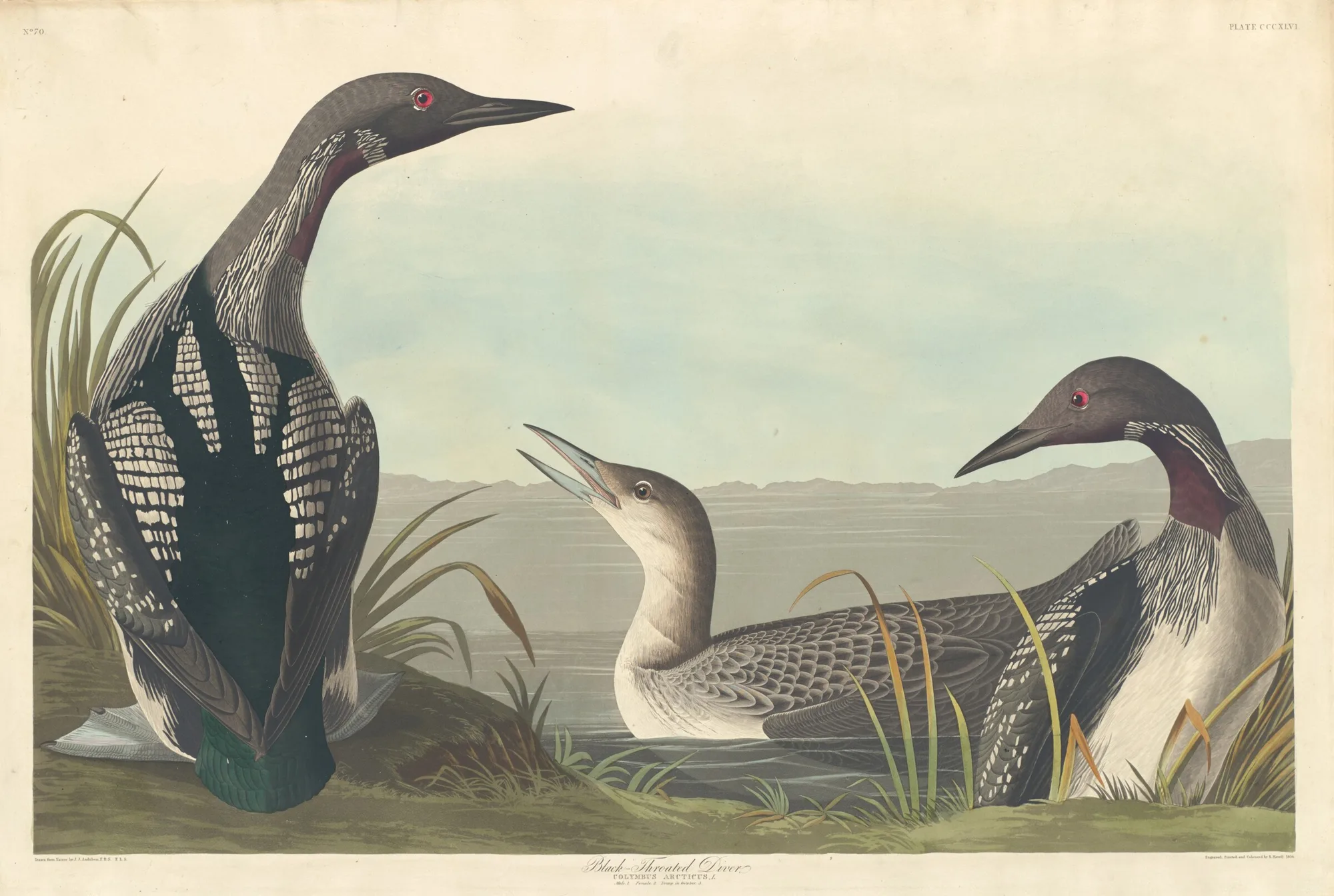
Audubon's “Black-throated Diver”, The Birds of America, plate CCCXLVI
Click or press Enter to enlarge
Open the full-resolution image (5470 px, National Gallery of Art)
| Plate | 346 (CCCXLVI) |
|---|---|
| Audubon's name | Black-throated Diver |
| Modern name | Arctic Loon |
| Scientific name | Gavia arctica |
| Status | Least Concern |
| Engraved by | Robert Havell, after Audubon's watercolor |
| Date | 1836 |
| Medium | Hand-colored engraving and aquatint on Whatman wove paper |
| Size | plate: 65.1 x 98.7 cm (25 5/8 x 38 7/8 in.) sheet: 67.8 x 101 cm (26 11/16 x 39 3/4 in.) |
| Collections | Seabirds |
| This impression | National Gallery of Art, Washington, 1945.8.346; Gift of Mrs. Walter B. James |
About this plate
Plate 346 shows three loons: an adult male and female in breeding plumage and a young bird in plain grey and white. The adults have a grey head, a black throat patch, black and white striped neck sides and a checkered back.
Audubon's Colymbus arcticus is the Arctic Loon, Gavia arctica, still called Black-throated Diver in Britain. In 1985 the closely similar Pacific Loon, Gavia pacifica, was split from it. In North America the Arctic Loon now breeds only in western Alaska, while the Pacific Loon is the common species across the continent. Audubon's American birds, especially young birds on inland rivers, may have been Pacific Loons or even other loons, so the identity of his figures is not certain.
Arctic Loons breed on large lakes in northern Eurasia and western Alaska and winter at sea. Like other loons they dive for fish and come ashore only to nest. The species is listed as Least Concern.
Audubon wrote that young birds wandered far south in autumn and appeared on the Ohio, Mississippi and Missouri as the leaves began to fall. He saw individuals in Texas in April 1837 and courting pairs in Labrador in 1833, but never found a nest. He also kept a drawing of a young bird made about thirty years earlier and labelled with Bewick's name, Imber Diver.
In Audubon's words
No sooner has the foliage of the trees that border our western waters begun to drop and float on the gentle current of the fair Ohio, than the Black-throated Diver makes its appearance there, moving slowly with the stream. The Mississippi, Missouri, and their tributaries, are at the same period supplied with these birds. Along our eastern and southern shores they are seen from the end of autumn until spring. Whilst in Labrador, I saw a few pairs courting on wing, much in the manner of the Red-throated Diver; but all our exertions failed to procure any of the nests, which I therefore think must have been placed farther inland than those of the Loon or Red-throated Diver.
John James Audubon, Ornithological Biography, vol. 4 (1838), “Black-throated Diver”. Read the full chapter.



