Smew (Plate 347)
Audubon's “Smew or White Nun”, The Birds of America, plate CCCXLVII
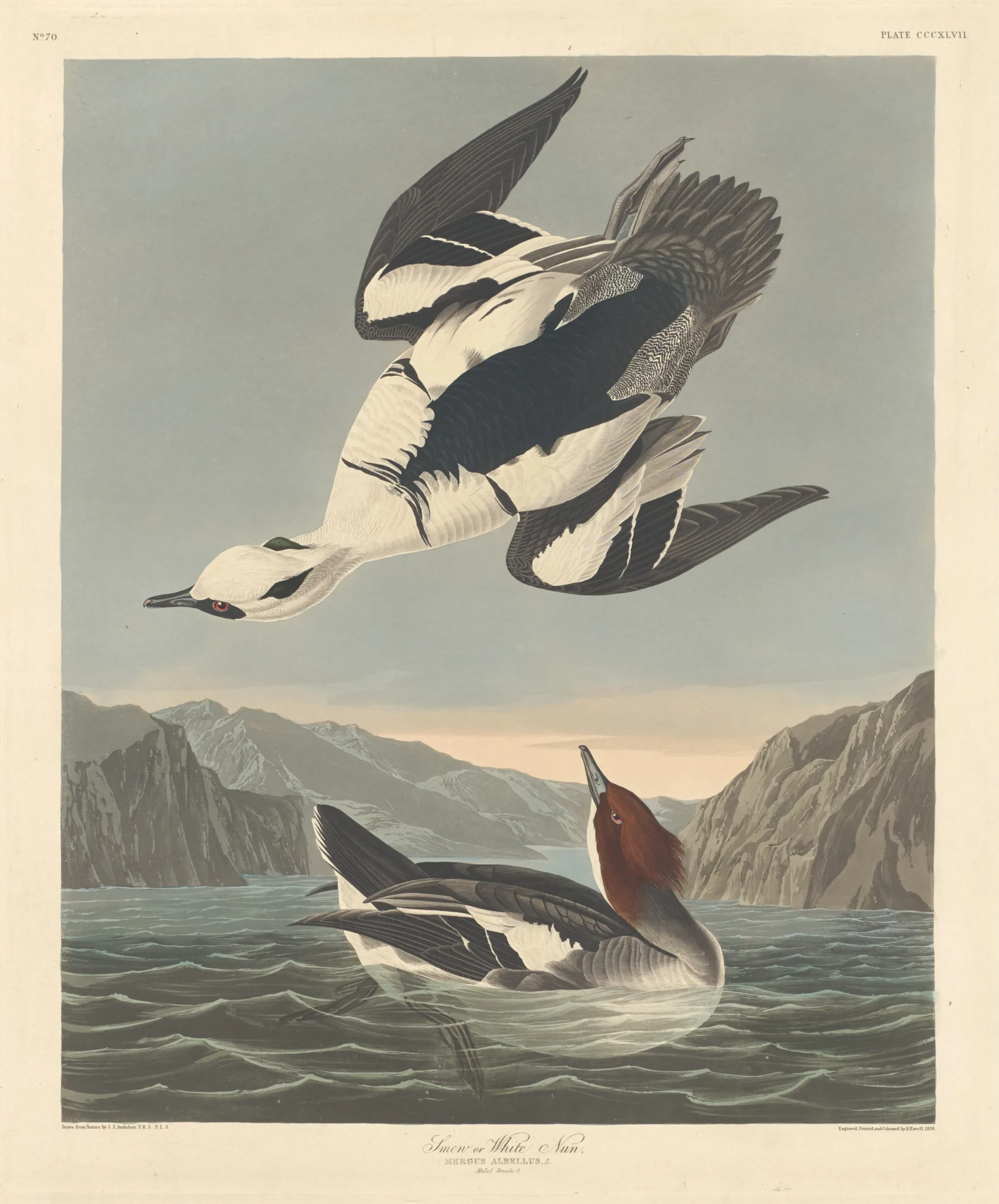
Click or press Enter to enlarge
Open the full-resolution image (3806 px, National Gallery of Art)
| Plate | 347 (CCCXLVII) |
|---|---|
| Audubon's name | Smew or White Nun |
| Modern name | Smew |
| Scientific name | Mergellus albellus |
| Status | Least Concern |
| Engraved by | Robert Havell, after Audubon's watercolor |
| Date | 1836 |
| Medium | Hand-colored engraving and aquatint on Whatman wove paper |
| Collections | Ducks, Geese and Swans |
| This impression | National Gallery of Art, Washington, 1945.8.347; Gift of Mrs. Walter B. James |
About this plate
Plate 347 shows a male and a female Smew. The male is mostly white with fine black lines on the head, back and breast, which earned it the name White Nun. The female is grey with a chestnut cap and white cheeks.
The Smew is Mergellus albellus, a small merganser placed in its own genus. Audubon called it Mergus albellus. It breeds in the taiga of northern Europe and Asia, nesting in tree holes, and winters on lakes and sheltered coasts. In North America it is a rare visitor, mostly in Alaska. The species is listed as Least Concern.
Audubon was doubtful that the Smew belonged in an American bird book. He argued that Alexander Wilson had been misinformed when he called it common in New England, and that Wilson's figure was drawn from a stuffed European specimen in Peale's Museum. He thought observers had mistaken distant Buffleheads for Smews.
His only American bird was an adult female that he said he shot on Lake Barataria near New Orleans, dating it to the winter of 1819, and drew on the spot. The male on the plate was added from another specimen. Audubon did not reach New Orleans until early 1821, so the date in the text may be wrong.
In Audubon's words
The only specimen procured by me was shot by myself on Lake Barataria, not far from New Orleans, in the winter of 1819. It was an adult female in fine plumage. How it had wandered so far south is an enigma to me; but having found it, and made a drawing of it on the spot, I have taken the liberty to add one of the other sex from an equally fine specimen. After all, the Smew can scarcely be considered as belonging to the American Fauna, any more than our Fork-tailed Hawk can with propriety be called a denizen of England; and in this I am supported by all the great navigators of our Arctic Seas, such as Ross, Parry, and Franklin, none of whom, nor any of their companions, ever met with a single individual of this beautiful bird.
John James Audubon, Ornithological Biography, vol. 4 (1838), “Smew or White Nun”. Read the full chapter.