Gadwall (Plate 348)
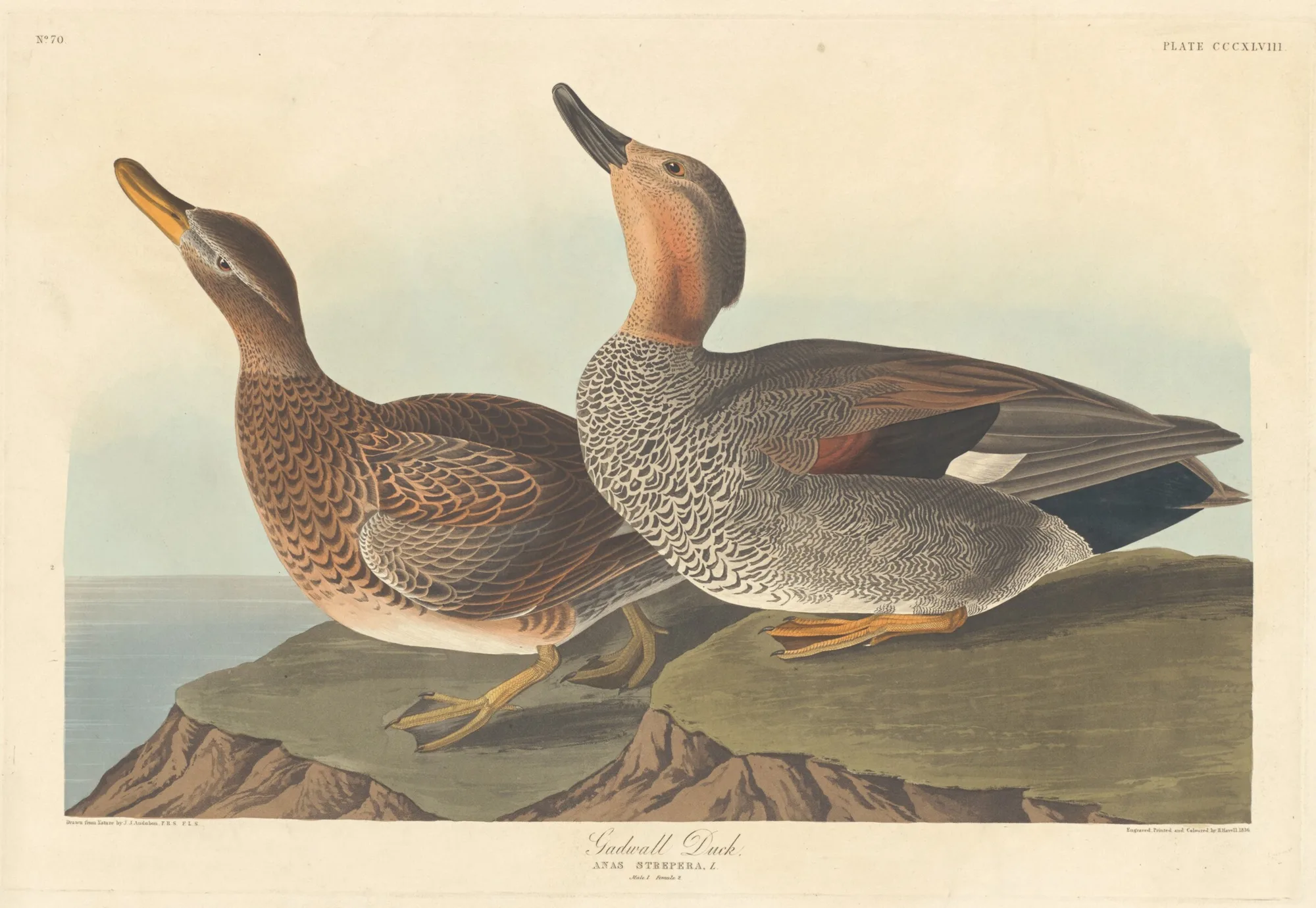
Audubon's “Gadwall Duck”, The Birds of America, plate CCCXLVIII
Click or press Enter to enlarge
Open the full-resolution image (3558 px, National Gallery of Art)
| Plate | 348 (CCCXLVIII) |
|---|---|
| Audubon's name | Gadwall Duck |
| Modern name | Gadwall |
| Scientific name | Mareca strepera |
| Status | Least Concern |
| Engraved by | Robert Havell, after Audubon's watercolor |
| Date | 1836 |
| Medium | Hand-colored engraving and aquatint on Whatman wove paper |
| Collections | Ducks, Geese and Swans |
| This impression | National Gallery of Art, Washington, 1945.8.348; Gift of Mrs. Walter B. James |
About this plate
Plate 348 shows a male and a female Gadwall. The male is grey with fine vermiculations, a black rear end and a small white wing patch. The female resembles a female Mallard but has an orange-edged bill and the same white patch in the wing.
Audubon called it Anas strepera, Linnaeus's name. It is now Mareca strepera, grouped with the wigeons. The Gadwall is found across the Northern Hemisphere, in North America, Europe and Asia.
Gadwalls breed mainly in the prairie pothole region of the northern United States and Canada and winter in the southern states and Mexico. Their numbers have grown strongly since the 1980s, and IUCN lists the species as Least Concern. They feed on submerged plants more than most dabbling ducks.
Audubon wrote that Louisiana Creoles called it Violon, from the whistling of its wings, and that it was about equal to the Redhead as food. In late April and early May 1837 he found it common on ponds and brackish inlets around Galveston Bay in Texas, where he was told it bred. He also cited his friend John Bachman's reports from South Carolina.
In Audubon's words
The Creoles of Louisiana name it “Violon,” on account of the whistling sound of its wings. It arrives in the neighbourhood of New Orleans and the mouths of the Mississippi along with the Widgeon, and is fond of the company of the Red-head, to which it is about equal as an article of food. The Gadwalls are usually seen in small flocks, and during winter resort to the larger lakes and the pools in the interior of the great marshes, adjoining the waters of the Gulf. In that part of the country they feed on small fish, insects, and aquatic grasses.
John James Audubon, Ornithological Biography, vol. 4 (1838), “Gadwall Duck”. Read the full chapter.