Black Rail (Plate 349)
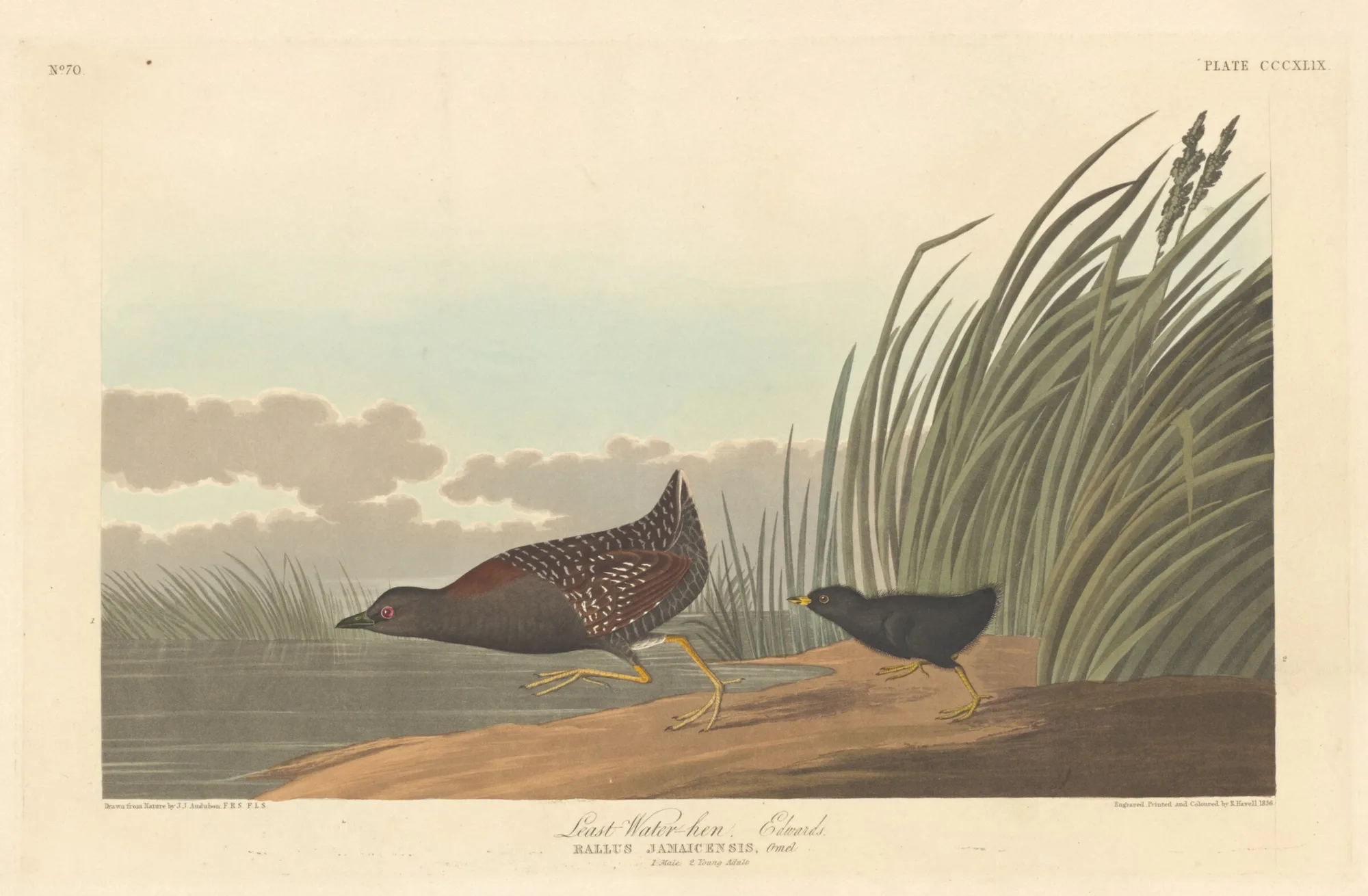
Audubon's “Least Water-hen”, The Birds of America, plate CCCXLIX
Click or press Enter to enlarge
Open the full-resolution image (2826 px, National Gallery of Art)
| Plate | 349 (CCCXLIX) |
|---|---|
| Audubon's name | Least Water-hen |
| Modern name | Black Rail |
| Scientific name | Laterallus jamaicensis |
| Status | Endangered |
| Engraved by | Robert Havell, after Audubon's watercolor |
| Date | 1836 |
| Medium | Hand-colored engraving and aquatint on Whatman wove paper |
| Collections | Shorebirds, Rails and Cranes |
| This impression | National Gallery of Art, Washington, 1945.8.349; Gift of Mrs. Walter B. James |
About this plate
Plate 349 shows the Black Rail, the smallest rail in North America, about the size of a sparrow. The adult is dark slate with a chestnut nape, fine white spots on the back and red eyes. A young bird is shown with it.
Audubon's Least Water Rail, Rallus jamaicensis, is the Black Rail, Laterallus jamaicensis. The species had long been doubted in the United States. A specimen in Peale's Museum labelled 'Little Rail' had been dismissed by Bonaparte and others as a young Spotted Crake from Europe.
Black Rails live in the densest parts of salt marshes, freshwater wetlands and wet meadows, and are almost never seen. They run through grass like mice and usually give themselves away only by their 'kik-kee-do' call at night. Populations along the Atlantic coast have fallen steeply with marsh loss and sea-level rise, and the species is listed as Endangered by IUCN. The eastern subspecies is listed as threatened under the US Endangered Species Act.
Audubon never saw the bird alive. In October 1836 Titian Peale of Philadelphia sent him a specimen with a letter. A Dr Rowan's mowers had caught an adult with four young beside a pond. Peale kept the adult alive for four days. Dissection showed it was a male that had let itself be caught by hand while defending the brood.
In Audubon's words
The young died soon after I received them, but the old one lived with me until the 26th of July (four days after its capture), evincing considerable anxiety for the young, as long as they lived. Both young and old partook sparingly of Indian meal and water, or bread and water, and soon became quite at home, and probably might have been domesticated, had they been properly accommodated. “The most remarkable part of the history of this individual is, that after its death we should have discovered on dissection that it was a male, rendering it singularly curious that he should have suffered himself to be captured by hand while in defence of the young brood.
John James Audubon, Ornithological Biography, vol. 4 (1838), “Least Water Rail”. Read the full chapter.