Children's Warbler (Yellow Warbler) (Plate 35)
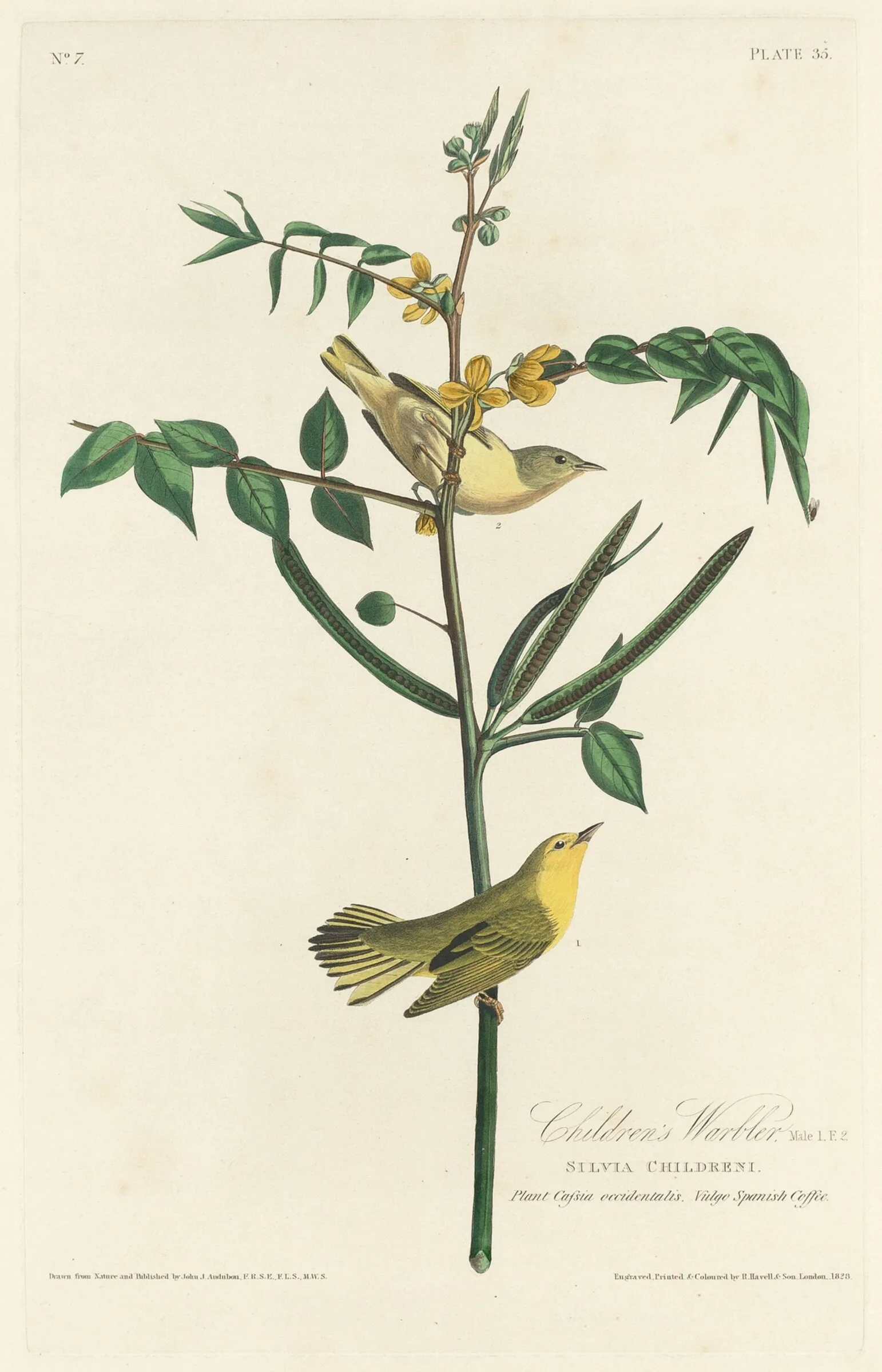
Audubon's “Children's Warbler”, The Birds of America, plate XXXV
Click or press Enter to enlarge
Open the full-resolution image (2496 px, National Gallery of Art)
| Plate | 35 (XXXV) |
|---|---|
| Audubon's name | Children's Warbler |
| Modern name | Yellow Warbler (female or immature) |
| Scientific name | Setophaga petechia |
| Status | Least Concern |
| Engraved by | Robert Havell, after Audubon's watercolor |
| Date | 1828 |
| Medium | Hand-colored engraving and aquatint on Whatman wove paper |
| Plants and setting | Wild Spanish Coffee, as named by Audubon (probably a Senna) |
| Collections | Songbirds |
| This impression | National Gallery of Art, Washington, 1945.8.35; Gift of Mrs. Walter B. James |
About this plate
Plate 35 shows a pair of small yellow-olive warblers among the stalks and flowers of the plant Audubon called Wild Spanish Coffee. He wrote that it grew abundantly in almost every field in the uplands of Lower Louisiana and that its flowers and leaves smelled nauseous. The plate was engraved by Robert Havell in 1828.
Audubon wrote that he shot two of these birds in May 1821 near the town of Jackson, Louisiana, sitting in the plant shown. He found their nest with five nearly fledged young, built of bark from the same plant and lined with what he thought was goat hair from a nearby pasture. He shot both parents and tried to raise the young, but they refused food and died within two days. He never saw another.
He named the bird for John George Children of the British Museum, a close friend who helped him in London. Audubon noticed the resemblance to the young of the Yellow Warbler but decided it was new. It is now treated as a female or immature Yellow Warbler, Setophaga petechia. Audubon's reasoning that young Yellow Warblers moult into full color before spring was wrong for females, which stay duller.
The Yellow Warbler breeds in willows, wet thickets and shrubby edges across almost all of North America and winters from Mexico to South America. It is listed as Least Concern.
In Audubon's words
They were sitting amongst the stalks of the plant, on which they are represented. Their wings were constantly drooping by the sides of their body, their tail spread out like a fan, and they uttered a low tweet note, which was very soft and sweet. They now and then chased small insects on the wing, but more commonly searched for them amongst the leaves and blossoms of the plants on which they were. After a few minutes, I discovered their nest, which contained five young ones nearly fledged. It was attached by the sides to two twigs of the plant, and was formed of the dried bark of the same plant, mixed with skins of caterpillars and some silky substances. The lining consisted of goat's or deer hair, I think the former, as there were some tame goats in an adjoining pasture. I shot both the parents, and took the young under my care, but they would not receive any food, and died towards the end of the second day after their removal.
John James Audubon, Ornithological Biography, vol. 1 (1831), “Children's Warbler”. Read the full chapter.



