Worm-eating Warbler (Plate 34)
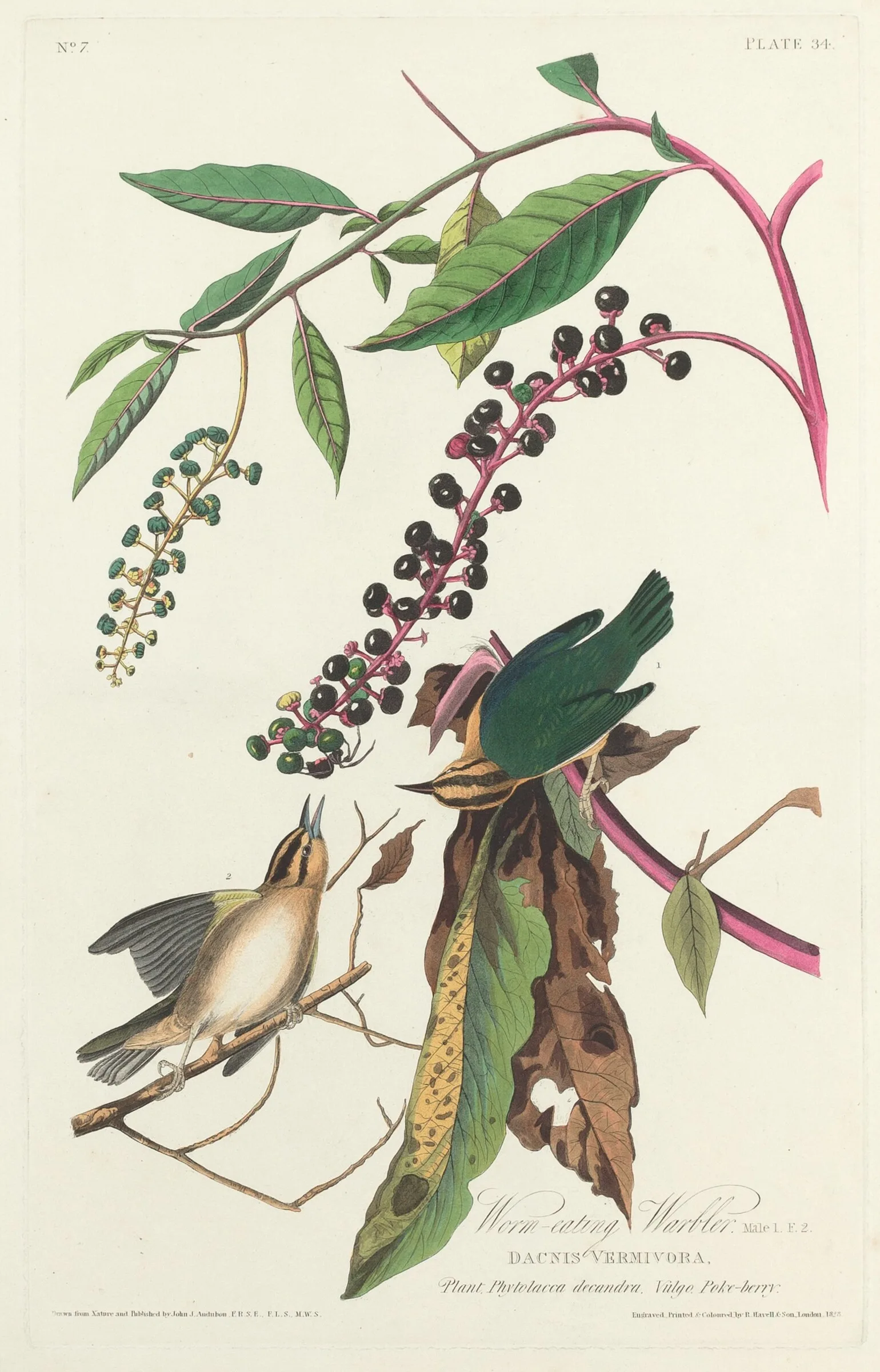
Audubon's “Worm-eating Warbler”, The Birds of America, plate XXXIV
Click or press Enter to enlarge
Open the full-resolution image (2500 px, National Gallery of Art)
| Plate | 34 (XXXIV) |
|---|---|
| Audubon's name | Worm-eating Warbler |
| Modern name | Worm-eating Warbler |
| Scientific name | Helmitheros vermivorum |
| Status | Least Concern |
| Engraved by | Robert Havell, after Audubon's watercolor |
| Date | 1828 |
| Medium | Hand-colored engraving and aquatint on Whatman wove paper |
| Plants and setting | Poke-berry (Phytolacca americana) |
| Collections | Songbirds |
| This impression | National Gallery of Art, Washington, 1945.8.34; Gift of Mrs. Walter B. James |
About this plate
Plate 34 shows a male and female Worm-eating Warbler, plain olive birds with bold black stripes on a buff head, on a stem of Poke-berry, Phytolacca americana, with its dark berries. Audubon described the plant in detail. He said country people used its crimson berry juice as red ink, ate the young shoots like asparagus, and took the juice for fever, though too large a dose was harmful. The plate was engraved by Robert Havell in 1828.
Audubon described a nest of dried moss and the green catkins of hickories and chestnuts, lined with fine roots, placed in a bush eight or nine feet from the ground. In fact the species nests on the ground, usually on a slope under leaf litter, so this part of his account is doubtful. He noted that the bird passed through Louisiana in early April and late October and that he shot several on the shores of Lake Erie in autumn.
The name is unchanged: Worm-eating Warbler, Helmitheros vermivorum. It is the only member of its genus. Despite the name it does not eat earthworms. It feeds mainly on caterpillars and other insects, often probing clusters of dead leaves that hang in the understory.
The species breeds in large tracts of deciduous forest on hillsides and in ravines across the eastern United States and winters in Mexico, Central America and the Caribbean. It is listed as Least Concern.
In Audubon's words
The nest of this active little bird is formed of singular materials, being composed externally of dried mosses and the green blossoms of Hickories and Chestnut-trees, while the interior is prettily lined with fine fibrous roots, the whole apparently rather small for the size of the occupants. About the middle of May the female lays four or five eggs, which are cream-coloured, with a few dark red spots near the larger end, leaving a circular unspotted part at the extremity. The nest is usually placed between two small twigs of a bush, not more than eight or nine feet from the ground, and sometimes only four or five.
The flight of the Worm-eating Warbler resembles that of the Crested Titmouse, being of short duration, and accompanied with the same rustling noise, which is occasioned by the rather concave formation of their wings.
John James Audubon, Ornithological Biography, vol. 1 (1831), “The Worm-eating Warbler”. Read the full chapter.



