Great Grey Owl (Plate 351)
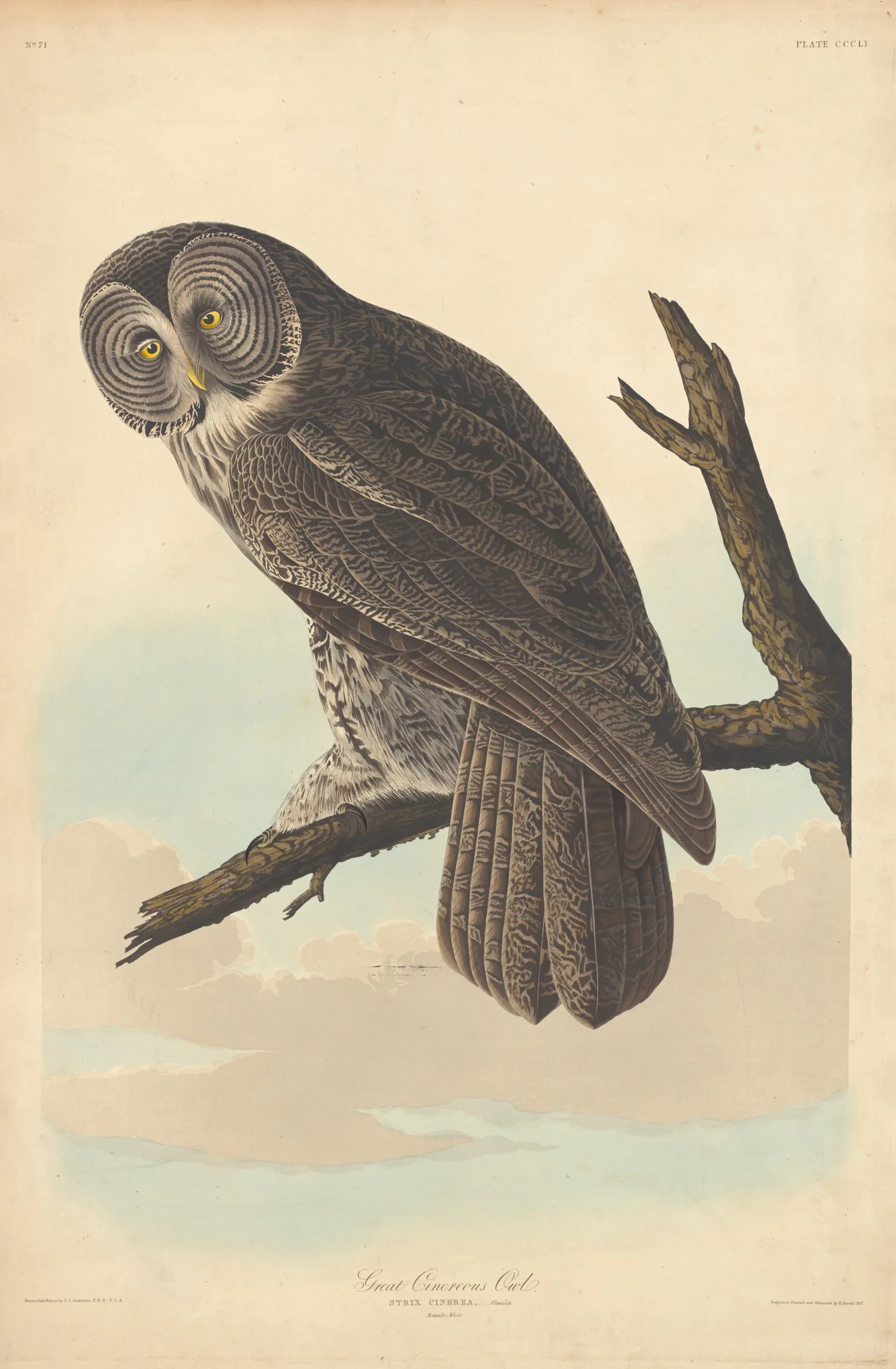
Audubon's “Great Cinereous Owl”, The Birds of America, plate CCCLI
Click or press Enter to enlarge
Open the full-resolution image (5492 px, National Gallery of Art)
| Plate | 351 (CCCLI) |
|---|---|
| Audubon's name | Great Cinereous Owl |
| Modern name | Great Grey Owl |
| Scientific name | Strix nebulosa |
| Status | Least Concern |
| Engraved by | Robert Havell, after Audubon's watercolor |
| Date | 1837 |
| Medium | Hand-colored engraving and aquatint on Whatman wove paper |
| Size | plate: 96.8 x 64.8 cm (38 1/8 x 25 1/2 in.) sheet: 100.3 x 67.5 cm (39 1/2 x 26 9/16 in.) |
| Collections | Owls |
| This impression | National Gallery of Art, Washington, 1945.8.351; Gift of Mrs. Walter B. James |
About this plate
Plate 351 shows a Great Grey Owl, the longest owl in North America. It has a huge round facial disc marked with concentric grey rings, small yellow eyes, a white bow tie below the bill and soft grey barred plumage.
Audubon's Strix cinerea is now Strix nebulosa, the Great Grey Owl, called Great Gray Owl in American spelling. He called it the largest North American owl. By length that is correct, but much of its bulk is feathers, and the Snowy Owl and Great Horned Owl are heavier.
Great Grey Owls live in the boreal forests of North America and Eurasia and in mountain forests south to the Sierra Nevada and the northern Rockies. They hunt voles by day and night, and can locate prey under deep snow by sound. In some winters food shortages drive many south, which explains the birds Audubon heard of in Maine and Massachusetts. The species is listed as Least Concern.
Audubon drew the plate from a fine specimen in the collection of the Zoological Society of London. He had tried to see a live bird taken on a woodpile at Marblehead, Massachusetts, in February 1831, but it had died before he reached Salem. Its keeper, Mr Ives, gave him a drawing made by his wife. In the winter of 1832 he watched one flying over Boston harbour while gulls mobbed it.
In Audubon's words
It has been procured near Eastport in Maine, and at Marble Head in Massachusetts, where one of them was taken alive, perched on a wood pile, early in the morning, in February 1831. I went to Salem for the purpose of seeing it, but it had died, and I could not trace its remains. The gentleman, Mr Ives, in whose keeping it had been for several months, fed it on fish and small birds, of which it was very fond. Besides shewing me various marks of attention, he gave me a drawing of it made by his wife, which is still in my possession. It uttered at times a tremulous cry not unlike that of the Little Screech Owl, Strix Asio, and shewed a great antipathy to cats and dogs. In the winter of 1832, I saw one of these Owls flying over the harbour of Boston, Massachusetts, amid several Gulls, all of which continued teasing it until it disappeared.
John James Audubon, Ornithological Biography, vol. 4 (1838), “Great Cinereous Owl”. Read the full chapter.