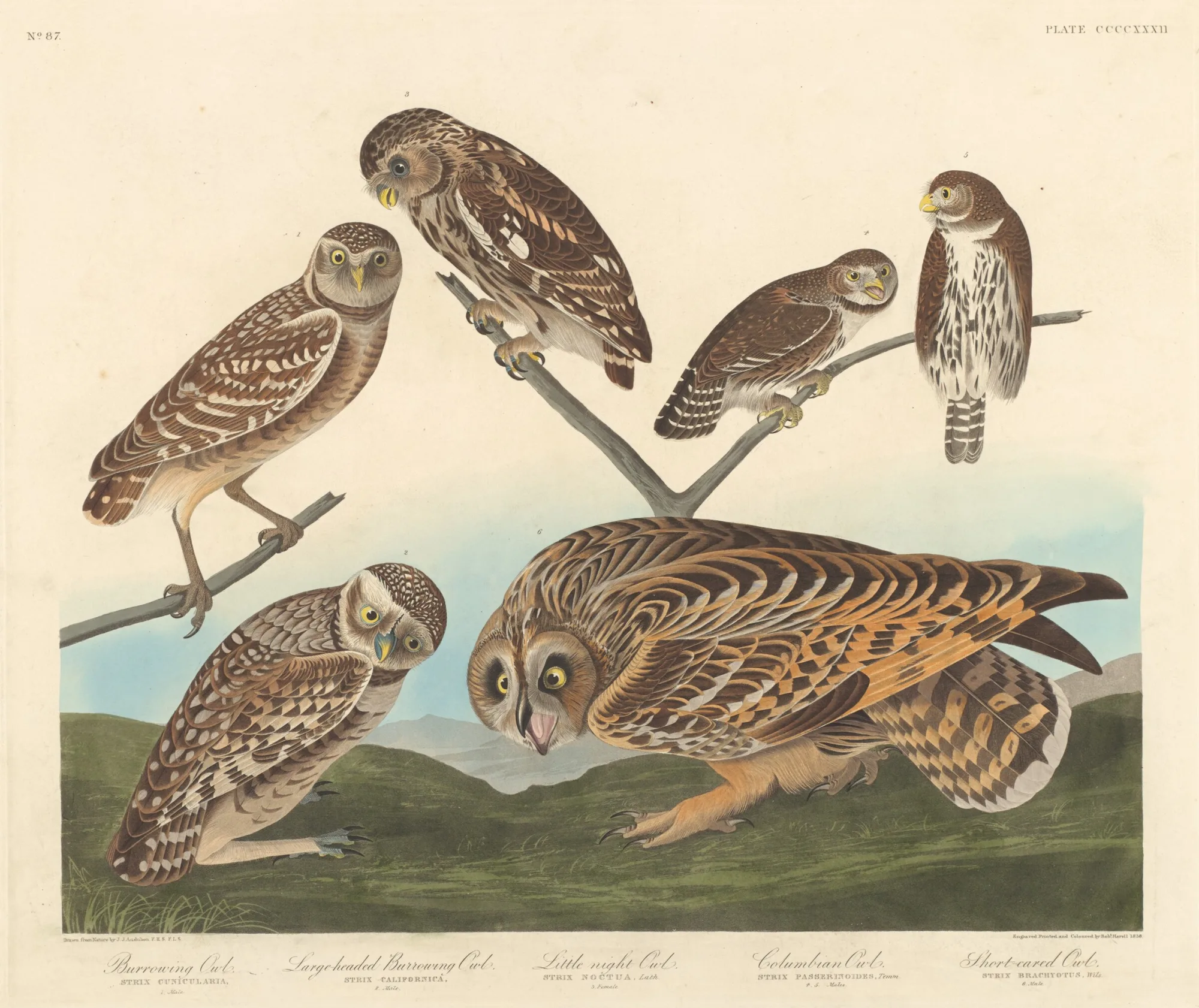
Burrowing Owl, Boreal Owl, Northern Pygmy-Owl and Short-eared Owl (Plate 432)
Audubon's “Burrowing Owl, Large-Headed Burrowing Owl andLittle Night Owl”, The Birds of America, plate CDXXXII
Click or press Enter to enlarge
Open the full-resolution image (3706 px, National Gallery of Art)
| Plate | 432 (CDXXXII) |
|---|---|
| Audubon's name | Burrowing Owl, Large-Headed Burrowing Owl andLittle Night Owl |
| Modern names | Burrowing Owl, Burrowing Owl, Boreal Owl, Northern Pygmy-Owl, Short-eared Owl |
| Scientific names | Athene cunicularia, Athene cunicularia, Aegolius funereus, Glaucidium gnoma, Asio flammeus |
| Status | Least Concern |
| Engraved by | Robert Havell, after Audubon's watercolor |
| Date | 1838 |
| Medium | Hand-colored engraving and aquatint on Whatman wove paper |
| Collections | Owls |
| This impression | National Gallery of Art, Washington, 1945.8.432; Gift of Mrs. Walter B. James |
About this plate
Plate 432 brings together the small owls Audubon had not yet figured. There are Burrowing Owls from Townsend, one of which Audubon at first took for a separate species and labelled Strix californica on the plate. There is a female Little Night Owl from Pictou, Nova Scotia, two figures of a male Little Columbian Owl, and a Short-eared Owl.
The Little Columbian Owl is the Northern Pygmy-Owl. Townsend shot it near Fort Vancouver in November, and its stomach held a Ruby-crowned Kinglet. The Little Night Owl, which Audubon thought was the European Pygmy Owl, Strix passerina, is most likely a Boreal Owl. Thomas McCulloch collected it near Pictou in winter. The extra Burrowing Owl labelled Strix californica is the same species as the others.
The Burrowing Owl nests in burrows dug by prairie dogs, ground squirrels and badgers in open country of the West and Florida. It hunts by day as well as at night. Loss of prairie dog towns has reduced it in many areas. The Short-eared Owl hunts low over marshes and grasslands at dusk and is found on every continent except Australia and Antarctica. All four species are listed as Least Concern.
Townsend wrote that Burrowing Owls on the Columbia plains used old marmot and badger holes at the foot of sagebrush and fed on grasshoppers. Audubon found Short-eared Owls so plentiful on the prairies of East Florida, at General Hernandez's plantation, that he shot seven in a morning and caught one by hand.
Birds on this plate
- Burrowing Owl Athene cunicularia (male and female). Least Concern
- Burrowing Owl Athene cunicularia: Audubon's Large-headed Burrowing Owl (Strix californica) (one figure). Least Concern
- Boreal Owl Aegolius funereus: Audubon's Little Night Owl (female). Least Concern
- Northern Pygmy-Owl Glaucidium gnoma: Audubon's Columbian Owl (Little Columbian Owl) (male, two figures). Least Concern
- Short-eared Owl Asio flammeus (male). Least Concern
In Audubon's words
This species inhabits the plains near the Columbia River and the whole extent of the Rocky Mountains, residing in the forsaken burrows of the Marmots and American Badgers, but never lives on terms of intimacy with either of these animals, as has been so often stated. The burrow selected by this bird is usually found at the foot of a wormwood bush (Artemisia), upon the summit of which this Owl often perches, and stands for a considerable while. On their being approached, they utter a low chattering sound, start, and skim along the plain near the ground for a considerable distance. When winged, they make immediately for the nearest burrow, and when once within it, it is impossible to dislodge them. They are strictly diurnal, feed principally upon grasshoppers and crickets, and, according to the Indians, sometimes upon field-mice. The nest is composed of fine grass, and placed at the extremity of the hole.
John James Audubon, Ornithological Biography, vol. 5 (1839), “Burrowing Owl”. Read the full chapter.