White-tailed Kite (Plate 352)
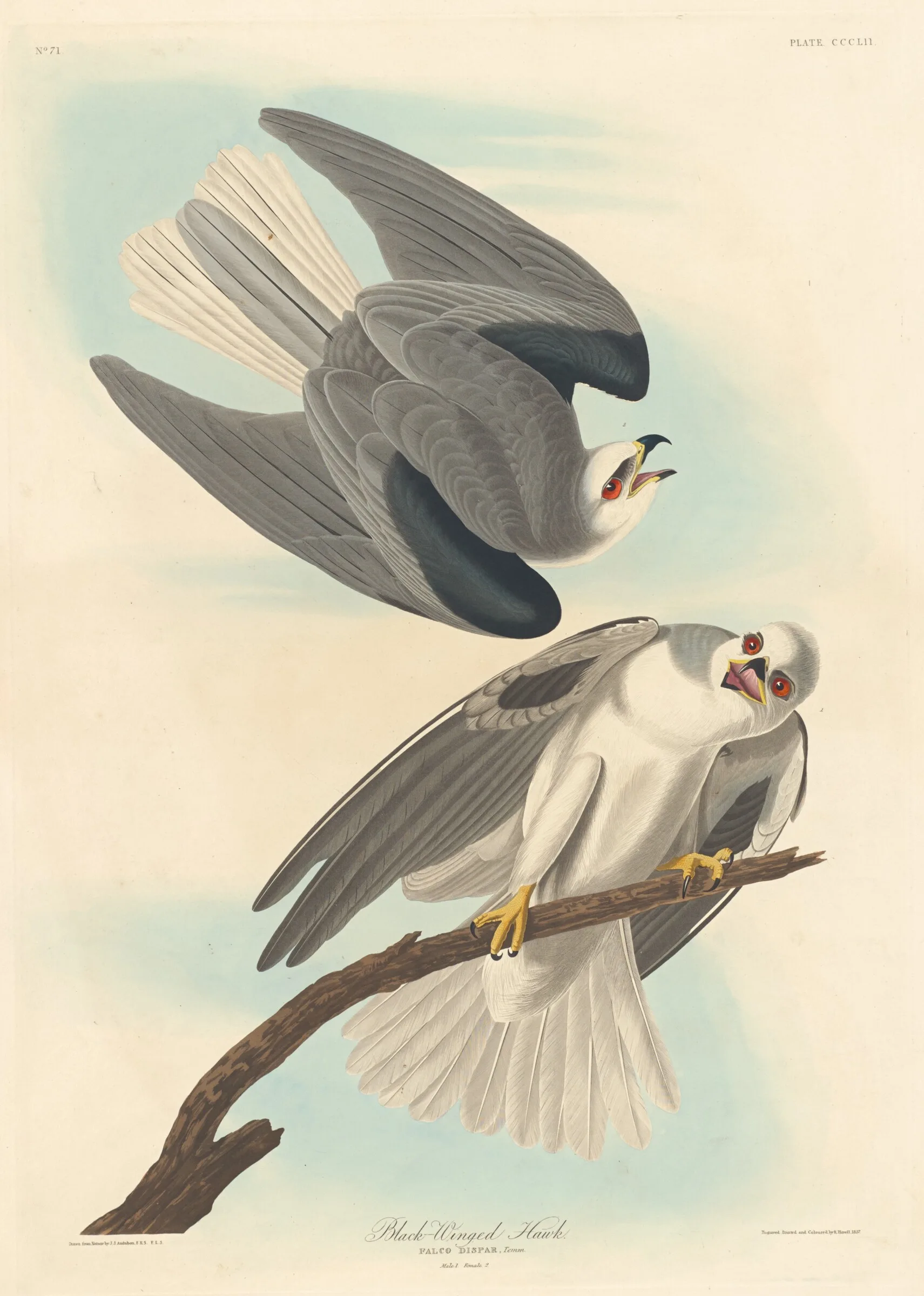
Audubon's “Black-winged Hawk”, The Birds of America, plate CCCLII
Click or press Enter to enlarge
Open the full-resolution image (4360 px, National Gallery of Art)
| Plate | 352 (CCCLII) |
|---|---|
| Audubon's name | Black-winged Hawk |
| Modern name | White-tailed Kite |
| Scientific name | Elanus leucurus |
| Status | Least Concern |
| Engraved by | Robert Havell, after Audubon's watercolor |
| Date | 1837 |
| Medium | Hand-colored engraving and aquatint on Whatman wove paper |
| Collections | Hawks, Eagles and Falcons |
| This impression | National Gallery of Art, Washington, 1945.8.352; Gift of Mrs. Walter B. James |
About this plate
Plate 352 shows a male and a female White-tailed Kite. They are pale grey and white hawks with black shoulder patches, white tails and red eyes. Audubon was struck by the size and beauty of the eyes when he first saw a live bird.
The plate names it Black-winged Hawk, while the Ornithological Biography calls it the Black-shouldered Hawk, Falco dispar. It is the White-tailed Kite, Elanus leucurus. From 1983 to 2000 it was lumped with the Old World Black-winged Kite as the Black-shouldered Kite, and then split again.
White-tailed Kites live in open grassland, marsh and farmland in California, Texas, Florida and south through Mexico to South America. They hunt by hovering in one place and dropping on voles and mice, exactly as described in a letter Audubon printed. The species declined sharply in the early twentieth century from shooting, then recovered. It is listed as Least Concern.
On 8 February 1834, while Audubon was staying in Charleston, Dr Ravenel of Charleston sent him a live male with an injured wing. Audubon drew it immediately; it was the first he had seen alive. On 23 February Francis Lee sent a female shot on his plantation forty miles west of the city. Audubon said he had traced the species' range from Texas to the mouth of the Santee River in South Carolina.
In Audubon's words
On the 8th of February 1834 I received one of these birds alive from Dr Ravenel of Charleston, who had kept it in his yard for eight days previously, without being able to induce it to take any food. The beauty of its large eyes struck me at once, and I immediately made a drawing of the bird, which was the first I had ever seen alive. It proved to be a male, and was in beautiful plumage. Dr Ravenel told me that it walked about his yard with tolerable ease, although one of its wings had been injured.
John James Audubon, Ornithological Biography, vol. 4 (1838), “Black-shouldered Hawk”. Read the full chapter.