Northern Hawk Owl (Plate 378)
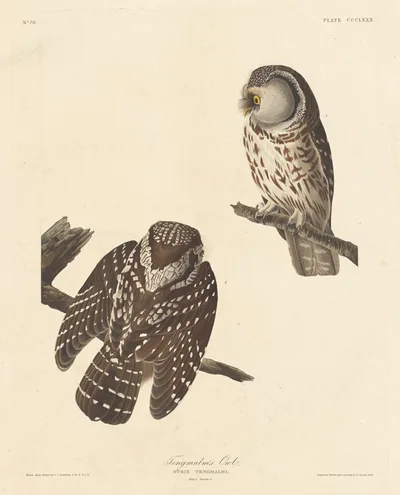
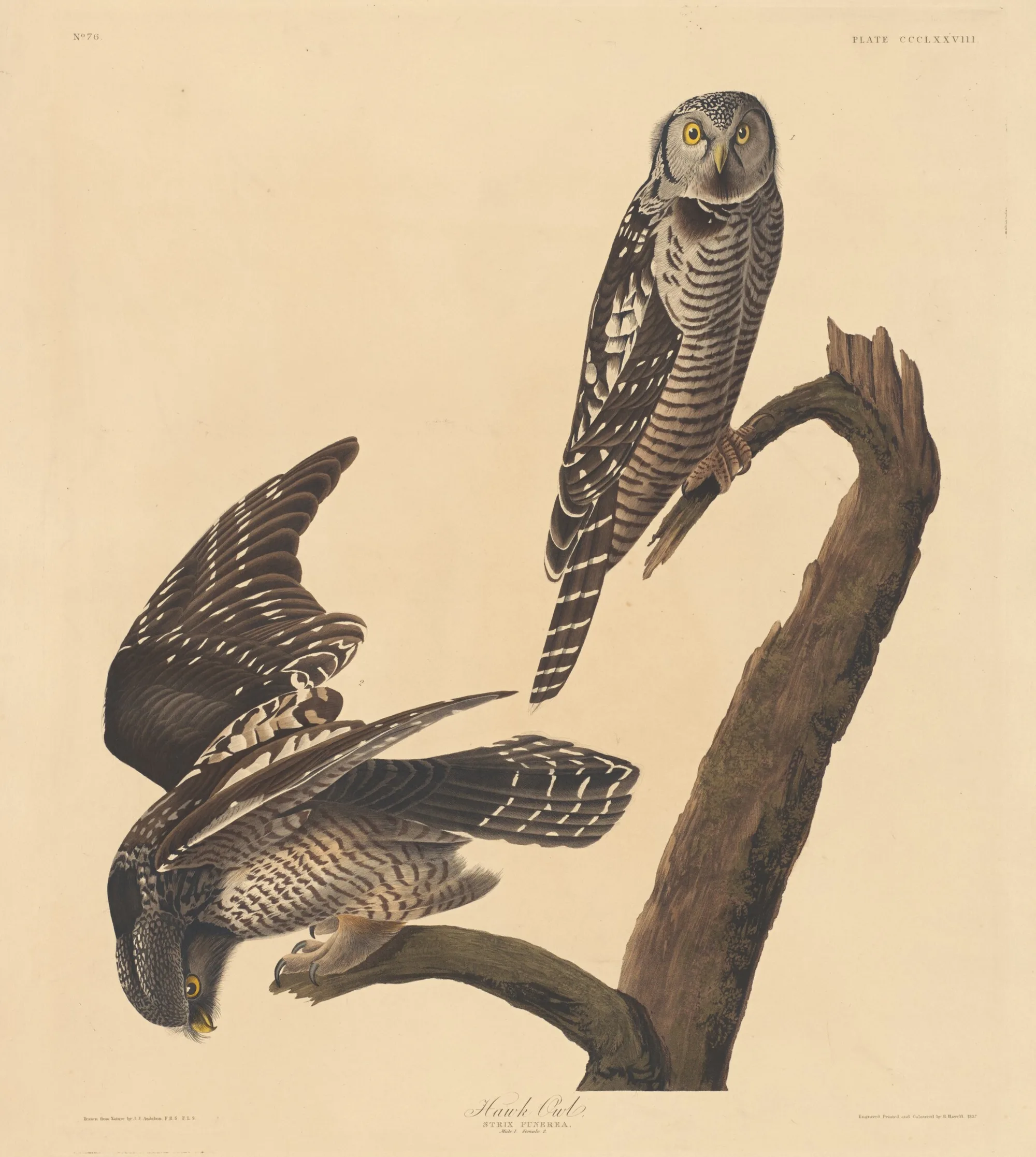
Audubon's “Hawk Owl”, The Birds of America, plate CCCLXXVIII
Click or press Enter to enlarge
Open the full-resolution image (3756 px, National Gallery of Art)
| Plate | 378 (CCCLXXVIII) |
|---|---|
| Audubon's name | Hawk Owl |
| Modern name | Northern Hawk Owl |
| Scientific name | Surnia ulula |
| Status | Least Concern |
| Engraved by | Robert Havell, after Audubon's watercolor |
| Date | 1837 |
| Medium | Hand-colored engraving and aquatint on Whatman wove paper |
| Collections | Owls |
| This impression | National Gallery of Art, Washington, 1945.8.378; Gift of Mrs. Walter B. James |
About this plate
Plate 378 shows a male and a female Northern Hawk Owl. It is a medium-sized owl with a long tail, a flat-topped head, a white face framed in black, and dense brown barring below. It looks and behaves much like a hawk.
Audubon used the name Strix funerea. It is now Surnia ulula, the only member of its genus. Audubon opened the chapter by admitting he had never seen the bird alive and had little of his own to say.
Northern Hawk Owls live in the open boreal forests and muskeg of Canada, Alaska and northern Eurasia. They hunt by day from the tops of spruce snags, mainly for voles, and can spot prey half a mile away. In years when voles crash they move south, and such winter irruptions bring them into the northern United States. The species is listed as Least Concern.
Audubon quoted Richardson's account of the owl in the Fur Countries, where hunters knew it for following Ptarmigan flocks and swooping on birds they had shot. His Boston friend Thomas Brewer wrote that it was common at Lake Memphremagog in Vermont and that nests were found in hollow trees there.
In Audubon's words
It is a common species throughout the Fur Countries from Hudson’s Bay to the Pacific, and is more frequently killed than any other by the hunters, which may be partly attributed to its boldness and its habit of flying about by day. In the summer season it feeds principally on mice and insects; but in the snow-clad regions which it frequents in the winter, neither of these are to be procured, and it then preys mostly on Ptarmigan. It is a constant attendant on the flocks of Ptarmigan in their spring migrations to the northward. It builds its nest on a tree, of sticks, grass, and feathers, and lays two white eggs. When the hunters are shooting Grouse, this bird is occasionally attracted by the report of the gun, and is often bold enough, on a bird being killed, to pounce down upon it, though it may be unable from its size to carry it off. It is also known to hover round the fires made by the natives at night.
John James Audubon, Ornithological Biography, vol. 4 (1838), “Hawk Owl”. Read the full chapter.