Long-eared Owl (Plate 383)
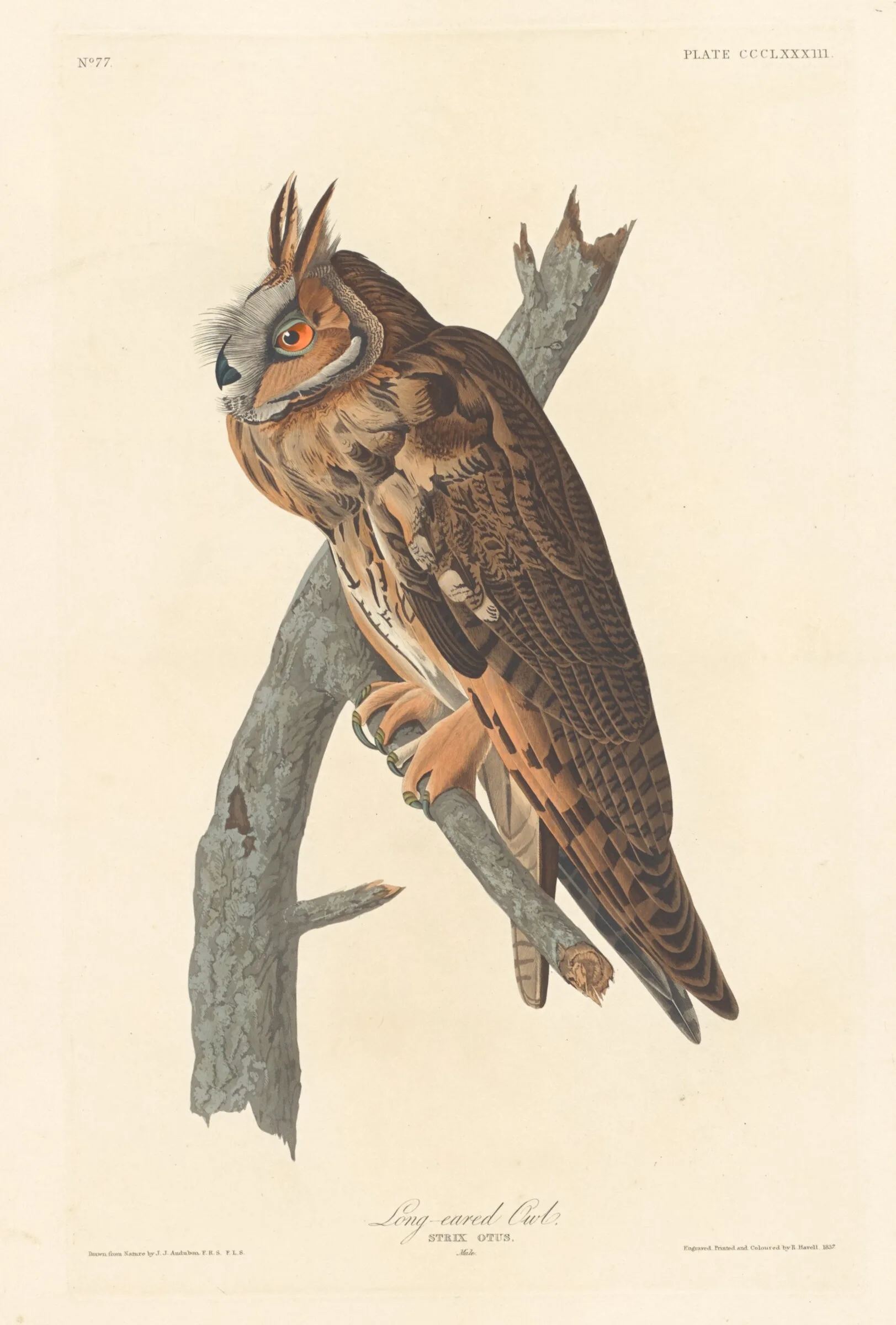
Audubon's “Long-eared Owl”, The Birds of America, plate CCCLXXXIII
Click or press Enter to enlarge
Open the full-resolution image (2906 px, National Gallery of Art)
| Plate | 383 (CCCLXXXIII) |
|---|---|
| Audubon's name | Long-eared Owl |
| Modern name | Long-eared Owl |
| Scientific name | Asio otus |
| Status | Least Concern |
| Engraved by | Robert Havell, after Audubon's watercolor |
| Date | 1837 |
| Medium | Hand-colored engraving and aquatint on Whatman wove paper |
| Collections | Owls |
| This impression | National Gallery of Art, Washington, 1945.8.383; Gift of Mrs. Walter B. James |
About this plate
Plate 383 shows the Long-eared Owl, a slim, medium-sized owl with long, close-set ear tufts, an orange facial disc, orange-yellow eyes and heavily streaked and barred brown plumage. When alarmed it stretches tall and thin against a tree trunk to look like a broken branch.
The species is Asio otus, found across North America, Europe, Asia and North Africa. Audubon's generation knew it as Strix otus. It is closely related to the Short-eared Owl, which hunts over open ground by day. The ear tufts are only feathers and have nothing to do with hearing.
Long-eared Owls breed in dense woods and thickets next to open country, where they hunt voles and mice at night. They use old crow, magpie or hawk nests rather than building their own. In winter several often roost together in dense conifers. Their soft hoots are rarely heard, so the species is easily overlooked. Winter roosts are the easiest place to find them, and birders are asked to keep their distance because disturbed owls may abandon a roost. IUCN lists it as Least Concern, though North American surveys suggest declines.
The Ornithological Biography chapter for this plate was not supplied, so details of where Audubon met the species or drew his figures are not given here.