Boreal Owl (Plate 380)
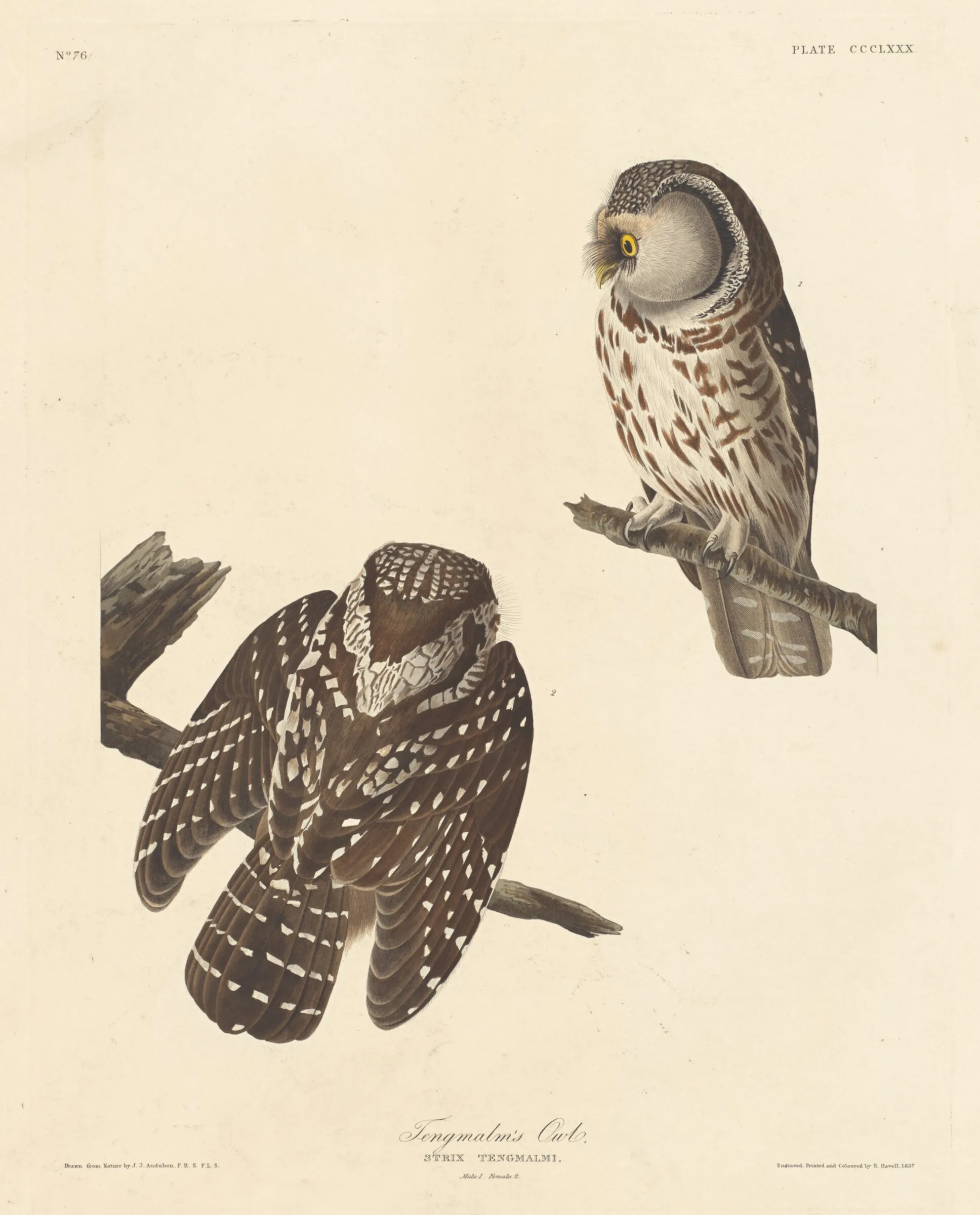
Audubon's “Tengmalm's Owl”, The Birds of America, plate CCCLXXX
Click or press Enter to enlarge
Open the full-resolution image (2948 px, National Gallery of Art)
| Plate | 380 (CCCLXXX) |
|---|---|
| Audubon's name | Tengmalm's Owl |
| Modern name | Boreal Owl |
| Scientific name | Aegolius funereus |
| Status | Least Concern |
| Engraved by | Robert Havell, after Audubon's watercolor |
| Date | 1837 |
| Medium | Hand-colored engraving and aquatint on Whatman wove paper |
| Collections | Owls |
| This impression | National Gallery of Art, Washington, 1945.8.380; Gift of Mrs. Walter B. James |
About this plate
Plate 380 shows a male and a female of a small, square-headed owl with a pale face framed in black, white-spotted brown upperparts and yellow eyes. The bird is the Boreal Owl.
Audubon called it Strix tengmalmi after the Swedish naturalist Peter Gustaf Tengmalm, and it is still called Tengmalm's Owl in Europe. North American birders long called it Richardson's Owl. The modern name is Aegolius funereus. It is a larger, darker-faced relative of the Northern Saw-whet Owl.
Boreal Owls live in the spruce and fir forests of Canada, Alaska and northern Eurasia, and in high-elevation subalpine forests of the Rockies. They nest in old woodpecker holes and hunt small mammals at night, mostly voles. Their song is a rapid series of hoots, like a winnowing snipe. They are seldom seen, and many early records came from birds found in daylight in late winter. The species is listed as Least Concern.
Audubon collected a fine male at Bangor, Maine, on the Penobscot River, in early September 1832. It was the only one he ever saw alive. Townsend reported that Nuttall walked within a few feet of one sitting tamely in the bushes on the Malade River Mountains.
In Audubon's words
I procured a fine male of this species at Bangor, in Maine, on the Penobscot River, in the beginning of September 1832; but am unacquainted with its habits, never having seen another individual alive. Dr Townsend informs me that he found it first on the Malade River Mountains, where it was so tame and unsuspicious, that Mr Nuttall was enabled to approach within a few feet of it, as it sat upon the bushes. Dr Richardson gives the following notice respecting it in the Fauna Boreali-Americana:—“When it accidentally wanders abroad in the day, it is so much dazzled by the light of the sun as to become stupid, and it may then be easily caught by the hand.
John James Audubon, Ornithological Biography, vol. 4 (1838), “Tengmalm's Owl”. Read the full chapter.