Bohemian Waxwing (Plate 363)
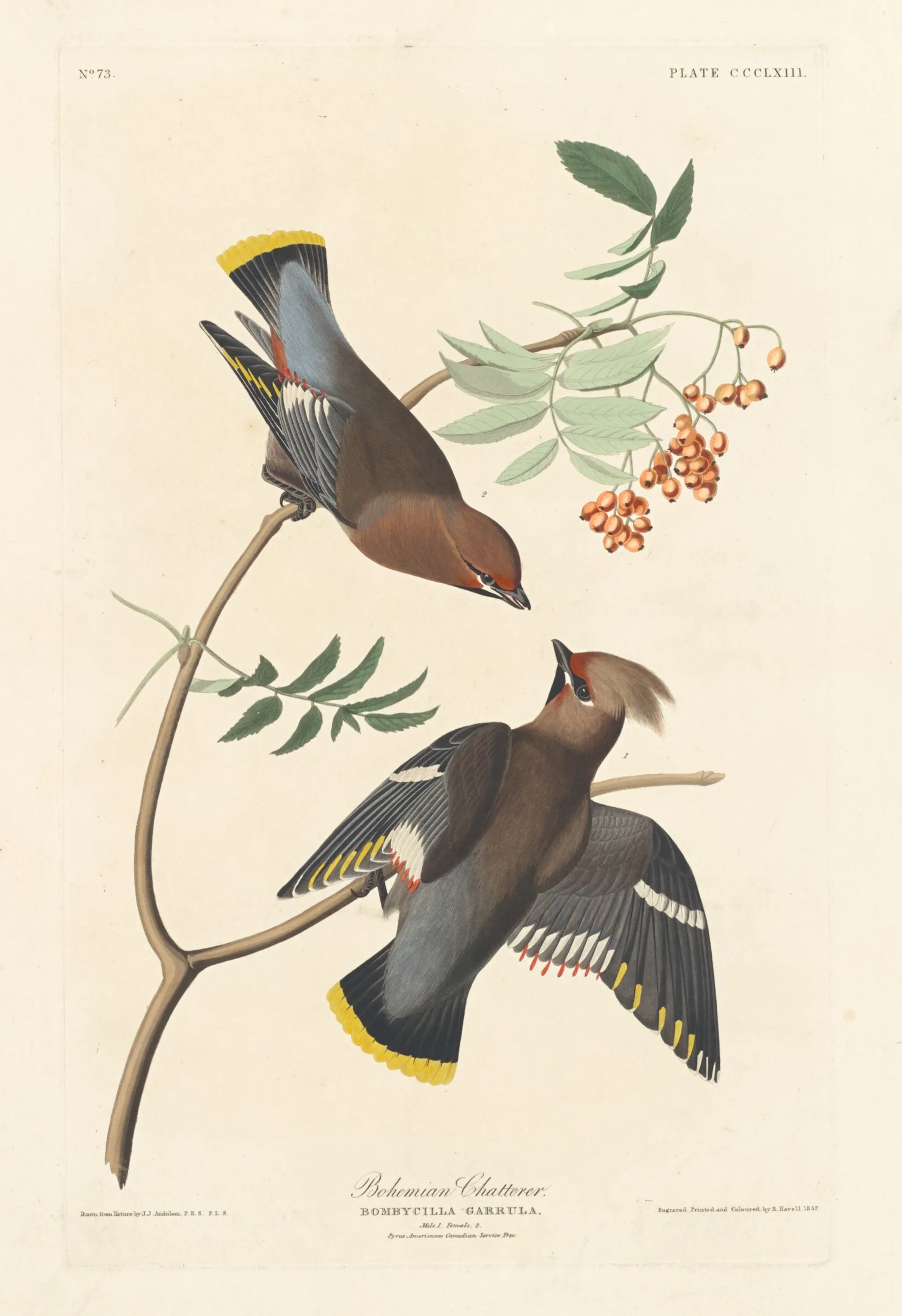
Audubon's “Bohemian Chatterer”, The Birds of America, plate CCCLXIII
Click or press Enter to enlarge
Open the full-resolution image (3032 px, National Gallery of Art)
| Plate | 363 (CCCLXIII) |
|---|---|
| Audubon's name | Bohemian Chatterer |
| Modern name | Bohemian Waxwing |
| Scientific name | Bombycilla garrulus |
| Status | Least Concern |
| Engraved by | Robert Havell, after Audubon's watercolor |
| Date | 1837 |
| Medium | Hand-colored engraving and aquatint on Whatman wove paper |
| Collections | Songbirds |
| This impression | National Gallery of Art, Washington, 1945.8.363; Gift of Mrs. Walter B. James |
About this plate
Plate 363 shows a male and a female Bohemian Waxwing. They are soft grey-brown birds with a swept-back crest, a black mask and throat, rusty undertail feathers, and yellow and white marks in the wing. The tips of the secondary feathers carry the small red waxy blobs that give waxwings their name.
Chatterer was an older English name for the waxwings, and Bohemian refers to the bird's wandering habits. Audubon used Vieillot's Bombycilla garrula. The modern name is Bombycilla garrulus. It is larger and greyer than the Cedar Waxwing, which Audubon had already figured.
Bohemian Waxwings breed in the boreal forests of northwestern North America and northern Eurasia. In winter they wander in large flocks in search of fruit and sometimes reach far south of their usual range. The species is listed as Least Concern.
Audubon drew the plate from specimens sent by his friend Thomas McCulloch of Pictou, Nova Scotia, who collected several in the winter of 1834, when many northern birds moved south. Audubon also noted records near Philadelphia and on Long Island in 1830 and 1832. His sons chased a pair near Boston for over an hour in 1832 without getting a shot.
In Audubon's words
It appears in flocks at Great Bear Lake about the 24th of May, when the spring thaw has exposed the berries of the alpine arbutus, marsh vaccinium, &c., that have been frozen and covered during winter. It stays only for a few days, and none of the Indians of that quarter with whom I conversed had seen its nests; but I have reason to believe, that it retires in the breeding season to the rugged and secluded mountain-limestone districts, in the sixty-seventh and sixty-eighth parallels, where it feeds on the fruit of the common juniper, which abounds in those places.
John James Audubon, Ornithological Biography, vol. 4 (1838), “Bohemian Chatterer”. Read the full chapter.



