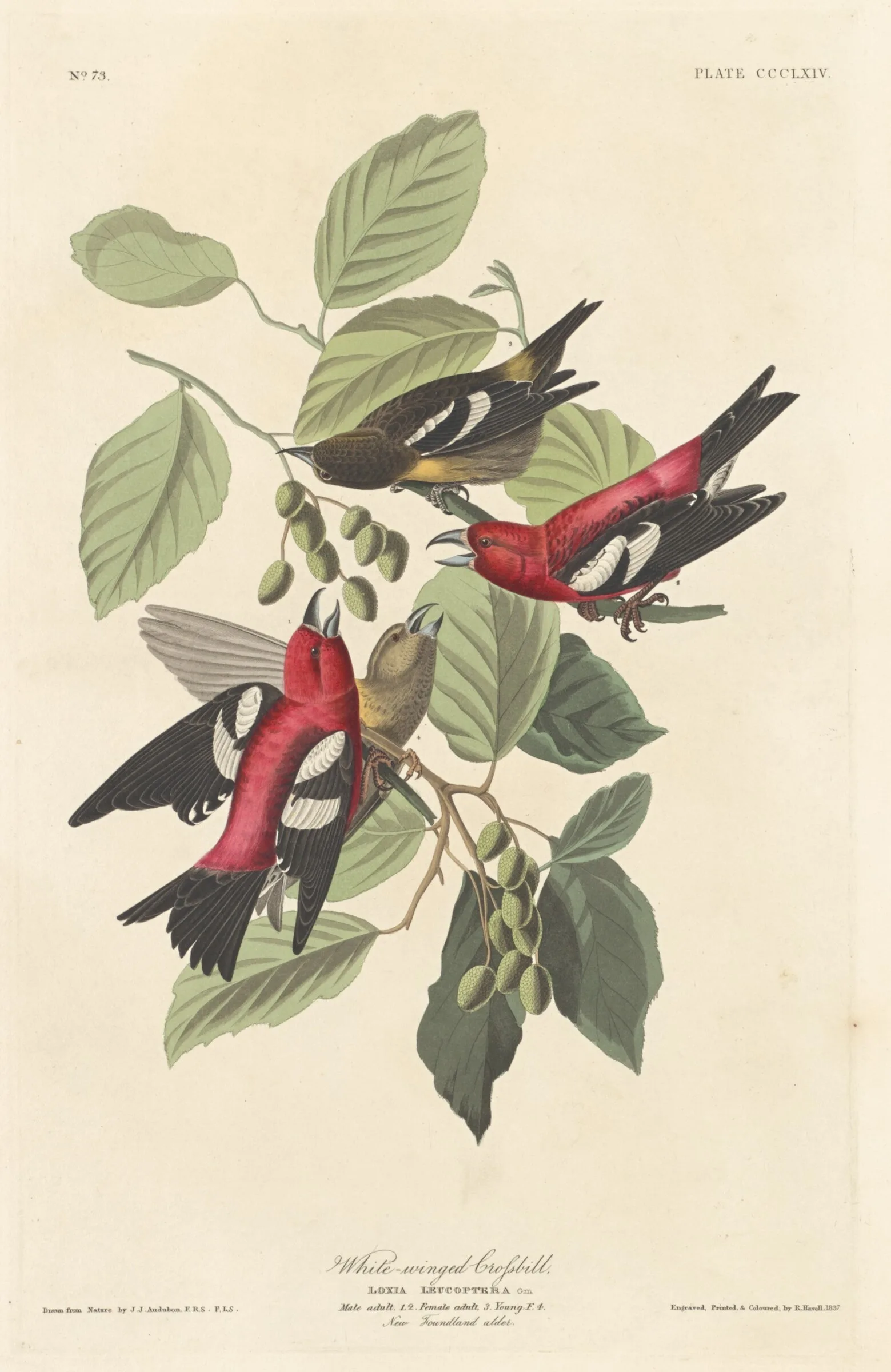
White-winged Crossbill (Plate 364)
Audubon's “White-winged Crossbill”, The Birds of America, plate CCCLXIV
Click or press Enter to enlarge
Open the full-resolution image (2831 px, National Gallery of Art)
| Plate | 364 (CCCLXIV) |
|---|---|
| Audubon's name | White-winged Crossbill |
| Modern name | White-winged Crossbill |
| Scientific name | Loxia leucoptera |
| Status | Least Concern |
| Engraved by | Robert Havell, after Audubon's watercolor |
| Date | 1837 |
| Medium | Hand-colored engraving and aquatint on Whatman wove paper |
| Collections | Songbirds |
| This impression | National Gallery of Art, Washington, 1945.8.364; Gift of Mrs. Walter B. James |
About this plate
Plate 364 shows a group of White-winged Crossbills: males, a female and young birds. The males are rosy pink with black wings crossed by two broad white bars. The females are olive-yellow and the young are streaked. All have the crossed bill tips used to pry seeds from conifer cones.
The scientific name, Loxia leucoptera, is the one Audubon used. In Europe and in the IOC world list the species is called the Two-barred Crossbill. North American birds are of the subspecies L. l. leucoptera.
White-winged Crossbills live in the spruce and larch forests of Canada, Alaska and northern Eurasia. They wander widely, following good cone crops, and can breed in almost any month when food is plentiful. In poor cone years they move south into the northern United States. The species is listed as Least Concern.
Audubon met the species on his 1833 Labrador voyage. In May he found it on islands at the mouth of the Bay of Fundy. About a dozen landed on the yards of his schooner, the Ripley, in the Gulf of St Lawrence. A male was shot in Labrador on 30 June and a female on the Murre Islands on 23 July by his young companion George Shattuck. He had also taken it in winter along the Schuylkill in Pennsylvania and in New Jersey.
In Audubon's words
On my passage across the Gulf of St Laurence to Labrador, in the same month, about a dozen White-winged Crossbills, and as many Mealy Redpolls, one day alighted on the top-yards of the Ripley; but before we could bring our guns from below, they all left us, and flew ahead of the vessel, as if intent on pointing out to us the place to which we were bound. On the 30th of June, a beautiful male was shot, on a bunch of grass growing out of the fissure of a rock, on a small island a few miles from the coast of Labrador; and on the 23d of July, my young friend Dr George Shattuck, procured a fine adult female on the Murre Islands, whilst she was feeding among the scanty herbage.
John James Audubon, Ornithological Biography, vol. 4 (1838), “White-winged Crossbill”. Read the full chapter.



