Gyrfalcon (Plate 366)
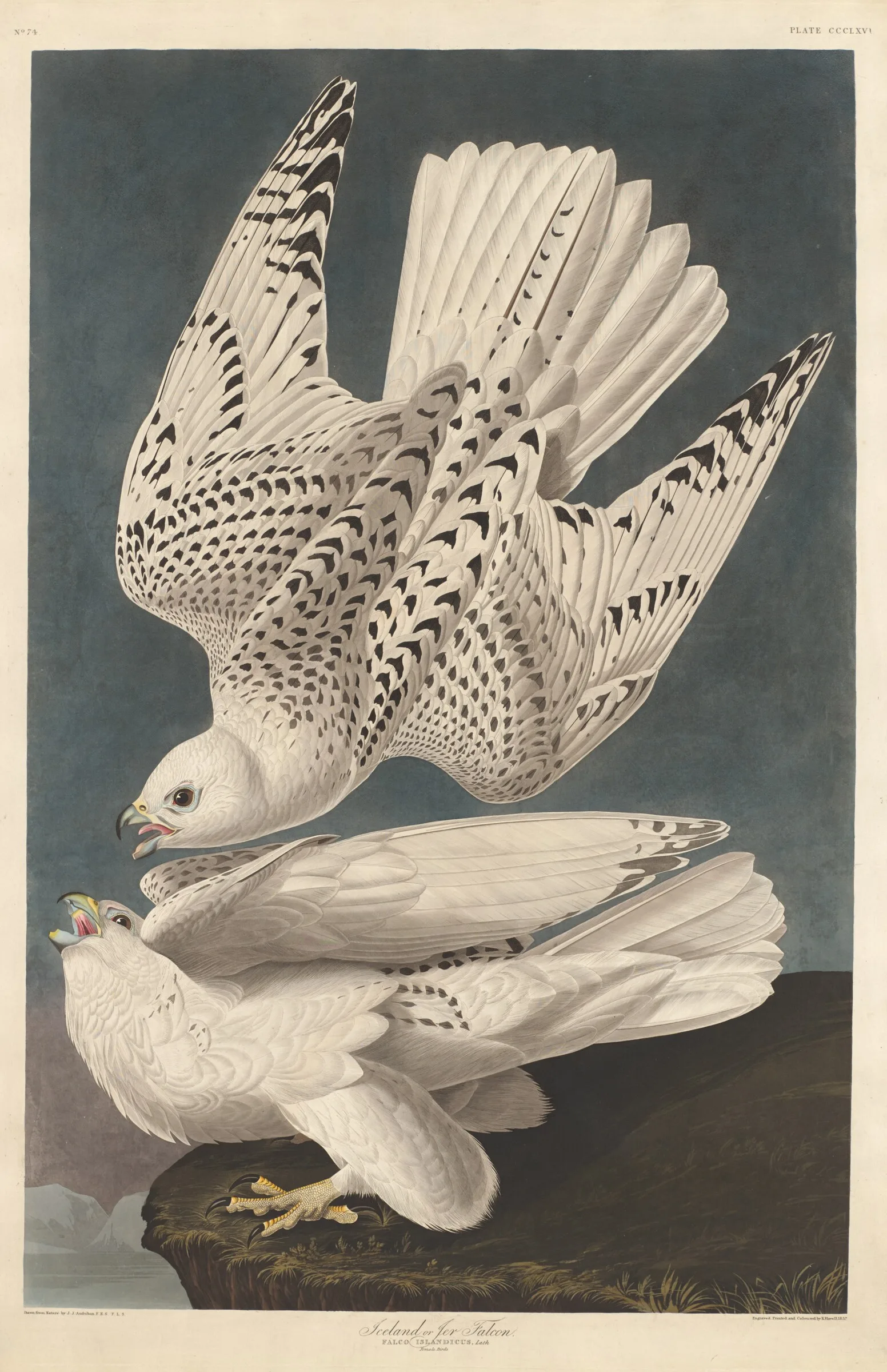
Audubon's “Iceland or Jer Falcon”, The Birds of America, plate CCCLXVI
Click or press Enter to enlarge
Open the full-resolution image (5494 px, National Gallery of Art)
| Plate | 366 (CCCLXVI) |
|---|---|
| Audubon's name | Iceland or Jer Falcon |
| Modern name | Gyrfalcon |
| Scientific name | Falco rusticolus |
| Status | Least Concern |
| Engraved by | Robert Havell, after Audubon's watercolor |
| Date | 1837 |
| Medium | Hand-colored engraving and aquatint on Whatman wove paper |
| Size | plate: 98.1 x 64.8 cm (38 5/8 x 25 1/2 in.) sheet: 100.7 x 67.3 cm (39 5/8 x 26 1/2 in.) |
| Collections | Hawks, Eagles and Falcons |
| This impression | National Gallery of Art, Washington, 1945.8.366; Gift of Mrs. Walter B. James |
About this plate
Plate 366 shows an adult female Gyrfalcon in two figures. It is pale grey-white, heavily marked with dark spots and bars, the plumage of the Iceland Falcon type. The Gyrfalcon is the largest falcon in the world.
Audubon called it Falco islandicus. He had already figured a darker pair from Labrador on plate 196 as the Labrador Falcon. He compared the two specimens and concluded that the differences in bill and claws came from wear and captivity, not from species differences. Modern ornithology agrees. All are Falco rusticolus, a species that varies from nearly white to almost black.
Gyrfalcons breed on Arctic cliffs and tundra around the pole and hunt ptarmigan, seabirds and hares. Some move south in winter. Falconers have prized them for centuries, and in medieval Europe they were reserved for kings. The species is listed as Least Concern.
The bird in the plate belonged to John Heppenstall of Sheffield, England, who kept it for over six years and had planned to send it to Audubon alive. It died of a throat ailment, and Heppenstall sent the body at once. Audubon drew it, took full measurements, and compared it with his Labrador specimen.
In Audubon's words
The figures of the adult female of this superb Falcon now before you were taken from the bird described by Mr John Heppenstall, at page 554 of the second volume of this work. It was kept by him upwards of six years; and it was his intention to have sent it to me alive from Sheffield; but it died of an affection of the oesophagus, which had for some days rendered it unable to swallow its food. My kind and most worthy friend, however, sent it to me immediately, so that after having received it in good condition, I was enabled not only to make it the subject of the present plate, and to take accurate measurements of all its parts, but also to institute a comparison between it and one of the specimens obtained in Labrador, which, with its consort, is represented in Plate CXCVI.
John James Audubon, Ornithological Biography, vol. 4 (1838), “Iceland or Jer Falcon”. Read the full chapter.