Rock Ptarmigan (Plate 368)
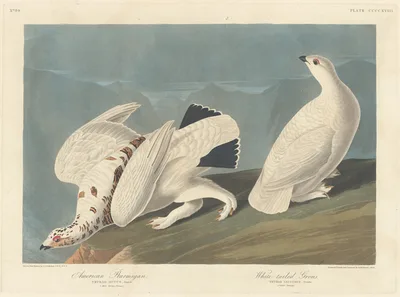
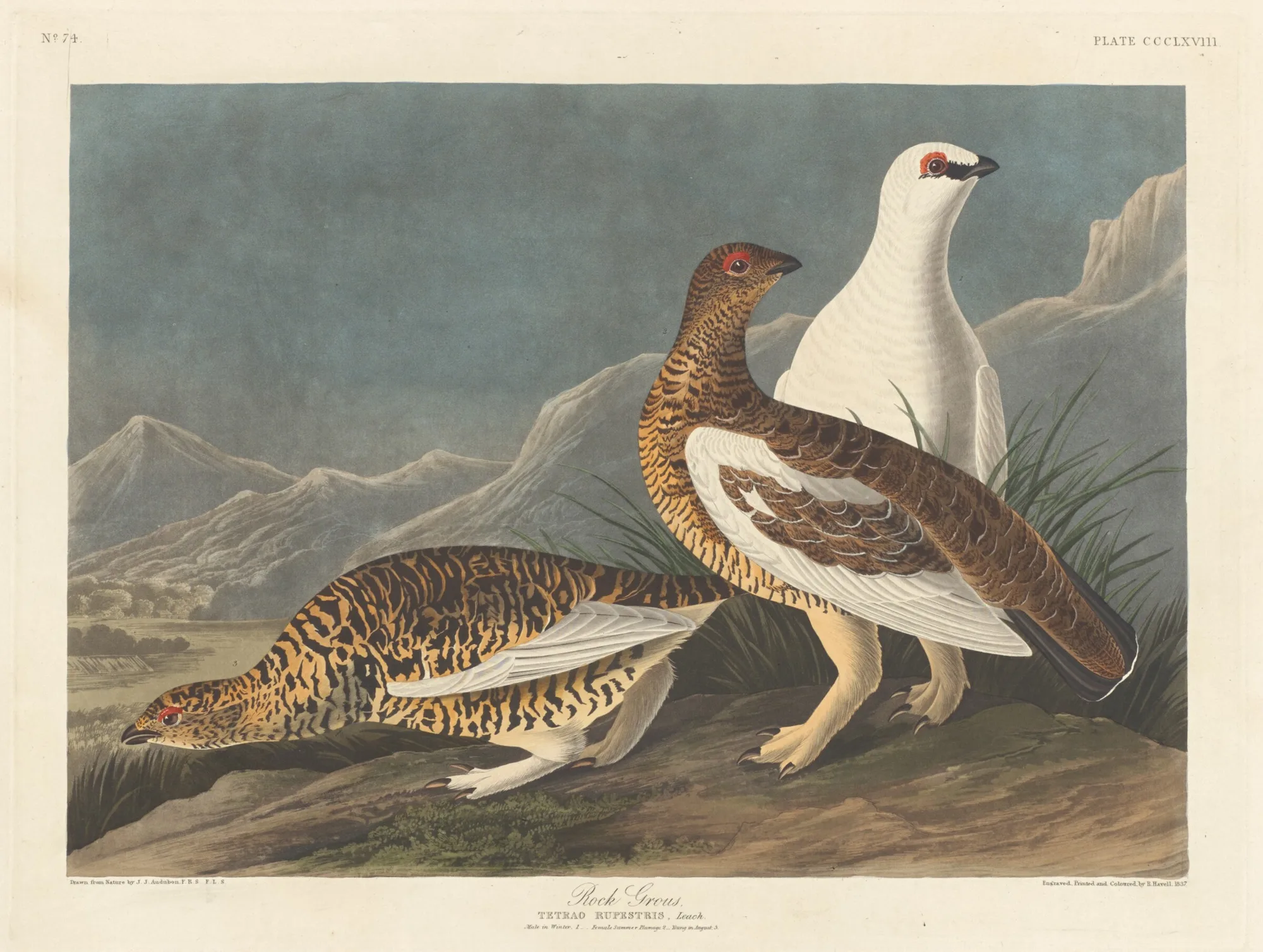
Audubon's “Rock Grous”, The Birds of America, plate CCCLXVIII
Click or press Enter to enlarge
Open the full-resolution image (3122 px, National Gallery of Art)
| Plate | 368 (CCCLXVIII) |
|---|---|
| Audubon's name | Rock Grous |
| Modern name | Rock Ptarmigan |
| Scientific name | Lagopus muta |
| Status | Least Concern |
| Engraved by | Robert Havell, after Audubon's watercolor |
| Date | 1837 |
| Medium | Hand-colored engraving and aquatint on Whatman wove paper |
| Size | plate: 41.6 x 54.8 cm (16 3/8 x 21 9/16 in.) sheet: 67.6 x 100.7 cm (26 5/8 x 39 5/8 in.) |
| Collections | Turkeys, Grouse and Game Birds |
| This impression | National Gallery of Art, Washington, 1945.8.368; Gift of Mrs. Walter B. James |
About this plate
Plate 368 shows a male and a female Rock Ptarmigan. Ptarmigan change plumage with the seasons, from white in winter to mottled brown and grey in summer. Their feathered feet act as snowshoes.
Audubon called it Tetrao rupestris. It is now Lagopus muta, the Rock Ptarmigan, the same species found in the Alps, Scotland and Scandinavia. It is smaller than the Willow Ptarmigan, which Audubon called the Willow Grous. Winter males have a black stripe from bill to eye, which the Willow Ptarmigan lacks.
Rock Ptarmigan live on Arctic tundra and on high, barren mountains in North America, Greenland, Europe and Asia. They prefer drier, rockier ground than the Willow Ptarmigan. They feed on buds, catkins and leaves of dwarf willow and birch. In winter they gather in flocks. The species is listed as Least Concern, though some southern mountain populations are vulnerable to climate warming.
Audubon never saw the species alive. He drew the plate from specimens given to him by the Arctic explorer Captain James Ross of the Royal Navy. In Labrador in 1833 a settler named Jones told him that a smaller ptarmigan wintered on the hills around Bras d'Or. Jones and his son killed and salted large numbers of them.
In Audubon's words
Whilst at Labrador, I was informed by Mr Jones, of whom I have made mention on several occasions, that a smaller species of Ptarmigan than that called the Willow Grous, Tetrao Saliceti, was abundant on all the hills around Bras d’Or, during the winter, when he and his son usually killed a great number, which they salted and otherwise preserved; and that in the beginning of summer they removed from the coast into the interior of the country, where they bred in open grounds, never, like the Willow Grous, retreating to the wooded parts. They seldom appear at Bras d’Or until the last of the Wild Geese have passed over, or before the cold has become intense, and the plains deeply covered with snow.
John James Audubon, Ornithological Biography, vol. 4 (1838), “Rock Grous”. Read the full chapter.