Sage Thrasher and Varied Thrush (Plate 369)
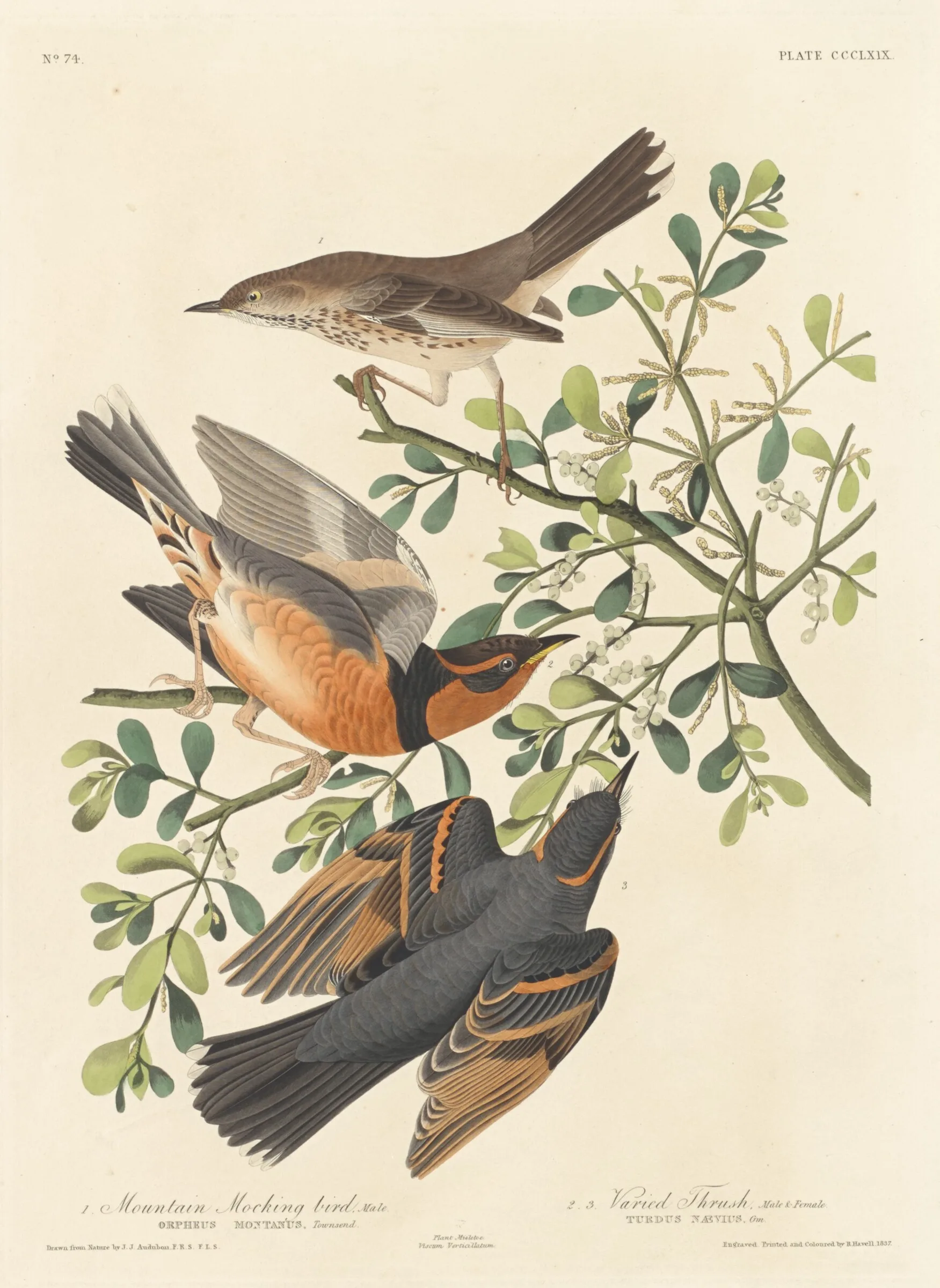
Audubon's “Mountain Mocking-bird and Varied Thrush”, The Birds of America, plate CCCLXIX
Click or press Enter to enlarge
Open the full-resolution image (2864 px, National Gallery of Art)
| Plate | 369 (CCCLXIX) |
|---|---|
| Audubon's name | Mountain Mocking-bird and Varied Thrush |
| Modern names | Sage Thrasher, Varied Thrush |
| Scientific names | Oreoscoptes montanus, Ixoreus naevius |
| Status | Least Concern |
| Engraved by | Robert Havell, after Audubon's watercolor |
| Date | 1837 |
| Medium | Hand-colored engraving and aquatint on Whatman wove paper |
| Collections | Songbirds |
| This impression | National Gallery of Art, Washington, 1945.8.369; Gift of Mrs. Walter B. James |
About this plate
Plate 369 shows two western birds. The Mountain Mocking Bird is a Sage Thrasher, a small grey-brown thrasher with a streaked breast and yellow eyes. The Varied Thrush is a robin-sized bird with a slate-blue back, an orange throat and eyebrow, orange wing bars and a black band across the breast.
Townsend described the Sage Thrasher as Orpheus montanus. It is now Oreoscoptes montanus, the only member of its genus. Audubon drew it in Philadelphia from the single specimen Townsend had sent from the Rocky Mountains. The Varied Thrush was found at Nootka Sound on Captain Cook's third voyage. Audubon's figure is an adult male with a complete black breast band, which he noted was missing from Swainson's earlier figure. It is now Ixoreus naevius.
Sage Thrashers breed in sagebrush across the Great Basin and interior West and winter in the deserts of the Southwest and Mexico. Varied Thrushes breed in wet conifer forests from Alaska to northern California. Both are listed as Least Concern.
For habits Audubon printed Nuttall's notes. Nuttall heard the Sage Thrasher singing for an hour at a time across the arid plains. Near Sandy Creek of the Colorado he found a nest of four green eggs in a wormwood bush, lined with bark and bison wool.
Birds on this plate
- Sage Thrasher Oreoscoptes montanus: Audubon's Mountain Mocking Bird (male). Least Concern
- Varied Thrush Ixoreus naevius (adult male). Least Concern
In Audubon's words
We met with it in the plains exclusively, till our arrival at Wallah Wallah, but we are not certain of having seen it in any part of California, it being apparently entirely confined to the cooler and open regions of the Rocky Mountains. Just before arriving at Sandy Creek of the Colorado, while resting for refreshment at noon, I had the good fortune to find the nest in a wormwood bush, on the margin of a ravine, from whence the male was singing with its usual energy. It contained four almost emerald green eggs, spotted with dark olive of two shades, more numerous towards the greater end, the spots large and roundish. The nest itself was made of small twigs and rough stalks, lined with stripes of bark and bison wool. The female flew off to a little distance, and looked on her unwelcome and unexpected visitor, without uttering either call or complaint.
John James Audubon, Ornithological Biography, vol. 4 (1838), “Mountain Mocking Bird”. Read the full chapter.



