Northern Flicker (Plate 37)
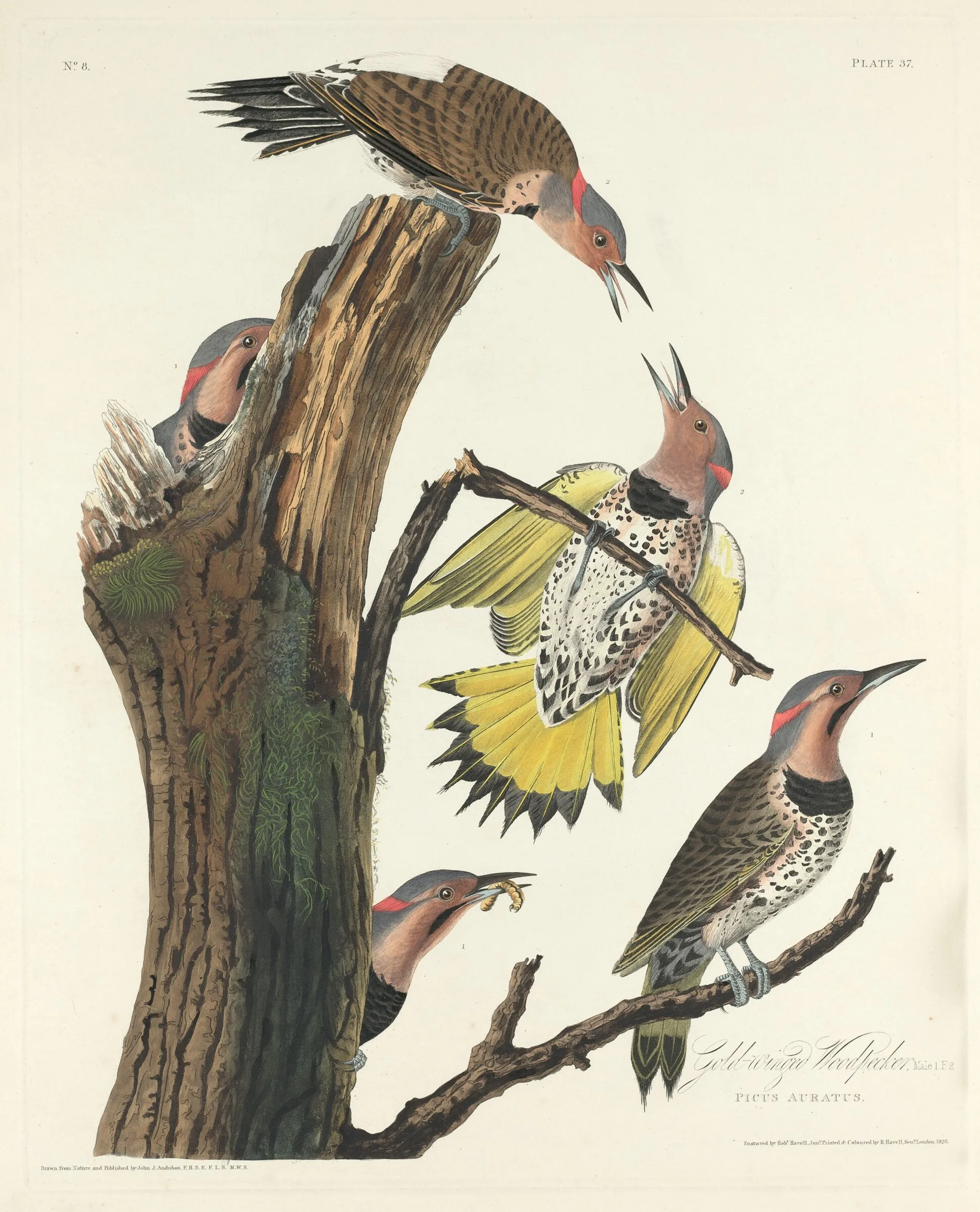
Audubon's “Gold-winged Woodpecker”, The Birds of America, plate XXXVII
Click or press Enter to enlarge
Open the full-resolution image (3342 px, National Gallery of Art)
| Plate | 37 (XXXVII) |
|---|---|
| Audubon's name | Gold-winged Woodpecker |
| Modern name | Northern Flicker (Yellow-shafted) |
| Scientific name | Colaptes auratus |
| Status | Least Concern |
| Engraved by | Robert Havell, after Audubon's watercolor |
| Date | 1828 |
| Medium | Hand-colored engraving and aquatint on Whatman wove paper |
| Collections | Woodpeckers |
| This impression | National Gallery of Art, Washington, 1945.8.37; Gift of Mrs. Walter B. James |
About this plate
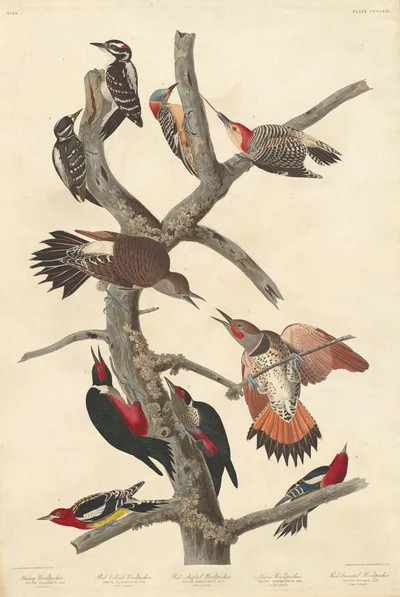
Plate 37 shows several Northern Flickers around a tree trunk, some climbing and some with wings spread to show the golden-yellow undersides of the flight feathers. Adults have a brown back barred with black, a black breast crescent and a red crescent on the nape. Males have a black moustache stripe. The plate was engraved by Robert Havell in 1828.
Audubon used this chapter to argue that American woodpeckers were not the gloomy, stupid birds earlier writers had described. He wrote of males chasing each other in spring with a call like a long, jolly laugh. He said a captive bird destroyed as much furniture in a day as a workman could mend in two. He recorded folk names: Pique-bois jaune among the French of Louisiana, and High-holder, Yucker and Flicker elsewhere.
The modern name is Northern Flicker, Colaptes auratus. The eastern form in this plate, with yellow wing shafts, was once a separate species called the Yellow-shafted Flicker. In 1983 it was merged with the western Red-shafted Flicker, with which it hybridizes widely across the Great Plains. Yellowhammer is still a common name in the South, and it is the state bird of Alabama.
Flickers feed largely on the ground, especially on ants. They breed across almost all of North America. The species has declined over recent decades but is listed as Least Concern.
In Audubon's words
Even in confinement, the Golden-winged Woodpecker never suffers its naturally lively spirit to droop. It feeds well, and by way of amusement, will continue to destroy as much furniture in a day as can well be mended by a different kind of workman in two. Therefore, kind reader, do not any longer believe that Woodpeckers, I mean those of America, are such stupid, forlorn, dejected and unprovided for beings, as they have hitherto been represented. In fact, I know not one of the seventeen species found in our extensive woods, that does not exhibit quite as much mirth and gaiety as the present bird. They are serviceable birds in many points of view, and therefore are seldom shot at, unless by idlers, their flesh, moreover, not being very savoury.
John James Audubon, Ornithological Biography, vol. 1 (1831), “The Golden-winged Woodpecker”. Read the full chapter.