Kentucky Warbler (Plate 38)
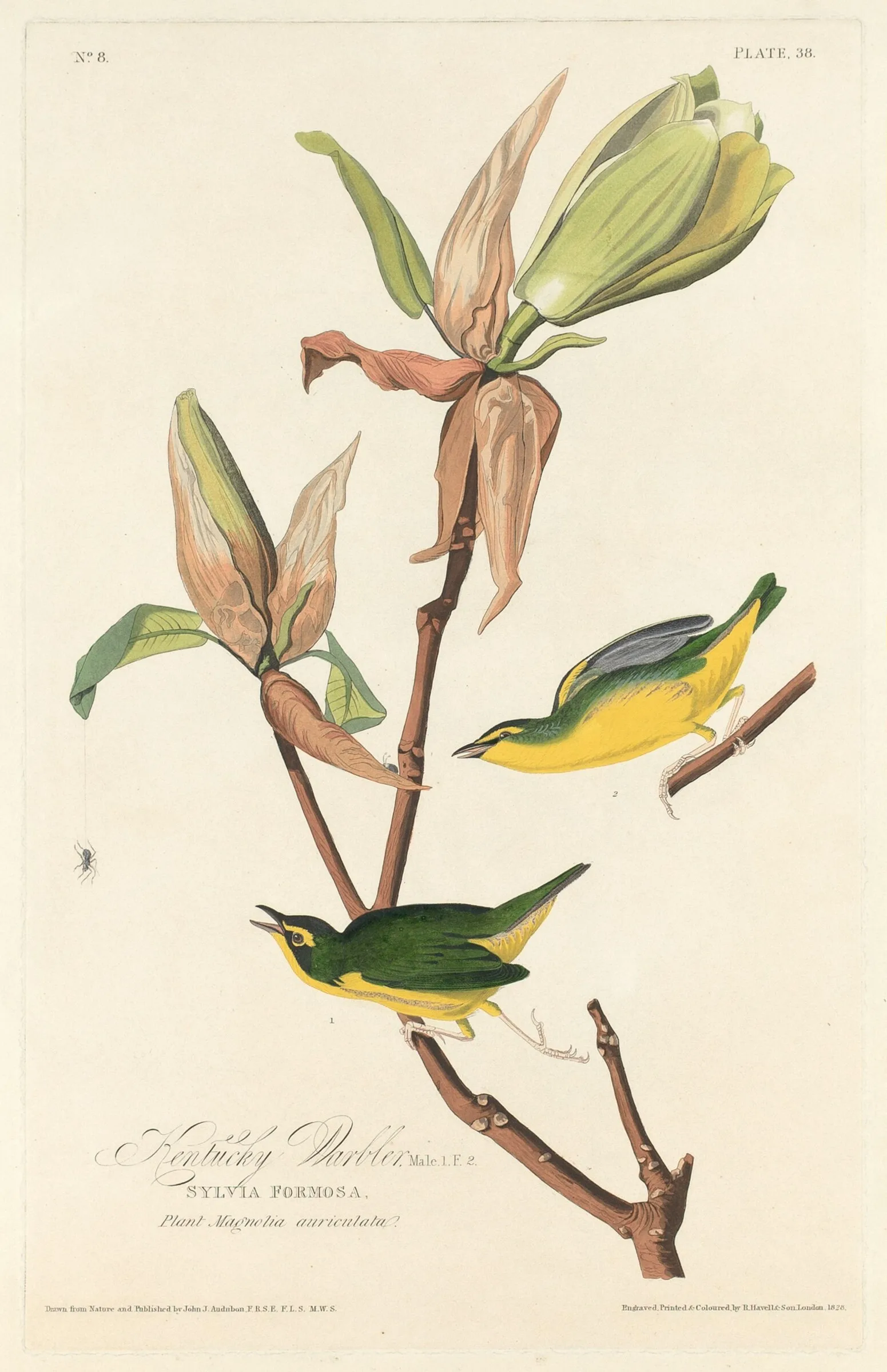
Audubon's “Kentucky Warbler”, The Birds of America, plate XXXVIII
Click or press Enter to enlarge
Open the full-resolution image (2506 px, National Gallery of Art)
| Plate | 38 (XXXVIII) |
|---|---|
| Audubon's name | Kentucky Warbler |
| Modern name | Kentucky Warbler |
| Scientific name | Geothlypis formosa |
| Status | Least Concern |
| Engraved by | Robert Havell, after Audubon's watercolor |
| Date | 1828 |
| Medium | Hand-colored engraving and aquatint on Whatman wove paper |
| Plants and setting | White Cucumber, a magnolia, in flower |
| Collections | Songbirds |
| This impression | National Gallery of Art, Washington, 1945.8.38; Gift of Mrs. Walter B. James |
About this plate
Plate 38 shows a male and female Kentucky Warbler, olive above and bright yellow below, with yellow spectacles and black sideburns. They are on a flowering branch of the tree Audubon called the White Cucumber, a species of magnolia. He wrote that it flowered as early as the dogwood, before the leaves opened, with a lemon scent that turned unpleasant as the blossoms faded. He had seen it only in Mississippi and Louisiana. The plate was engraved by Robert Havell in 1828.
Audubon wrote that the bird was most common in Louisiana and along the Mississippi, less so in Kentucky and scarcer still in Ohio. He described it hopping among tall weeds and low bushes in damp bottomland, peering out from the edge of the thicket before slipping back in. He wrote its song as tweedle, tweedle, tweedle. He never saw it farther east than North Carolina.
The modern name is Kentucky Warbler, Geothlypis formosa. Alexander Wilson named it from birds he found in Kentucky. It was long placed in Oporornis and was moved to Geothlypis, with the Common Yellowthroat, in 2010.
The species breeds in moist deciduous forest with a dense understory across the southeastern and central United States and nests on or near the ground. It winters from southern Mexico to northern South America. It has declined with the loss and fragmentation of forest but is listed as Least Concern.
In Audubon's words
This beautiful species is the most common and abundant that visits the State of Louisiana and those situated on the borders of the Mississippi. In Kentucky it is much less common, and in the State of Ohio scarcer still. It is an extremely active and lively bird. It is found in all the low grounds and damp places near water-courses, and generally among the tall rank weeds and low bushes growing in rich alluvial soil. Continually in motion, it is seen hopping in every direction from stalk to stalk, or from one twig to another, preying upon insects and larvæ, or picking small berries, seldom, however, pursuing insects on wing. During spring, its agreeable notes are heard in every quarter. They are emphatic, and resemble the words tweedle, tweedle, tweedle, distinctly repeated. This little bird is seen at intervals of a few minutes on the skirts of the tall plants, peeping cunningly to discover whether any intruders may be near; after which it immediately re-enters the thicket, and repeats its little ditty.
John James Audubon, Ornithological Biography, vol. 1 (1831), “The Kentucky Warbler”. Read the full chapter.



