Greater Sage-Grouse (Plate 371)
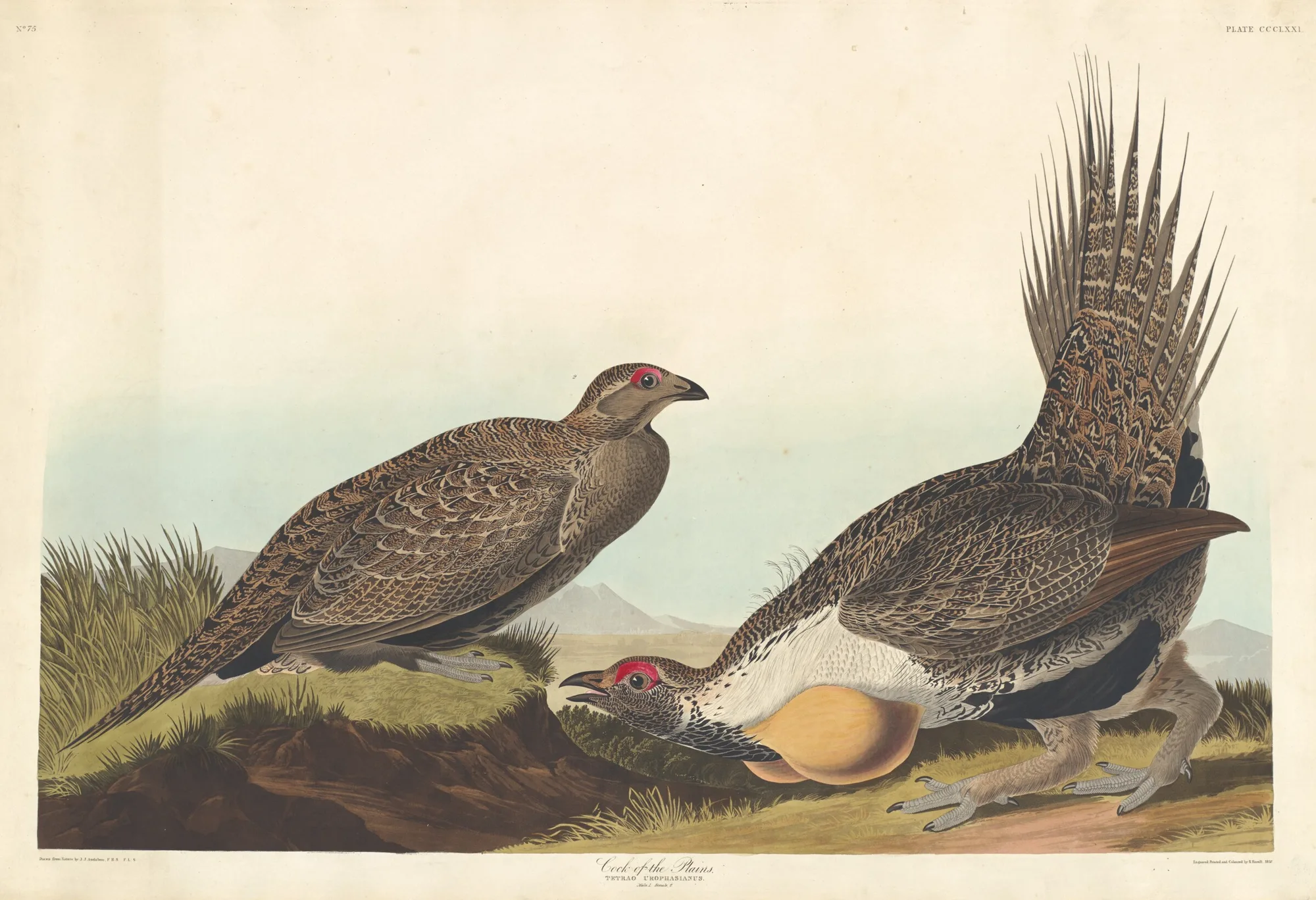
Audubon's “Cock of the Plains”, The Birds of America, plate CCCLXXI
Click or press Enter to enlarge
Open the full-resolution image (5365 px, National Gallery of Art)
| Plate | 371 (CCCLXXI) |
|---|---|
| Audubon's name | Cock of the Plains |
| Modern name | Greater Sage-Grouse |
| Scientific name | Centrocercus urophasianus |
| Status | Near Threatened |
| Engraved by | Robert Havell, after Audubon's watercolor |
| Date | 1837 |
| Medium | Hand-colored engraving and aquatint on Whatman wove paper |
| Collections | Turkeys, Grouse and Game Birds |
| This impression | National Gallery of Art, Washington, 1945.8.371; Gift of Mrs. Walter B. James |
About this plate
Plate 371 shows a male and a female Greater Sage-Grouse. The male is a large grey-brown grouse with a black belly, a white ruff on the breast and long, spiky tail feathers. The female is smaller and mottled brown.
Bonaparte described it as Tetrao urophasianus, the pheasant-tailed grouse, and Audubon kept that name. It is now Centrocercus urophasianus. A second, smaller species, the Gunnison Sage-Grouse of Colorado and Utah, was recognised in 2000.
Sage-grouse depend entirely on sagebrush, which they eat through the winter. Townsend noted that this diet made the flesh bitter. In spring the males gather at leks and display by inflating two yellow air sacs on the chest with a popping sound. Loss and fragmentation of sagebrush, fire and energy development have caused long declines. IUCN lists the species as Near Threatened.
Audubon never saw the bird alive. He built his chapter from notes by Townsend and Nuttall, who met it west of the Black Hills on the way to the Columbia, and from the botanist David Douglas. Townsend recorded its names among the Walla Walla and Nez Perce. He described a tame bird that clucked like a hen and ran under travellers' horses.
In Audubon's words
This bird is only found on the plains which produce the worm-wood (Artemisia), on which plant it feeds, in consequence of which the flesh is so bitter that it is rejected as food. It is very unsuspicious, and easily approached, rarely flies unless hard pressed, runs before you at the distance of a few feet, clucking like the common Hen, often runs under the horses of travellers when disturbed, rises very clumsily, but when once started flies with rapidity to a great distance, and has the sailing motion of the Pinnated Grous.
John James Audubon, Ornithological Biography, vol. 4 (1838), “Cock of the Plains”. Read the full chapter.